


MUMBAI: Salary taxpayers claiming House Rent Allowance (HRA) under the Income Tax (IT) Act, face stricter disclosure norms from April 1, 2026, with the introduction of a new declaration format: Form 124 which replaces the earlier Form 12BB and requires additional details to curb misuse.Employees are required to submit this form to their employers for the purpose of tax deduction at source (TDS). If they claim an HRA, they will now have to declare their relationship with the landlord.The main change is improved additional disclosures. Besides details of rent paid and landlord information – which continues to include the landlord’s PAN number if the rent paid exceeds Rs 1 lakh per annum – employees will now be asked to specify whether the landlord is a relative and the nature of the relationship such as parent, spouse or siblings.
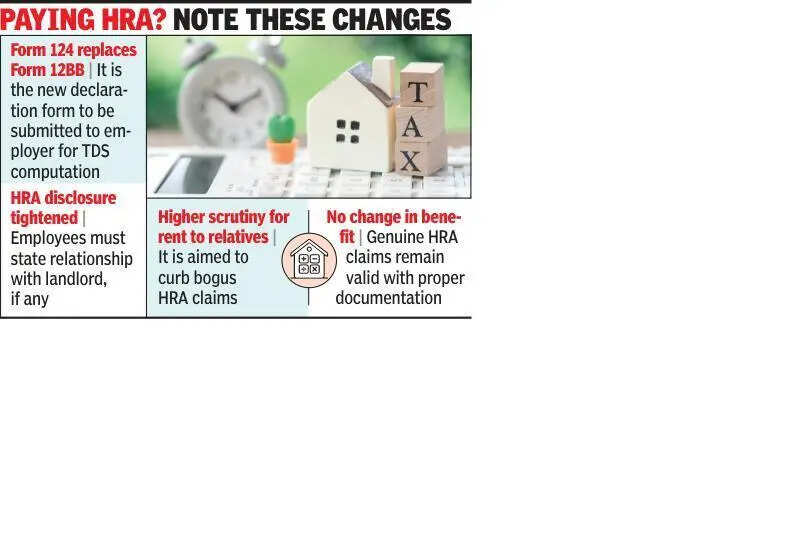
The new HRA unveiling begins
Government officials told TOI that the move is aimed at addressing long-standing concerns over bogus HRA claims within families, where there is no real rental transaction. By requiring employees to explicitly disclose the nature of their relationship with the landlord, IT will be in a better position to verify rental income returns and identify mismatches.During the assessment process tax authorities have historically examined HRA claims involving payments to family members, particularly spouses or parents.
Tax courts, based on the patterns of facts in each case, have upheld or rejected HRA claims.Government officials noted that this was not a “hardship” because the real arrangements remained in place. For example, paying rent to a relative will still be eligible for HRA relief, provided there is actual payment of rent via banking channels, supported by documentation such as the tenancy agreement and rent receipts, and the landlord declares the rental income in their IT return.One tax expert stated that even if an owner who is a parent has income below the minimum, it is recommended that a “zero” return be filed by the receiving parent. This will provide a chain of evidence and will strengthen the credibility of HRA’s claim.It should be noted that HRA tax procedures are only available if the taxpayer opts for the old tax regime.In Mumbai, which is classified as a metro city, the tax benefits of HRA are comparatively higher than in non-metro cities. The exempt portion of the HRA is calculated as the lower of three amounts: the actual HRA received from the employer, 50% of salary (basic plus dearness allowance), or rent paid minus 10% of salary.