

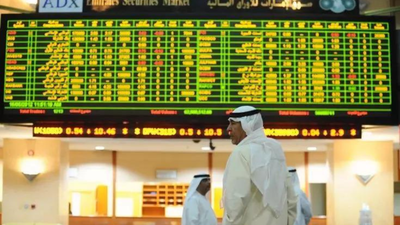
Stocks in the United Arab Emirates fell sharply on Wednesday as markets reopened after a rare two-day trading halt due to Iranian missile and drone attacks on the Gulf state over the weekend, prompting investors to reassess geopolitical risks, Reuters reported.The Dubai and Abu Dhabi stock exchanges suspended trading on March 2 and 3, in an unusual step outside of routine closure or mourning periods, as the authorities assessed the damage resulting from the strikes that targeted airports, ports, and residential areas across the Emirates.When trading resumed, Dubai’s benchmark index fell 4.7 per cent, its biggest intraday drop since May 2022. The declines were broad-based, led by major real estate developer Emaar Properties, which fell 4.9 per cent, while low-cost Air Arabia fell 5 per cent.
Airlines and tourism companies have come under pressure after more than 20,000 flights were canceled across the region, while governments rushed to bring back travelers stranded in the Middle East.Among financial stocks, Emirates NBD Bank, the largest bank in the Emirates, fell 5 percent.In Abu Dhabi, the main index fell 3.3 percent, which is also the largest decline since May 2022. The shares of First Abu Dhabi Bank, the largest bank in the Emirates, fell 5 percent, while the shares of the energy companies Dana Gas and Taqa lost 5 percent each.
Aldar Properties shares fell five percent. Energy companies linked to ADNOC across fuel distribution, drilling, logistics and the gas chain have also come under pressure with the sale of the wider energy complex.The combined market capitalization of companies listed on the Abu Dhabi Securities Exchange (ADX) and Dubai Financial Market (DFM) is approximately US$1.1 trillion.To contain the volatility, both exchanges have temporarily fixed the minimum price of securities at 5 per cent.
The Abu Dhabi Securities Exchange also requested listed companies to conduct an immediate assessment of financial and operational exposure and disclose any material information that could affect investors’ decisions.Abu Dhabi Commercial Bank shares fell 4.9 percent after the bank said it had restored its mobile banking application after a disruption that also affected its call center, although some services are still being restored.“The shutdown sent investors a message that regulators are prioritizing regulated price discovery at the expense of volatile volatility,” said Ahmed Asiri, research strategist at Pepperstone, quoted by Reuters.Traders should expect a volatile phase as markets reprice two days of global and regional developments, he said, adding that trading volumes may pick up as pent-up orders hit the market.“As the Saudi market has already absorbed the initial shock, and recovered from a 5% decline on Sunday to record gains by Tuesday, the UAE’s reopening is expected to follow this recovery model to some extent,” Al-Asiri said.Elsewhere in the Gulf, the main index of the Saudi market rose 1 percent, continuing the gains it achieved in the previous session. Al Rajhi Bank shares gained 0.9 percent, while the shares of the giant petrochemical company Saudi Basic Industries Corporation (SABIC) rose 1.2 percent despite recording a large net loss in 2025 due to the decline in the value of assets and the liquidation of investments in Europe and the Americas.Shares of Jabal Omar Development, which operates a hotel and real estate complex near the Grand Mosque in Mecca, jumped about five percent after it announced a sharp rise in its annual profits.
Low-cost airline Flynas gained 2.1 percent, despite the major oil company Saudi Aramco’s decline 0.7 percent.Oil prices rose about three percent as the US-Israel war on Iran disrupted Middle East supplies, although gains slowed after US President Donald Trump suggested the US Navy could escort ships through the Strait of Hormuz.In Qatar, the main index rose 0.6 percent, with Qatar Islamic Bank shares advancing 1.1 percent. But Industries Qatar shares fell 1.3 percent after announcing plans to suspend and reduce some products.The Muscat index in Oman fell 0.7 percent, the Bahrain index fell 0.8 percent, and the Kuwaiti market index fell 0.2 percent. Outside the Gulf region, the main index of the Egyptian Stock Exchange fell 1.6 percent.