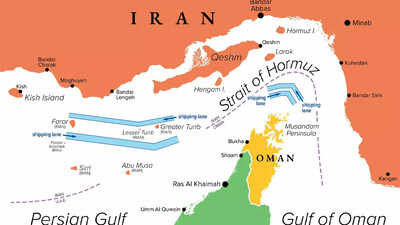
Any interruption to navigation in the Strait of Hormuz poses a serious threat to international oil trade flows.
The closure of the Strait of Hormuz sent shockwaves through global markets, and with no signs of de-escalation in the war between the US, Israel and Iran, oil prices rose. The expanding conflict in Iran has halted tanker traffic through the Strait of Hormuz, sending oil prices sharply higher and underscoring the strategic importance of the sea lane vital to global energy markets.The Strait of Hormuz forms the narrow entrance to the Arabian Gulf and through it passes approximately 20% of global oil shipments. Ships passing through the canal, along whose northern edge Iran is located, transport crude oil and gas from Saudi Arabia, Kuwait, Iraq, Qatar, Bahrain, the United Arab Emirates and Iran. A large share of these exports are destined for Asian economies, and India is seen as particularly vulnerable. Therefore, any interruption to navigation in the Strait of Hormuz poses a serious threat to international oil trade flows.
Confirmed: Iranian missiles destroy and destroy American radars and satellites worth millions of dollars | He watches
The importance of the Strait of Hormuz to global shipping
The Strait of Hormuz is a curved channel that narrows to about 33 kilometers, or 21 miles, at its narrowest stretch. It serves as a link between the Persian Gulf and the Gulf of Oman, providing ships with access to global sea routes.Read also | India’s Energy Security Exposure in the Middle East: What Oil, LPG and LNG Reserves Do We Have? Although parts of the strait lie within the territorial waters of Iran and Oman, it is considered an international passageway open to ships from all countries. The United Arab Emirates, which includes the city of Dubai that dominates the skyline, is located close to this strategic corridor.
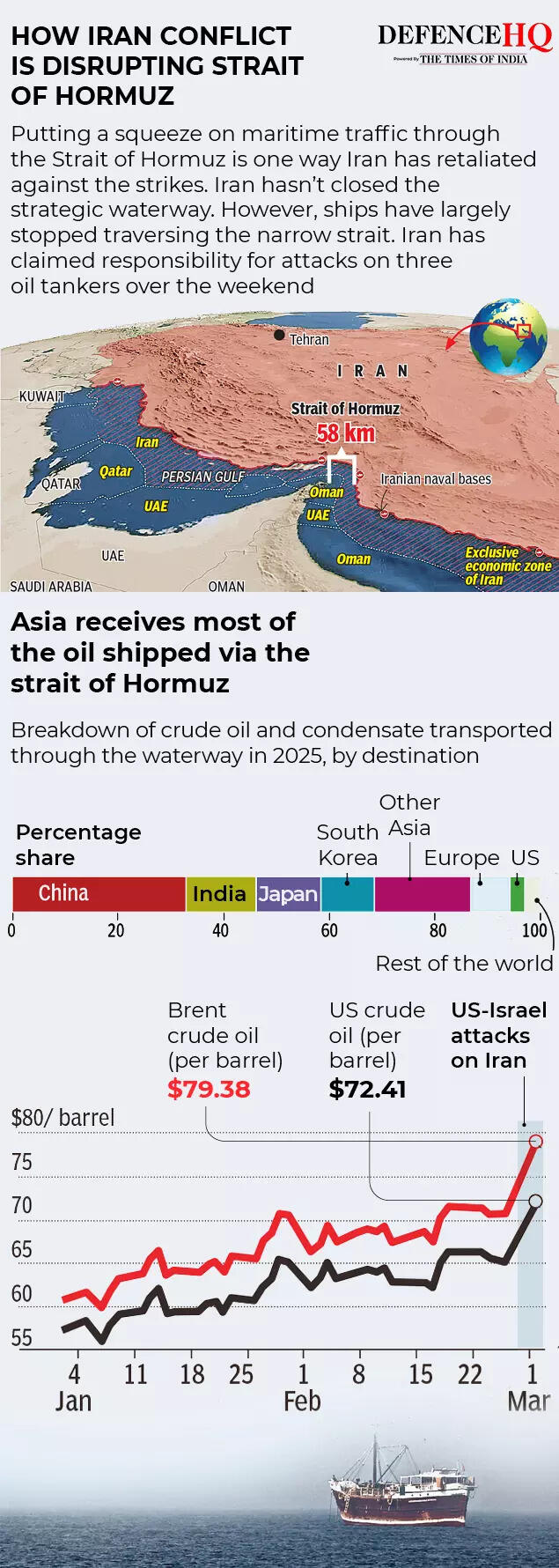
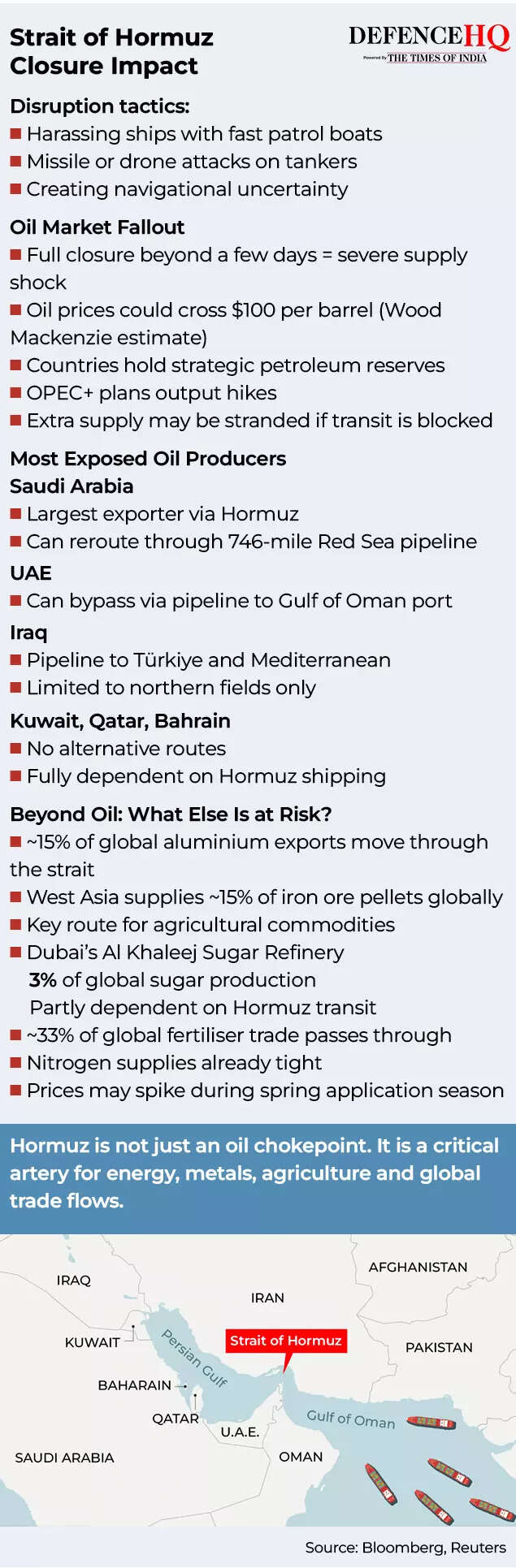
For centuries, the Strait of Hormuz has played a central role in trade, with goods such as ceramics, ivory, silk and textiles from China moving through the region. In contemporary times, it serves as a major transit point for huge tankers transporting oil and gas from Saudi Arabia, Kuwait, Iraq, Qatar, Bahrain, the United Arab Emirates and Iran. Most of these energy supplies are shipped to Asian destinations, including China, which remains the only significant buyer of Iranian oil.“The scale of what is at stake cannot be overstated,” Hakan Kaya, senior portfolio manager at investment management firm Neuberger Berman, told the AP. He noted that it is likely that energy companies will be able to manage a limited outage lasting a week or two. However, a full or near-total shutdown lasting a month or more would push crude oil prices “into the triple digits” and push European natural gas prices “towards or above the crisis levels seen in 2022.”Although Saudi Arabia and the United Arab Emirates operate pipelines that can bypass the strait, the US Energy Information Administration notes that “most of the volumes that cross the strait have no alternative means of exiting the area.”Read also | 70’s style oil shock load? Crude Oil Could Hit $100 If Strait of Hormuz Closes Amid Middle East Tensions – What Does It MeanIran has already targeted several ships in the Strait of Hormuz and warned ships not to attempt to cross, effectively halting traffic through the waterway.The Iranian brigadier general announced that “the Strait of Hormuz is closed.” Gen.
Ibrahim Jabbari, an advisor to the paramilitary Revolutionary Guards, warned that any ship trying to cross the passage would be burned.
Major global shipping lines have issued warnings confirming the suspension of operations in the region. Danish shipping giant Maersk, the world’s largest container carrier, announced on Sunday that it would halt all ship transits through the Strait of Hormuz until further notice.
Other major operators, including Hapag-Lloyd, CMA-CGM and MSC, issued similar statements.Data from Clarksons Research, a company that monitors global shipping activity, indicates that approximately 3,200 ships, about 4% of global shipping tonnage, are currently idle in the Persian Gulf.
Trump and insurance reaction
US President Donald Trump said Tuesday on social media that he had directed the US Development Finance Agency to offer political risk insurance for ships transporting oil and other goods through the Persian Gulf, describing the coverage as available at a “very reasonable price.”Political risk insurance is designed to protect companies from financial setbacks caused by political instability, government interventions, or acts of violence.Read also | US-Israel-Iran war hits oil supplies: How India prepares for economic falloutHe added that the US Navy would provide escort for oil tankers sailing in the Strait of Hormuz if necessary. The Navy currently maintains a presence in the region of at least eight destroyers and three littoral combat ships. These ships have previously been deployed to escort merchant shipping in both the Persian Gulf and the Red Sea.
Dependency of India and China
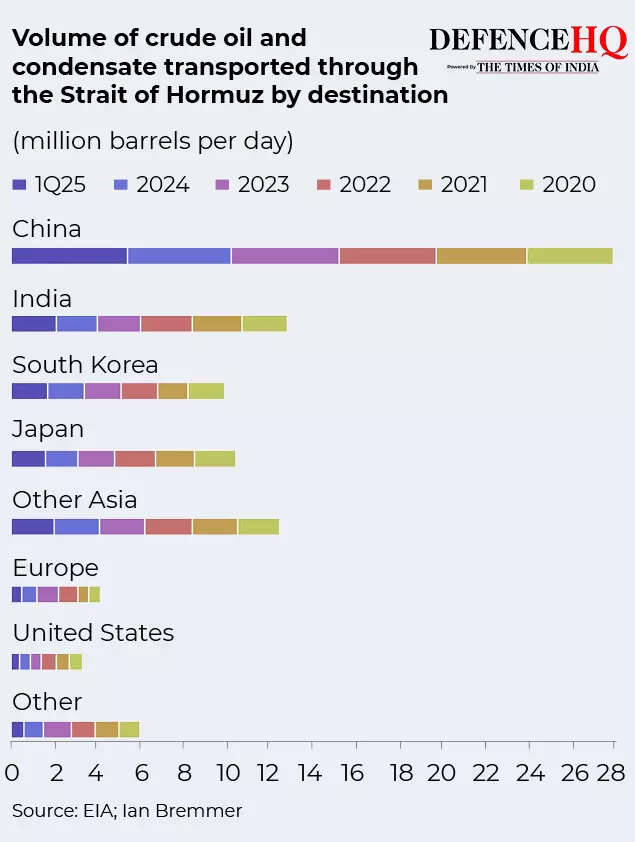
On the oil, LNG and LNG trade front, India is vulnerable to the impact of the closure of the Strait of Hormuz. A large portion of the oil that flows through the Strait of Hormuz every day is headed to China and India. However, vulnerabilities to closing the Strait of Hormuz differ significantly between India and China.
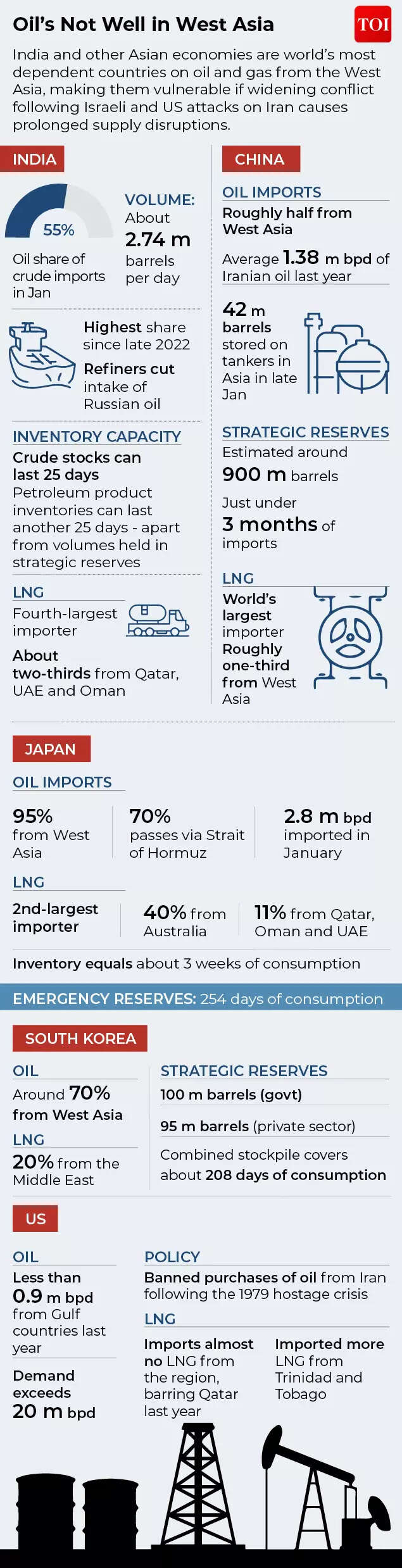
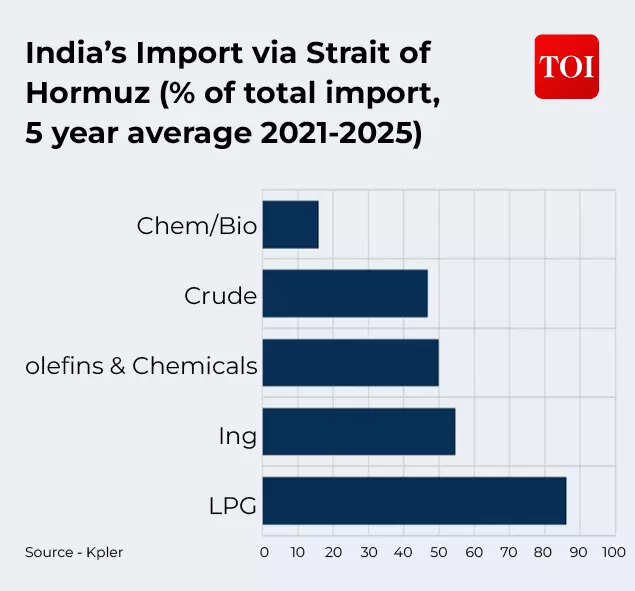
According to global real-time data and analytics firm Kpler, approximately 2.5-2.7 million barrels per day of India’s crude imports pass through the Strait of Hormuz, mainly sourced from Iraq, Saudi Arabia, UAE and Kuwait. Incidentally, in recent months, refiners have reduced part of their consumption of Russian oil, which has led to an increase in the share of Middle Eastern barrels in the overall import mix. This shift has increased India’s short-term exposure to any disruption affecting transit through Hormuz.Shipping data from Kpler shows that Russian crude shipments remain in the Indian Ocean and Arabian Sea, including supplies in floating storage.
If flows from the Gulf diminish, Indian refiners will likely be able to redirect oil Its purchases of Russian raw materials relatively quickly. Russia has already announced that it is ready to help meet India’s energy needs.Although India is expanding its oil basket, crude oil from the Gulf still offers a logistical advantage as the journey time is approximately 5 to 7 days compared to 25 to 45 days for shipments coming from the Atlantic Basin.India also relies on imports for about 80-85% of its LPG consumption, with most of these supplies coming from Gulf producers and passing almost entirely through the Strait of Hormuz. In contrast to crude oil, India does not have strategic LPG reserves on a similar scale, making LPG supply chains logistically more vulnerable in the event of disruptions.Currently, the government said India is in a “comfortable position” in terms of its energy security with petrol and diesel supplies and strategic reserves available to meet the needs.
China is the world’s largest energy importer, which may indicate that it will be particularly vulnerable to rising crude oil and natural gas prices resulting from the conflict between Israel, the United States, and Iran.However, according to a Reuters column by Clyde Russell, the situation is likely to develop differently. China’s huge crude oil reserves provide a significant buffer against sudden price increases, reducing the risk of the impact of energy-induced inflation affecting other economies significantly.In the event of a prolonged disruption to oil supplies in the Middle East, Chinese refiners would likely benefit by increasing exports of refined fuels. If export-focused refineries in parts of Asia, including India and Singapore, face constraints due to limited availability of crude oil, China will be in a position to process oil from its stockpiles and ship products such as diesel and gasoline, while benefiting from higher fuel prices, the analysis says.China also has additional strategic advantages. Iran remains the main buyer of discounted Russian crude that is subject to sanctions, and remains a potential destination for Iranian oil shipments that managed to leave the Strait of Hormuz before the recent Israeli and US strikes.