

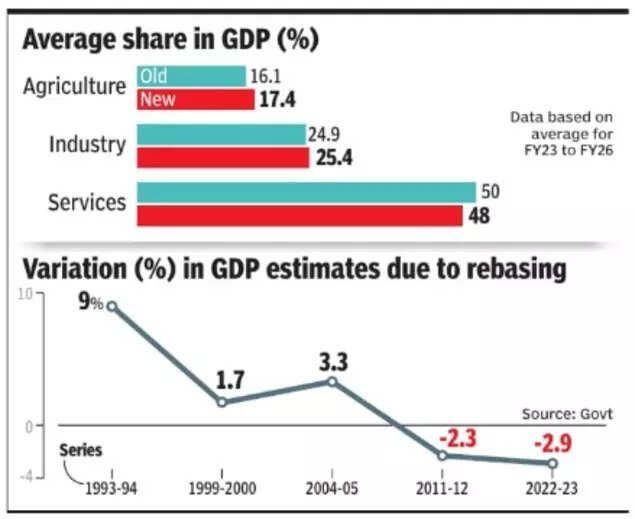
The Ministry of Statistics and Program Implementation has issued a new series of national accounts with 2022-2023 as the base year, replacing the 2011-2012 series. The review includes new data sources such as GST, PFM and e-Vahan, introduces double deflator in key sectors, and relies on annual surveys to improve household estimates.■ What is the base year? Why do you need to review periodically?A base year is a fixed point in time from which changes in prices, quantities, or other economic indicators are measured. It allows analysts to adjust nominal values to real values, removing the effect of inflation and enabling comparison of growth over years. It is revised periodically to ensure that it accurately reflects the current structure of the economy and takes into account changes in relative prices and the composition of production, as the parameters that make up the calculation of these indicators become outdated over time, making comparisons between years useless.
■ Which macroeconomic indicators get a new base year?The Ministry of Statistics has already updated the base year for the Consumer Price Index, which is used to derive inflation in the retail sector, from 2012 to 2024. The GDP, a measure of a country’s broad economic size, sees the base year revised to FY 2022-2023 instead of FY 2011-2012. The Index of Industrial Production (IIP), which measures industrial activity in the country, will see its base year revised to the 2022-2023 fiscal year on May 28.

■ What are some of the major changes in New GDP series?There is a shift from “agent-based” estimation to “direct data” integration, with many alternative data sources being used. The previous series calculated private final consumption expenditure (PFCE), a measure of demand in the economy, as a proportion of how much product goes to households versus businesses. The new chain will calculate demand directly using a consumer spending survey. To track the large-scale informal sector, the old series used the labor entry method.
The new series will use data from the Annual Survey of Individual Sector Enterprises (ASUSE) and the Periodic Labor Force Survey (PLFS) to measure their output and productivity.Recognizing the structural shifts in the economy, the new series will better capture sectors, such as the digital economy (e-commerce, fintech, freelance work) and renewable energy, which were negligible in the old series.■ What are some new and alternative data sources used in the new GDP series?High-frequency administrative data such as: ä GSTN data are used to allocate gross value added at the state level, cross-check firm activity, and as a high-frequency indicator of trade and services. ➤ The MCA-21 (Version 3), the most advanced version for all corporate and LLC filings, will be used to measure the private company sector. ➤ e-Vahan data used for real-time vehicle registration to estimate road transport services and consumption. FASTag data is used as a proxy for commercial road traffic and logistics activities. ➤ Public financial management system for direct tracking of government spending at the central and state levels. ➤ ESIC/EPFO payroll data to track formal employment and wages. Data from household and enterprise surveys: ä Household Consumption Expenditure Survey 20222023. ➤ All India Debt and Investment Survey 2019 to calculate interest rates and capital formation for the unincorporated sector. ➤ Periodic labor force survey to obtain annual and quarterly labor market data to improve income approach estimates. ➤ Annual survey of individual sector enterprises to directly measure the gross value added (GVA) of small enterprises and MSMEs. ■ What is deflation and how has it changed?Unlike the CPI, which only tracks the prices of goods and services consumed by households, the GDP deflator tracks the price of everything made in the country such as machinery, construction, and government services. It is used to deflate nominal GDP to find real GDP. The new series will use a double shrinkage device. Hence, the output and input values will be adjusted separately to calculate the real value added, which helps prevent distortions caused by fluctuating prices of raw materials, such as oil or metals.
The GDP deflator basket will now contain 600 items, up from 180 items in the old series.