

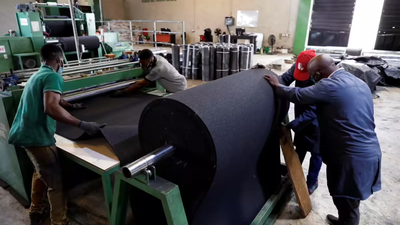
Hyderabad: India’s rubber industry has requested urgent government intervention, as global supply disruptions linked to the conflict in West Asia drive up raw material and shipping costs, threatening thousands of small manufacturers and exporters across the country.In a report to the commerce ministry, the All India Rubber Industries Federation said small and medium enterprises (SMEs) are facing severe pressure as prices of natural rubber, synthetic rubber and rubber chemicals have risen amid shipping delays, increased insurance and uncertainty in crude oil-related inputs.
He watches
‘Take every step’: PM Modi’s big guarantee to address global shock without harming citizens
The industry body urged the government to ensure fair access to raw materials for SMEs, provide credit support, waive customs duties on some synthetic rubber, and speed up port permits to protect jobs and export commitments.
It also urged the government to facilitate alternative sourcing by granting temporary exemptions or relief on imports from China and Southeast Asian countries.“The impact on the rubber industry is huge because all the raw materials we use to produce rubber components are based on oil, especially carbon black, and synthetic rubber oils,” said Anai Gupta, president of the association. “So any time oil prices go up, everything goes up.”
“Currently there is a 30% to 40% increase in raw material prices when compared to what they were before the war started,” Gupta said, adding that the sharpest increases were seen in carbon black, synthetic rubber and processed oils, while natural rubber has also become more expensive.“For natural rubber, the increase is about 10% because even though it is not oil-based but demand driven, about 40% of the natural rubber used in India is imported.
Shipping fees and insurance costs have risen due to the conflict.The association said shipping lines imposed exorbitant surcharges, exacerbating the burden on manufacturers. “Shipping lines have imposed an additional fee of $2,000 on 20-foot containers and $3,000 on 40-foot containers. Insurance costs have also increased and freight charges have almost doubled,” Gupta said.He said India’s dependence on imports made the sector particularly vulnerable.
India produces only about 60% of the natural rubber it consumes, while synthetic rubber imports account for a very large share of domestic demand, Gupta said.Industry data shows that India consumed 8,56,900 metric tons of synthetic rubber in FY25, of which 4,13,627 metric tons, or nearly 48%, was imported.The impact of the conflict is expected to be significant on export-oriented sectors such as automobile components, belts, shoes and sporting goods.
“Anyone and everyone who uses rubber and these inputs is severely affected,” Gupta said.In Telangana, the rubber industry largely comprises about 800 units, mostly small and medium enterprises, with an annual turnover of about Rs 3,000 crore, and contributes 0.5% to 1% of manufacturing output and less than 1% of the Planning Secretariat.Clusters around Hyderabad and Mahabubnagar produce hoses, tubes, sheets and sections, while reclaimed rubber units process waste tyres.