
The first step in taxing capital gains is to identify the assets sold and determine whether the resulting gains are taxable. (Image source: Magnifique)
Many individual taxpayers view filing an Income Tax Return (ITR) as a straightforward task – declaring salary income, updating investment details, and paying any credit tax. However, capital gains can turn a straightforward tax return into a complicated exercise.Post Covid, it has become popular for salaried employees to invest in and trade stocks and similar assets. During the year, they may sell stocks, redeem mutual funds, reserve gains from foreign employee stock options (ESOPs), restricted stock units (RSUs) or other investments, or dispose of inherited property. At first glance, while these transactions may seem straightforward, an incorrect holding period, mismatch with the Annual Information Statement (AIS), or failure to disclose foreign assets can result in tax notices, delayed refunds or additional tax demands.As the 2025-26 ISA filing season progresses, capital gains reporting is under greater scrutiny than ever before. With income tax administration’s increasing use of technology, data analytics, AIS, broker reporting, mutual fund disclosures, and offshore information sharing, providing accurate international tax regulations now requires not only correct tax calculations, but also complete and consistent reporting.
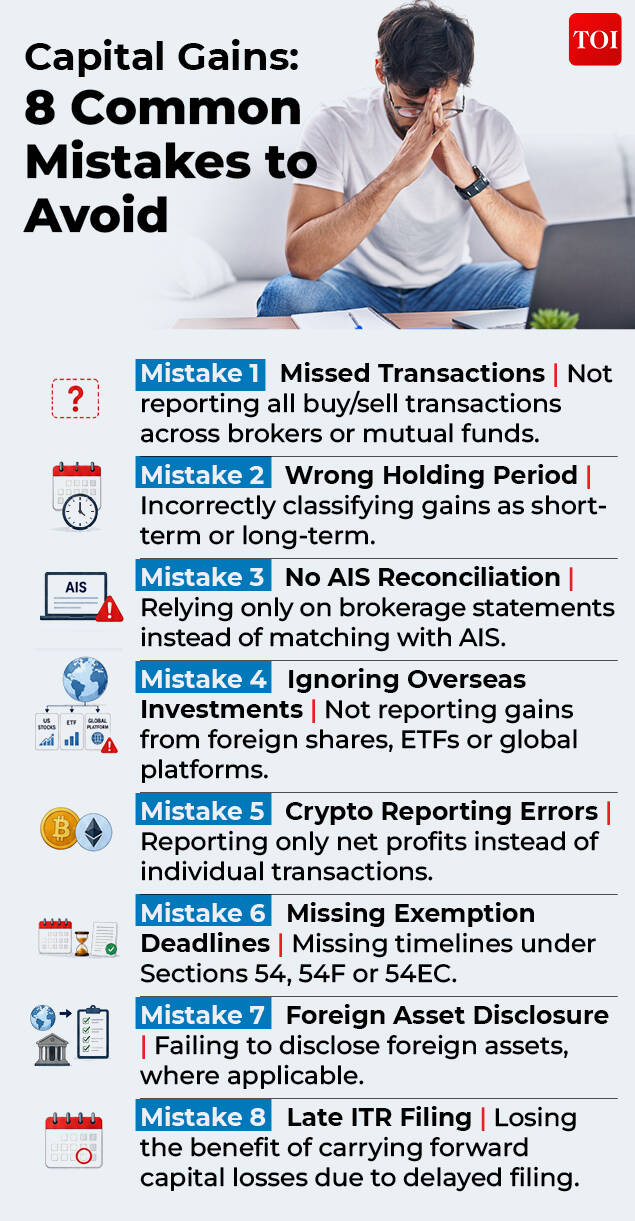
Eight common capital gains mistakes taxpayers make
Before diving into the rules, taxpayers should be aware of some of the most common mistakes:
- Missing one or more buy or sell transactions across multiple brokers and funds.
- Applying the wrong holding period and wrongly classifying gains into short-term or long-term.
- Relying only on brokerage data without matching numbers with AIS.
- Ignore gains from foreign stocks, offshore ETFs, or global investment platforms.
- Cryptocurrency transactions are reported only on a net profit basis.
- Missing exemption deadlines under sections 54, 54F or 54EC.
- Non-disclosure of foreign assets, where applicable.
- Loss of benefit from carry-forward losses due to failure to submit IRRs on time.
Many tax notices arise not from intentional underpayment of tax, but from incomplete or inaccurate reporting.
Start by determining the nature of the capital gain
The first step in taxing capital gains is to identify the assets sold and determine whether the resulting gains are taxable. In general, gains from the sale or transfer of a capital asset are subject to tax in the year of the transfer, after deducting:
- Acquisition cost
- Eligible improvement costs;
- Expenses directly related to the transfer; and
- Exemptions apply, where reinvestment is permitted by law.
Although this principle seems clear and straightforward, many taxpayers face difficulties in correctly determining the nature of gains and applying the correct tax provisions.
Capital Gains: 8 Mistakes to Avoid
Why correct classification matters
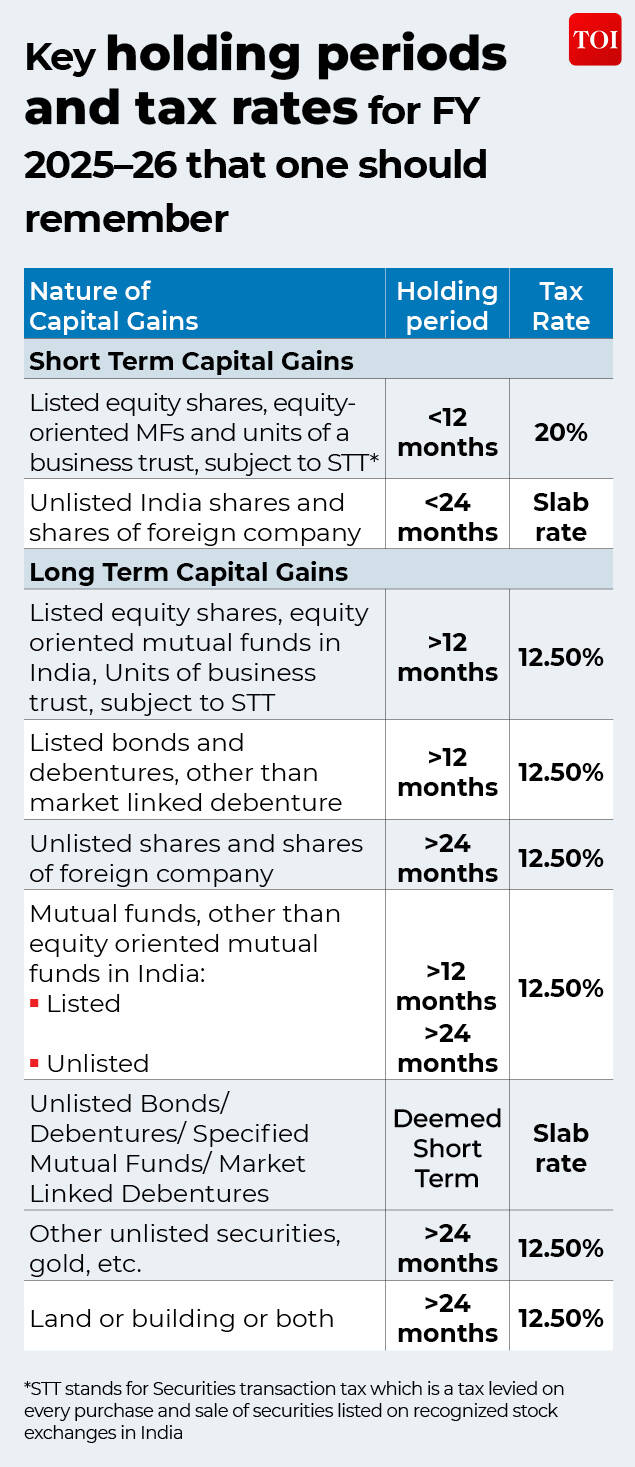
One of the most common errors in reporting capital gains is incorrectly classifying gains as short-term capital gains (STCG) or long-term capital gains (LTCG).For example, consider two investors who sell listed shares: one after holding them for 8 months and the other after 14 months. Although both transactions involve the same asset class, their tax treatment may differ significantly.This distinction is important because tax rates, exemptions, loss offset rules, and reporting requirements can differ significantly for short-term and long-term gains. The key factor is the holding period, which varies across asset classes, and taxpayers must first determine the asset class and then apply the relevant rule.
Capital Gains: Key Holding Periods and Tax Rates
Stocks and Mutual Funds: Similar investments, different tax consequences
Stocks and mutual funds may look similar from an investment perspective, but their tax treatment can differ significantly. Listed equity shares and equity-oriented mutual funds are generally taxed on similar lines. Long-term gains from these assets currently enjoy an annual exemption of Rs 1.25 lakh before tax applies.However, not all mutual funds qualify as stock funds. Debt funds, international funds, gold funds, funds of funds and some hybrid schemes may follow different tax rules.
For example, debt mutual fund investments made on or after April 1, 2023, generally do not qualify for long-term capital gains treatment and may be taxed at the taxpayer’s applicable rates.Therefore, taxpayers should carefully determine the nature of the investment before reporting gains.
Understanding grandfathering and end indexing
Changes in tax law often create confusion for taxpayers. One of these concepts is grandfathering. In simple terms, it is beneficial because it ensures tax certainty for taxpayers by ensuring that any change in the law takes effect from a future date and not retrospectively.
Grandfathering ensures that gains earned before the tax law change are not unfairly taxed under the new tax law.For example, when long-term capital gains tax was reintroduced on listed equity investments from 1 April 2018, gains accumulated up to 31 January 2018 were protected under special provisions and remained tax-free.The other major change is the withdrawal of indexation benefits for many capital assets.
Earlier, index linkage allowed taxpayers to adjust the acquisition cost in line with inflation, so the tax was only applied to real gains after excluding inflation-related appreciation. Under the revised framework, many long-term gains are taxed at 12.5% without being linked to an index. While a lower rate may seem beneficial, the absence of an inflation adjustment can increase the taxable gains of assets held over several years.
Residential real estate has an important exception: a practical clarification
Consider a taxpayer who purchased a residential property several years ago and sells it in fiscal year 2025-2026. In such cases, the taxpayer may choose between:
- Tax at 12.5% without indexation; or
- The tax is 20% with indexation.
The most advantageous option depends on the holding period, inflation and actual appreciation.
Therefore taxpayers should compare both accounts before filing.
Unquoted shares, foreign investments, company stock purchase plan and RSUs require special attention
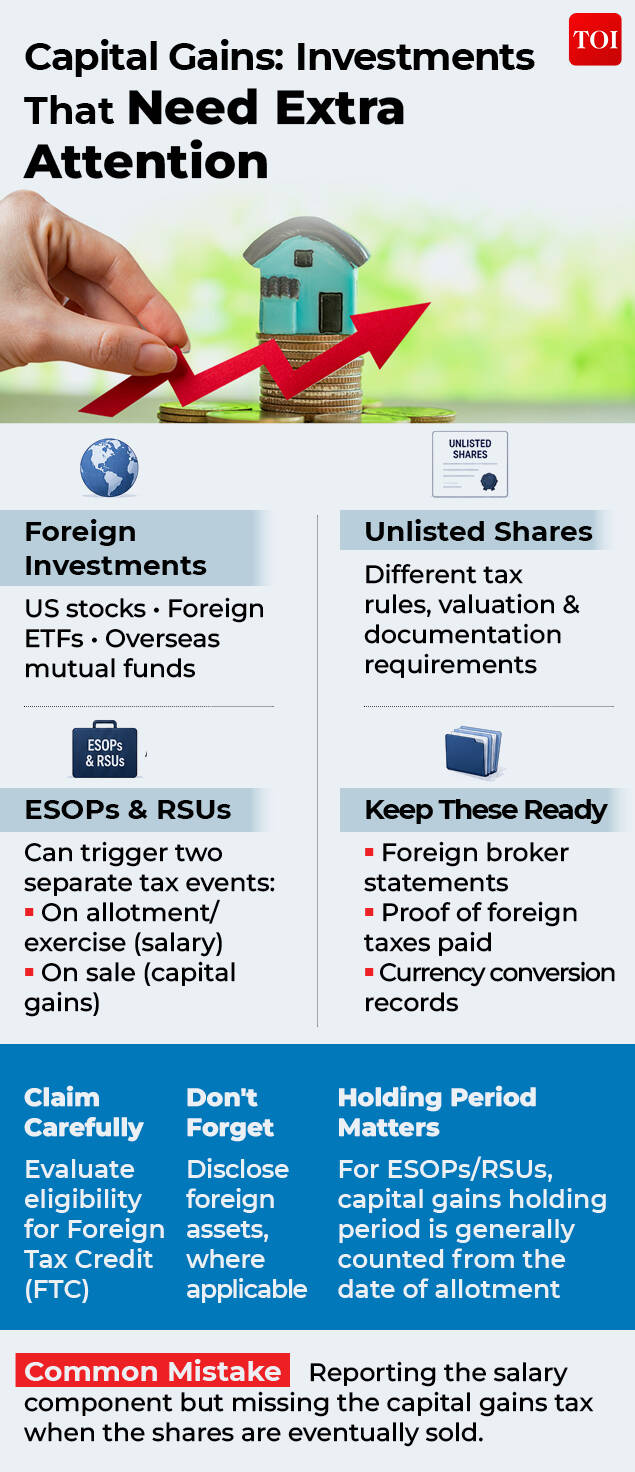
Global companies are increasingly issuing ESOPs and RSUs to employees across jurisdictions. Meanwhile, many individuals invest in unlisted stocks, US stocks, foreign exchange ETFs and offshore mutual funds through digital platforms. These investments require careful attention because their tax treatment and reporting requirements differ from those of standard listed equity investments. Since unlisted shares are not traded On recognized exchanges, evaluation and documentation are important. Short-term gains are generally taxed at slab rates, while long-term gains are taxed at 12.5% without indexation.Foreign investments, whether owned directly or through overseas intermediaries, generally do not get the same favorable tax treatment as listed Indian stocks. Foreign tax credit may be available, but claiming it involves additional compliance requirements.In addition to correctly calculating gains, taxpayers may need to:
- Retention of foreign intermediary data;
- Maintain proof of payment of foreign taxes;
- Maintain the way currency conversion works;
- Evaluate eligibility for foreign tax credit; and
- Reporting foreign assets, where applicable.
As financial information is increasingly exchanged between countries, accurate reporting of foreign income and assets has become critical.ESOPs and RSUs can also trigger more than one tax event. The first event typically occurs when shares are allotted or exercised, when the value is taxed as a condition of pay. The second generally arises when shares are sold and capital gains are calculated.
For capital gain purposes, the holding period is usually calculated from the date of allotment, and shares of foreign companies may also need to be disclosed in the foreign assets schedule of the ITR.Many employees report the salary component correctly but miss the capital gain implications that arise later.
Investments that require extra attention
Crypto: One of the most misunderstood areas of tax
Cryptocurrency remains one of the most misunderstood areas of tax compliance. Many investors only report their annual net profits.
However, this may not meet the reporting requirements for virtual digital assets.In the current frame:
- Gains are taxed at a flat rate of 30%, regardless of income level;
- Only the acquisition cost is allowed as a deduction;
- Losses cannot be offset against other income or carried forward;
- Cryptocurrencies received as a gift may be taxable to the recipient;
- Transactions must be reported separately in the VDA table; and
- A 1% TDS tax may apply in specific cases.
Each transaction must generally be identified and reported separately, including cryptocurrency-to-crypto trades and transactions on third-party platforms or exchanges.Accurate reporting of cryptocurrencies in ITR is crucial. Cryptocurrencies cannot be reported based on net profit alone; Each transaction must be recorded separately, making detailed records necessary including crypto-to-crypto trades and transactions through foreign platforms.
Incomplete reporting can lead to mismatches with AIS, Form 26AS or exchange records, especially as tax authorities increasingly rely on analytics and tracking systems.
Investment or business income?
Dividends on securities are not always taxed as capital gains. For example:
- Intraday trading profits are generally treated as trading income, not capital gains; and
- Gains or losses resulting from futures and options transactions are generally treated as non-speculative trading income.
This distinction is important because business income and capital gains follow different rules for calculating, compensating losses, expense deductions, and reporting.
Tax saving opportunities that taxpayers often miss
Despite the changes to capital gains tax, taxpayers can still reduce their tax liability using certain exemption provisions. Some widely used exemptions include:Article 54 – Applies when gains from a long-term residential property are reinvested in another residential property in India.Section 54F – Applies when the sale proceeds of certain long-term capital assets, other than residential property, are invested in residential property.Section 54EC – It applies when qualifying gains are invested in specified bonds, such as NHAI or REC bonds, within six months, subject to the specified investment limit.However, taxpayers often miss out on these exemptions due to unavailability of procedural requirements. If the stipulated conditions, timelines, or documentation requirements are not met, the exemption may be denied.
Don’t ignore Capital losses
Taxpayers often focus on gains and ignore the tax value of capital losses. This can be expensive.Short-term capital losses can generally be offset against short-term and long-term capital gains. Long-term capital losses can generally only be offset against long-term capital gains.Unabsorbed capital losses can generally be carried forward for up to eight valuation years if the return is filed by date.Delaying the filing of IFRs may therefore result in the loss of a valuable tax benefit.
Inherited assets and gifts: an area that is often misunderstood
Many taxpayers assume that inherited property or gifted investments are irrelevant for capital gains purposes.While receiving an asset through inheritance is generally not a taxable capital gain event, tax implications may arise when the asset is later sold.In such cases, determining the acquisition cost and holding period may require special analysis.
Taxpayers should keep historical records where possible and review the relevant provisions before reporting gains.
Reporting capital gains is no longer routine compliance
Capital gains reporting has evolved beyond the simple exercise of calculating dividends and paying taxes.Today’s taxpayers must navigate changing tax laws, offshore investments, digital assets, exemption provisions, disclosure schedules, and increasingly sophisticated data analytics by tax authorities.The greatest risk often lies not in aggressive tax planning, but in incomplete information, insufficient documentation, incorrect classification, or reliance on outdated rules.As AIS, Form 26AS, broker reports, mutual fund disclosures and international information exchanges become more interconnected, even minor discrepancies can lead to audits, delayed refunds or avoidable tax demands.The safest approach is:
- Maintain complete transaction records;
- Check booking periods;
- Reconciling numbers with AIS and Form 26AS;
- Evaluate applicable exemptions before submitting them; and
- Maintaining documents related to foreign investments and assets.
For taxpayers with capital gains, taking a few extra hours before filing ISAs can save months of follow-up, unnecessary tax costs, and avoidable stress later.(The author, Ravi Jain, is a tax partner at Vialto Partners. Vikas Narang, Director, and Teja TC, Associate, at Vialto Partners also contributed to this article. Views are personal.)