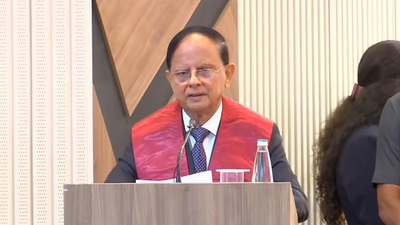
Prime Minister Narendra Modi’s Principal Secretary BK Mishra on Saturday warned that financial systems must remain linked to the real economy and daily lives of citizens, warning of risks arising from excessive speculation and instability in the markets, ANI reported.Addressing the 20th convocation ceremony of the National Institute of Banking and Management in Pune, Mishra said financial systems should not drift away from productive economic activity.“Financial systems cannot be separated from the real economy and the lives of ordinary citizens,” he said. “Excessive speculation, irresponsible lending, unsustainable leverage, and instability in financial markets can lead to disruption.”Meanwhile, Mishra highlighted the role of India’s digital public infrastructure in transforming financial inclusion and expanding access to banking, digital payments and formal credit.“In India, this convergence of finance and technology has enabled the creation of one of the most ambitious and comprehensive digital public infrastructures in the world,” Mishra said, as quoted by ANI.He said the trinity of JAM – Jan Dhan accounts, Aadhaar and mobile connectivity – has significantly reshaped the scope of the Indian banking system.
“The Pradhan Mantri Jan Dhan Yojana has brought millions of people, unbanked citizens, into the formal banking system. Aadhaar has created a digital identity structure that can be verified on an unprecedented scale. Mobile connectivity has provided the last layer of access,” Mishra said.Referring to India’s digital payment ecosystem, he highlighted the rapid growth of the Unified Payments Interface (UPI), describing it as one of the largest real-time payment systems in the world.“In less than a decade, India has built the world’s largest real-time digital payment ecosystem. From just Rs 2 lakh transactions in 2016-17, UPI now processes over 25,000 crore transactions annually,” he said.Mishra said one of the biggest achievements of the digital payments revolution is expanding access to formal finance in both rural and urban India.“A small tea seller in a village or a professional in an urban city can transact today through the same interoperable digital payment infrastructure,” he said.He also noted that digital transaction records are increasingly creating formal credit records for individuals who previously lacked collateral or banking relationships.“Every payment made, every purchase recorded, every transfer completed, leaves behind a data trail. This data trail can over time become the foundation of a credit history, for those who have no formal credit history, no collateral to offer, and no prior relationship with the bank,” Mishra said.Emphasizing the broader goal of financial inclusion, he said access to financial services must ultimately translate into economic opportunities.“True inclusion must ultimately create productive economic opportunities,” he said.Highlighting the government’s Mudra scheme, Mishra said that more than 57 crore loans worth around Rs 40 lakh crore have been sanctioned to MSMEs, benefiting a large number of women and people from marginalized communities.He said: “Behind every loan from Mudra lies a human story, where the tailoring business expanded, a small workshop was modernized, a transport vehicle was purchased, a family enterprise was stabilized, and the first job opportunity was created.”