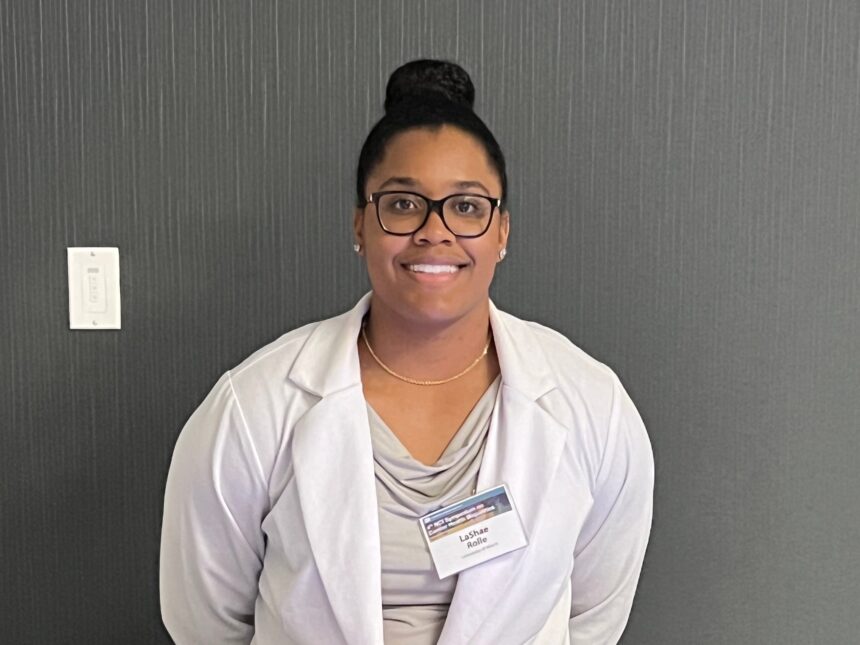

- Ph.D. One student cancer researcher noticed she had two major warning signs herself, and got checked out.
- She was diagnosed with breast cancer when she was 26, and now advocates for other young patients.
- Her background in competitive weightlifting helped her stay strong throughout treatment.
When Ph.D. Student Lashay Rolle felt pain in her chest, and didn’t think much of it at first.
The pain made sense: She had been working hard in the gym, preparing to bench press nearly 300 pounds for a powerlifting competition.
The pain came and went, but then Rolle noticed a lump in her breast, a warning sign of breast cancer. This was a red flag of which she was keenly aware from her own studies on cancer prevention and treatment.
At 26 years old, Rolle never expected to have this experience herself. She had no family history of the disease and no genetic risk factors.
However, she took her symptoms seriously. I scheduled a checkup and mammogram for peace of mind. When the results came back, she and the medical technicians were shocked to discover it was cancer.
“It wasn’t on my radar. I did it just to check the box, so I had no regrets moving forward,” Rule told Business Insider.
Roll, 28, said she works to raise awareness about cancer screenings for young patients who may not even realize they are sick.
“The only reason I was able to recognize the signs early was because of my background in the laboratory learning about cancer control and prevention,” she said. “I’m so grateful; not everyone knows.”
Unique challenges for young cancer patients
Even a decade ago, some cancers were rarely diagnosed in younger patients. The average age for breast cancer is 62, and for people with no genetic risk or family history of the disease, preventive screenings don’t begin until age 40.
Increasingly, patients in their 20s and 30s are being diagnosed with breast cancer, as well as colorectal cancer. It is a big problem for the healthcare industry, which is mainly used to treating very young or older patients, to treat the growing number of early-stage cancer patients.
Rule said she saw this firsthand at the cancer center where she underwent treatment. In the waiting room, she was the youngest patient in decades. When her mother accompanied Rule to appointments, medical staff assumed her mother was the patient.
Rule said it was a very isolating experience, made worse by having to postpone some key exams for her PhD. After struggling to find peers she could connect with, Rule said an app called Cancer Buddy helped her connect with patients of a similar age and diagnosis.
Roll said this community of young patients was key to dealing with the distinct challenges of treatment in her 20s: the financial burden, the rush to preserve fertility, and the shattering of the illusion that youth is invincible.
“It’s very difficult, especially when you’re young, because we think nothing can happen to us,” Rolle said. “You have to deal with your reality now and find ways to accept it.”
Exercise to fight cancer
After the initial shock of the diagnosis, Rule saw a unique opportunity to put everything she had studied into practice.
I pursued oncology to understand how to avoid the disease through exercise and diet. In fact, it was one of the first questions I asked my Ph.D. The guide was about whether cancer patients should exercise.
She had been weightlifting since college, going to the gym during basketball practice, but decided she would rather lift weights than run up and down the court.

So when she became the patient, Rolle had no intention of giving up weightlifting even during treatment. The guidelines suggest that light exercise can help cancer patients, but they don’t say much about intense exercise.
When there wasn’t much information about what she should do, Rolle researched and wrote down the information herself. She published her experience in a 2025 case study, the first of its kind to analyze elite weightlifters during chemotherapy.
Roll used everything she knew about the benefits of weight training, along with conditioning exercises like cycling, to make exercise part of her recovery plan.
Throughout the treatment, including surgeries, she maintained about 90% of her strength and said being an athlete helped her face the challenge head-on. This even prompted the doctors I spoke with to start recommending more exercise to patients.
“It completely changed the way I did things,” Rolle said. “I don’t think I would have had the confidence to do that, nor the experience in the field to even try something like this. It’s crazy when I look back on it.”
Roll completed her cancer treatment in October 2024 and is in remission. My recent scans keep coming back clear. She is still taking medication and hormone therapy, and will do so for the next eight years to remain cancer-free.
Meanwhile, Rolle is back on track to graduate with her Ph.D. This spring. She’s still lifting weights, is considering a return to powerlifting competitions, and is coming to terms with her new identity as a cancer survivor.
“For me, it’s like I’m trying to not stress, get things done, advocate, do research, and live my life to the best ability I can,” Rolle said.
Read next