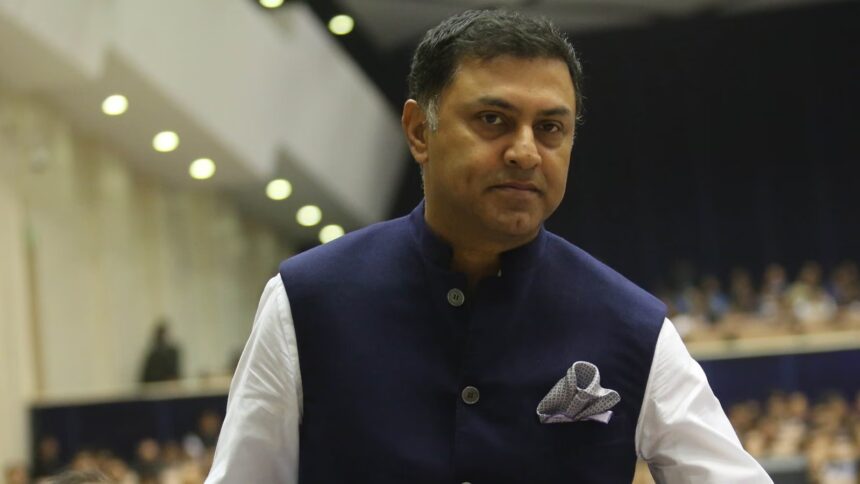
Advances in artificial intelligence (AI) are currently skewed toward speed and not trust or inclusion, Nikesh Arora, chairman and chief executive officer of cybersecurity firm Palo Alto Networks and formerly president of Japanese investment company SoftBank, warned Thursday.
“If we are to enjoy the benefits of AI, we have to settle for inclusion, trust and security as we continue to make progress in AI. At the current moment, I would say the balance is not in favor of trust, inclusion and security; it is actually in favor of speed. You see them, they can absorb very fast. Last day of India AI Impact Summit.
Arora’s words were echoed by others, including comments made by various global tech leaders on the topics of inclusivity and security. Vishal Sikka, founder and CEO of AI platform and products firm Vianai and formerly CEO of Infosys and chief technology officer of SAP, listed security, illusions, understanding the physical world and motion as limitations of AI that prevent its use in enterprises. As such, “safer” AI must be delivered: “We’ve done it with nuclear power for the last 80-plus years. We can and must do it with AI”, says Sikka.
The warnings come at a time when new and newer AI models and agents are being released around the world and are being considered a threat to human employment. Although experts say that the use of AI could, in the long term, create new types of employment, thousands of job cuts have been announced recently as more companies around the world integrate AI and its applications into their processes. In an interview earlier this month, Microsoft’s AI CEO Mustafa Suleiman said that most white-collar jobs will be automated by AI in the next 18 months. Microsoft itself has announced thousands of layoffs over the past year or so, including nearly 9,000 in July 2025. Tata Consultancy Services announced last year that it would shed more than 12,000 employees as part of a restructuring exercise.
But it will take a long time for jobs to be filled by AI agents, said Arora of Palo Alto Networks.
“I was at Google in 2009, and I remember driving in the first iteration of a self-driving car. That was 16 years ago. So, it takes a long time to fill a job with an agent. So, all of you who are really worried about our jobs going away — it’s going to take a little longer than you think. We can’t believe it’s quick.
Industry and Products
The AI threat has cast a dark cloud over IT companies, including Indian companies, amid concerns over business orders and profits, with their share prices taking a hit. On Thursday, HCL Technologies Chairperson Roshni Nadar said India needs to transform from a provider of technology services to a country that builds intellectual property (IP) and drives innovation.
The story continues below this announcement
“Services scale with effort, IP scales infinitely. In the AI economy, value only grows for those who build and own the platforms, models and products, not just those who implement them,” Nadar said at the summit. This re-invention will create new industries and new professions for India, she said.
Meanwhile, Vianai’s Sikka says that being effective with AI requires not only learning about it but also understanding its limitations and how to overcome them. “There’s a huge gap between LLMs (large language models) and business users in enterprises and how to bring value to those users. And there’s an opportunity to create a lot of value by bridging that gap.”
According to Wipro Executive Chairman Rishad Premji, India’s advantage in the AI era will come from developing talent. About 6.5 lakh professionals are currently working in AI-related roles in India and this number is expected to double by 2027, Premji said. However, he argues that India will need to go beyond training to work with AI; Applying AI with the ability to adapt to context, judgment and change is critical.
“That’s why AI fluency needs to expand beyond engineers to teachers, nurses, managers, supervisors, small business owners, etc. The dividing line is not man and machine; it’s between true adopters and reluctant adopters,” Premji said.
The story continues below this announcement
In the near term, Vinod Khosla of venture capital firm Khosla Ventures and co-founder of Sun Microsystems, which was acquired by Oracle in 2010, said the impact of AI will not be large until it benefits the bottom half of India’s population. According to Khosla, AI tutors for farmers, doctors and agronomists is a quick way to benefit Indians will provide
“These services should be part of the Aadhaar system. Aadhaar has allowed us to provide UPI; there is no reason why we cannot provide these services to every Indian within a year or two, in the same identity-based system that has worked so hard,” Khosla said.