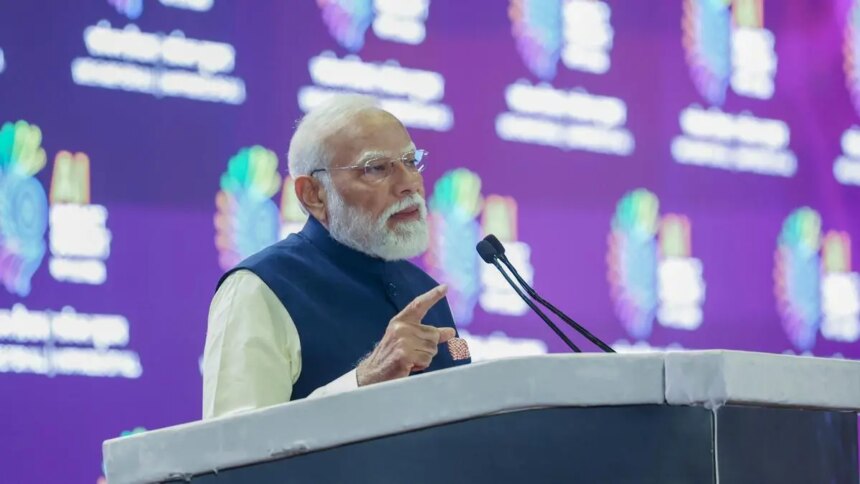

Prime Minister Narendra Modi addresses the gathering during the India AI Impact Summit 2026, in New Delhi. | Image Source:-
Prime Minister Narendra Modi on Thursday said it is important to democratize artificial intelligence (AI) so that humans do not become just a data point or limited to just raw materials.
“We need to democratize AI. We need to make it a vehicle for inclusion and empowerment, especially in the Global South… We also need to provide open skies for AI and keep the leadership in our hands just like GPS suggests our path, but we take the final decision on the direction in which we will go,” Modi said here at the inaugural session of India AI Impact Summit 2026.
Noting that India’s vision for artificial intelligence is clearly reflected in the theme of the summit – well-being for all, happiness for all, Modi stressed that this is the norm for India.
Regarding jobs, the Prime Minister noted that the future of work in the field of artificial intelligence is not predetermined, but will depend on collective decisions and actions. The future of work represents a new opportunity, an era in which humans and intelligent systems co-create, work together and co-evolve. He emphasized that artificial intelligence will make work smarter, more efficient, and more impactful, enabling better design, faster construction, and improved decision-making.
“AI will also open up higher-value, creative and meaningful roles to more people, creating opportunities for innovation, entrepreneurship and new industries. We must make upskilling, reskilling and lifelong learning a mass movement,” he said.
Modi also stressed that transparency is the greatest guarantee. He said that while some countries and companies consider artificial intelligence a strategic asset that must be developed secretly, India believes that artificial intelligence will benefit the world only when it is shared. He emphasized open code and shared development that will allow millions of young minds to make AI better and safer. He called for a collective determination to develop artificial intelligence as a global common good.
He also noted that there is an urgent need for global standards due to deepfakes and fabricated content destabilizing open societies.
“Just as we see nutrition labels on food, digital content should also carry authenticity labels so that people can differentiate between real materials and AI-created materials. There is a growing need for watermarks and clear source criteria as AI increasingly creates text, images and videos, to build trust in the technology from the beginning,” he added.
Emphasizing the importance of children’s safety, the Prime Minister also stated that just as the school curriculum is structured, the AI space must also be child-safe and family-oriented. He noted that today there are two types of people: those who see fear in artificial intelligence and those who see luck.
He emphasized that India sees wealth and future in artificial intelligence, supported by talent, energy capacity and policy clarity. Noting that three Indian companies launched their own AI models and applications during the summit, he said that these models reflect the talent of India’s youth and showcase the depth and diversity of solutions that India is contributing to the global AI landscape.
More like this


Posted on February 19, 2026