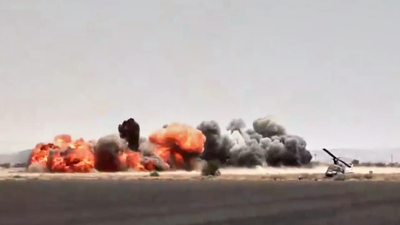
The Saudi authorities issued emergency warnings to the provinces of Jizan and Yanbu
CAIRO: Iran-backed Houthi rebels said Saturday they launched missiles and drones into Saudi Arabia in response to Saudi air strikes on the strategic Red Sea city of Hodeidah, in an escalation on vital Middle East shipping routes as the United States and Iran vie for control of the Strait of Hormuz. Dean. Brigadier General Yahya Saree, the military spokesman for the Houthis, said in a recorded statement that the attack targeted facilities in the cities of Yanbu and Jizan on the Red Sea belonging to Aramco, the largest oil company in the world. Saudi Civil Defense said alerts were issued several times early Saturday in both cities, but the kingdom did not comment further. No strikes were reported overnight in Iran, in an apparent break from nearly two weeks of consecutive nights in the United States
Attacks. The escalation in the Red Sea further threatens global shipping, and the Houthis have said they will close the Bab al-Mandab Strait to shipping linked to Saudi Arabia in response to the kingdom’s blockade of Yemen and the recent attack on the international airport in the rebel-controlled Yemeni capital, Sanaa. Mahdi Al-Mashat, head of the Houthi-led Supreme Political Council that governs Houthi-controlled areas in Yemen, said about what it would take for the Houthis not to besiege Bab al-Mandab: “Nothing less than ending the aggression and lifting the siege, otherwise all of this is an illusion and a mirage.”
This strait, located at the southern tip of the Arabian Peninsula, is a vital shipping corridor linking the Red Sea to the Gulf of Aden. About 12% of global trade passes through the strait, including a quarter of container traffic. The Houthis targeted two Saudi oil tankers in the Red Sea this week. In response, Saudi Arabia bombed the city of Hodeidah, the Saudi-led coalition opposing the rebels announced on Saturday. Anis Al-Asbahi, spokesman for the Houthi-run Ministry of Health, said the raids late Friday hit the port and the state-run communications corporation, wounding two people. The Saudi-led coalition said it did not strike the port but did strike “legitimate military targets” in Hodeidah Governorate that were “linked to threats to commercial ships in the Red Sea.” Iranian Foreign Minister Abbas Araqchi called for “diplomacy and dialogue” to resolve the Yemeni conflict without “military confrontations,” in an interview published Saturday by the government newspaper “Iran.” Iran condemns Ukrainian attack on merchant ship “Iran had a peaceful night,” Hossein Kermanpour, spokesman for the Iranian Ministry of Health, posted on X.
US Central Command did not immediately respond to a request for comment. Unlike the previous 13 nights, no new strikes were announced. But the Iranian Foreign Ministry condemned what it described as the Ukrainian attack on Saturday on an Iranian commercial ship in the Caspian Sea, saying that one person was killed and another wounded and described it as an act of aggression. In a separate statement, Araqchi said that he had spoken with European Union Foreign Policy Coordinator Kaja Kallas about the matter, and that Tehran had demanded a response.
Iranian official media reported that the diplomatic representative of Ukraine to Iran had been summoned. Ukraine “has achieved very strong results with long-range strikes in the Caspian Sea – including on ships used in military cargo shipments involving Iran,” Ukrainian President Volodymyr Zelensky previously said on X.com. While mediation efforts between the United States and Iran continue, Israeli Prime Minister Benjamin Netanyahu intends to travel to the United States next week to meet with President Donald Trump in Washington on Tuesday, his office announced Friday.
They last met in Washington in February, weeks before the war was launched. More than 7,000 people have been killed, including in Lebanon, and a fragile ceasefire that halted major operations for weeks appears to have collapsed this month. The United States accused Iran of striking three ships in the Strait of Hormuz, and responded by striking dozens of targets in Iran, which responded by firing at the Arab Gulf states allied with the United States. The US military renewed its blockade of Iranian ports.
The Iranian Revolutionary Guard advised residents of neighboring countries to stay away from bases that house American forces. The war has claimed the lives of more than 3,400 people in Iran, according to the Ministry of Health. Eighteen American soldiers, 24 civilians in Israel, and smaller numbers of civilians, including foreign workers and sailors, were reportedly killed throughout the region. In Lebanon, more than 4,000 people have been killed since Iranian-backed Hezbollah fighters opened fire on Israel in support of the Islamic Republic two days after the war began, and Israel responded with strikes and ground forces. Thirty-eight Israeli soldiers were also killed.