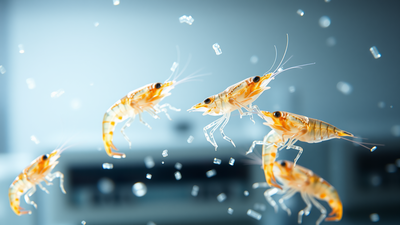
Feeding astronauts on long-duration missions remains one of the most difficult problems in space exploration, as food simply cannot be grown in the same way as on Earth. A team of researchers at Okayama University of Science in Japan investigated whether seafood, one of the oldest and most widely eaten foods on the planet, could realistically become part of that solution.
Their new study, recently published in the journal Microgravity Science and Technology, examined how shrimp behave and feed when exposed to simulated microgravity, providing an early but promising indication that the crustacean could form part of a future food chain for astronauts living on or beyond the Moon.
Why is testing animals in microgravity so difficult?
Most microgravity experiments on Earth rely on drop chambers or parabolic flights, both of which provide only a few seconds of true weightlessness, a very short window for meaningful behavioral testing.
The International Space Station allows for longer exposures, but access is expensive and space on board is very limited. To get around this problem, the research team turned to a device called a clinostat, which is a chamber that rotates its contents to mimic some of the effects of microgravity by canceling out the pull of gravity through constant repositioning.
According to the study titled “In situ monitoring of shrimp feeding process under microgravity environment,” published by researcher C. Yokota and colleagues, standard clinical cells typically rotate at only 10 to 25 revolutions per minute, a speed so slow for agile animals that they can simply reorient themselves before the simulation of weightlessness takes effect.
Faster clinostat construction for complex animals
To solve this problem, the researchers designed a custom clinostat that rotates at 130 revolutions per minute, more than twice a second. This rapid rotation does not give animals like shrimp enough time to reorient their bodies toward Earth’s gravity before their direction changes again, effectively creating a state of false weightlessness inside the chamber. According to the official announcement from Okayama University of Science, this was the first study of its kind to observe the feeding behavior of live shrimp under simulated microgravity conditions using this type of high-speed rotary setup.
Watch the baby shrimp trying to eat while spinning
For the main experiment, juvenile Kuruma shrimp were placed inside a specimen box equipped with a digital camera and light source, then subjected to fifteen minutes of simulated microgravity while researchers monitored their attempts to feed. The rapid rotation caused the water to flow into the container with great force, generating an internal flow estimated at 0.15 meters per second. To cope with this disturbance, the shrimp were seen clinging to a plastic net placed inside the container, and they were largely just eating food pellets that drifted directly in front of their mouths rather than actively hunting as they would under normal gravity.
It is worth noting that the shrimp feed most effectively during short moments when the water flow stabilizes, providing strong evidence that the animals were able to feed in microgravity conditions when given the opportunity.
Genetic changes associated with movement and body structure
Beyond behavior, researchers also looked for biological changes at the genetic level. A separate group of shrimp was exposed to twenty-four hours of simulated microgravity, after which their RNA was compared to a control group kept under normal gravity using gene ontology analysis.
This comparison revealed significant changes in genes associated with chitin metabolism and cuticle development, both of which are closely linked to the shrimp’s exoskeleton and ability to move.
These genetic shifts suggest that microgravity affects shrimp on a biological level, and not just in terms of visual movement or feeding behavior.
Artemia test over several continuous days
Because it is difficult to test larger shrimp in statistically significant numbers, the team conducted a supporting experiment using brine shrimp, more commonly known as brine shrimp or sea monkeys, exposing them to four continuous days of rotation inside a clinostat.
Throughout this longer exposure, the brine shrimp continued to successfully feed on algae, produce waste, and grow significantly in size, indicating that they were able to live a largely normal life even under constant simulated microgravity, with no visible significant disease effects recorded during the experiment.
What still needs to be studied before shrimp hits the space menus
Not every part of the study went as planned. The researchers originally hoped to collect comparable data on the fish, but limitations in the camera setup mean that the current results only cover prawns and brine shrimp, leaving fish behavior as an open question for future research.
Separate ongoing efforts, including the Lunar Hatch program, which aims to introduce fertilized fish eggs into lunar water systems, and SpaceGenFish, which is developing robotic aquaculture systems for use aboard the International Space Station, are filling this gap.
For now, the shrimp results provide an encouraging, if early, sign that seafood aquaculture could realistically play a role in feeding astronauts on future lunar bases, provided more research continues to build on these preliminary findings.