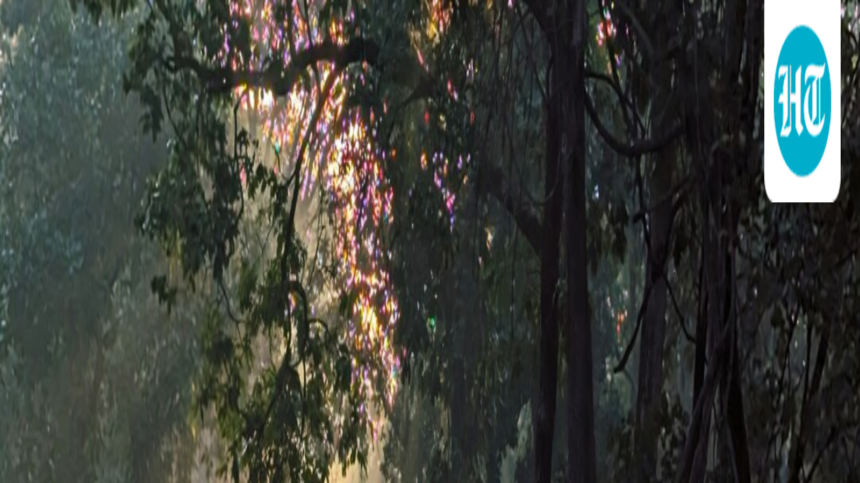
It’s well past sunset and I’m on my way to my lodge in Satpura National Park. The lamps are dimly lit, and I see the outlines of the trees, fluid, swaying, standing under a canopy of stars. It’s the sounds of the forest that keep me grounded.
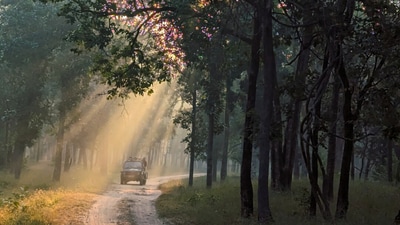
The harmonious chirping of crickets surrounds me. There is the occasional sound of a splash of water from a frog jumping into a nearby body of water; The leaves crunched beneath my feet. The sudden burst of a hollow chirp from a forest owl, perched above. The distinctly different sounds blend together to create a wonderful symphony that is completely unpredictable, yet strangely rhythmic and soothing.
“Listening to the sounds of nature is part of our DNA,” says Shaheen Sheikh, naturalist at Pugdundee Safaris. Sheikh explains that the sound of birds chirping is known to be therapeutic. But one of the reasons we feel calm is because of the knowledge passed down by our ancestors. Without any technical jargon, Shaik skillfully explains what scientists refer to as the “biophilia hypothesis,” an innate tendency to seek connections with and take cues from nature. “The music of some songbirds told our ancestors – back when we lived outdoors – that we were safe, that there were no predators lurking nearby,” Sheikh says.
“Bird sounds also allow for communication between species, that is, between birds and plants,” says Anand Pendharkar, wildlife biologist and CEO of SPROUTS. Citing a 2024 study conducted by GK Gulari at Sri Venkateswara University, Pendharkar explains that the study found that sound waves positively affect plant processes such as stomatal behavior and photosynthesis, and help build resilience to environmental stresses.
Sheikh also explains how species communicate. “Forest bird calls can alert us to the presence of a tiger,” she says. The birds’ unique visual abilities allow them to spot tigers brilliantly. However, “to understand whether a bird’s call will lead us to a big cat, we have to decode sound level, pitch, and frequency,” says Shaik. Sheikh explains that, as with humans when they fear imminent danger, bird calls become increasingly frantic and high-pitched. They also serve to alert other creatures to lurking dangers.
Conversely, Pendharkar explains why predators like tigers have thick, soft, padded claws, which act as natural shock absorbers. “They muffle the sounds, allowing tigers to ambush their prey,” he says.
While tracking calls, it is important to be wary of creatures that mimic others. Many species of drongo are known to be excellent at imitating and reproducing the calls of many different birds. This serves as a way to ensure their safety, so that when they are afraid of predators they imitate larger, stronger birds.
Apart from birds, trees also speak. Canadian scientist Dr. Suzanne Simard coined the term “broad lattice.” Dr. Simard’s work popularized the theory that there are fungal threads running beneath the soil that connect entire forests. These mycelium strands intertwine and form a network known as the “broad web,” which allows the trees to talk to each other and provide food for themselves. We cannot hear these conversations, and to us the trees are largely silent. However, they are important vocal tools, explains Sheikh. “Trees, with their branches, canopies, leaves and flowers, act as sound filters,” says Sheikh. “They absorb sounds, as well as scatter them and reflect them.” Deforestation and widespread damage to trees from wildfires dramatically alter the acoustics of the forest.
As we continue to infiltrate their natural habitats, many species have been lost forever. Natural scientists remind us that the world is interconnected, and that we depend on each other. For example, logging affects bats, which feed on insects that in turn breed in the dense foliage. Most bats emit sounds at frequencies inaudible to the human ear. However, sound plays a very important role in the life of bats, as they hunt by echolocation. This means that sound waves emitted by bats bounce off objects or creatures in the environment. This, in turn, helps the bat determine the exact location of its prey and pounce on the creature. Bats may not be audible to us, but when they are silent, we pay the price. “Bats feed on insects and thus help in controlling insect populations,” says Pendharkar. If you remove this natural insecticide, you have upset the delicate balance of nature, including crop productivity.
Today, all over the world, many species have become extinct due to widespread urbanization, but some have learned to speak our language. Pendharkar reports that researchers have discovered young macaques in Bandipur National Park that make a distinctive soft sound, and extend their hands to get food, when they spot tourists carrying food.
Even though the forests of India house an orchestra of magnificent creatures, we still hunt the big cats. But Shaik, who works with Waghoba Eco Lodge by Pugdundee Safaris inside Tadoba National Park, is noticing a shift. She says many visitors come for the tigers, but often what stays with them are the echoes of the unsung heroes.
“In the end, I ask people to choose the highlight of their visit,” she explains. “Increasingly, people are mentioning experiences other than seeing tigers.” A recent group she led unanimously reported that “listening to carpenter bees” was their most treasured moment. “We were parked, engines off, waiting to see a sloth bear,” she explains. “Instead, in silence, we listened to the buzz of bees, nesting in a nearby tree.”
On World Listening Day (18 July), dedicated to the sounds of the natural world, it’s time to turn off the noise and listen to the cries of nature. After all, as part of a magnificent but threatened ecosystem, we cannot ignore nature. Our survival depends on it.
One factual correction: The Canadian scientist’s name is Dr. Suzanne Simard, not Suzanne Simard. This is a typo, not an editorial change, and should be corrected.