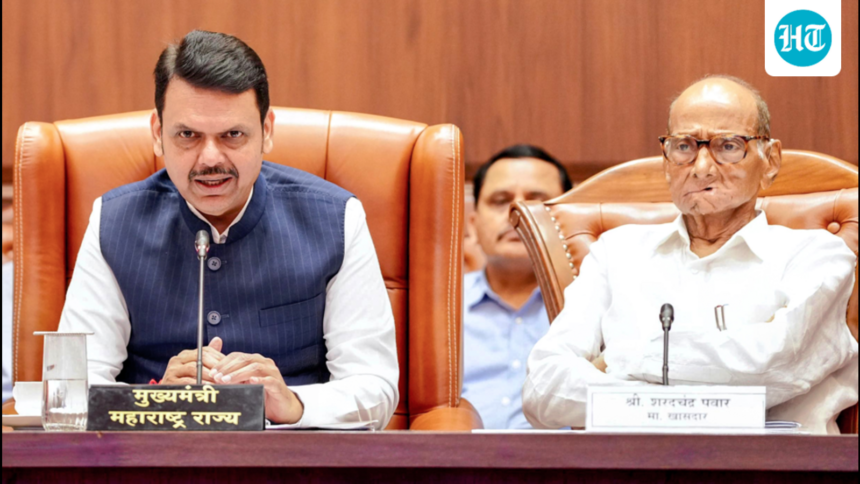
A meeting between the Chief Minister of Maharashtra and NCP leaders
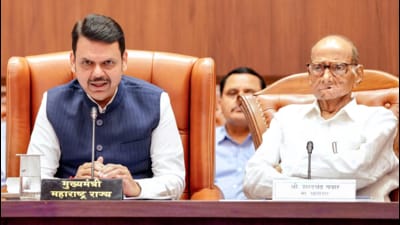
Maharashtra Chief Minister Devendra Fadnavis met leaders of both factions of the NCP at his Mumbai residence on Tuesday evening, raising speculation about efforts to reunite them with the BJP’s approval.
NCP leader Praful Patel and Sunil Tatkare attended the meeting even as NCP-Sharadchandra Pawar (NCP-SP) leader Jayant Patel, who was reportedly a part of it, denied his attendance. People familiar with the matter said the meeting lasted about an hour.
The meeting comes amid growing speculation that Sharad Pawar-led NCP-SP is preparing to join the ruling BJP-led National Democratic Alliance.
The NCP-SP leadership sought views of legislators, and the majority favored joining the two governments both at the Center and in Maharashtra, the people cited above said. Senior leaders of the National Congress Party and the Socialist Party have reached out to those who oppose this political realignment in order to build consensus.
The two factions were discussing the possibility of reunification, and the merger formula was about to be finalized and was about to be announced when NCP chief Ajit Pawar died in a plane crash in Baramati on January 28.
NCP and SP leaders, including Sharad Pawar, have indicated that the merged party is expected to become part of the NDA. But the plan was put on hold after Ajit Pawar’s death. Later, the new NCP chief, Sunetra Pawar, Ajit Pawar’s widow, opposed the merger.
An NCP-SP leader said most lawmakers are keen to join the government because it helps address their issues, including development funds. “Our first preference has always been a merger with the NCP. If reunification is back on the table, the party leadership will welcome it.”
The fresh merger speculation comes weeks after six Shiv Sena (UBT) MPs defected last month to the Shiv Sena led by Eknath Shinde, an NDA member. Earlier, 20 Trinamool Congress (TMC) MPs announced their defection to the little-known Nationalist Citizen’s Party of India (NCPI), allied with the NDA, after the party lost power in West Bengal.
The defections came against the backdrop of the National Democratic Alliance government’s keenness to approve the draft border demarcation law. The NDA needs a two-thirds majority in the Lok Sabha to pass the bill. The TMC and Shiv Sena (UBT) played a major role in defeating the Constitutional Delimitation Amendment Bill earlier this year.
In 2019, the BJP’s tally fell below the majority mark in Parliament, leaving it dependent on the Telugu Desam Party (TDP) and the Janata Dal (United) or JD(U) to retain power. The BJP won 240 seats in the 543-member Lok Sabha. The Congress-led opposition alliance won 234 seats. The TDP’s 16 seats and the JD(U’s) 12 helped the NDA cross the majority mark, reaching 293 seats.
The NDA’s strength in the Lok Sabha rose after defections and splits within the TMC and the Shiv Sena (UBT). It is still short of a two-thirds majority of 363 seats. The NCP-SP has eight seats in the Lok Sabha and one in the Rajya Sabha.