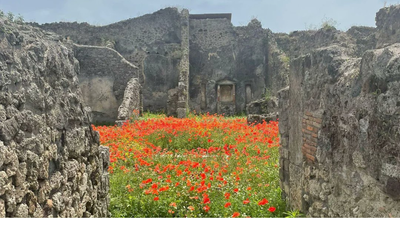
Nearly 2,000 years after Mount Vesuvius buried the thriving Roman city of Pompeii under volcanic ash, one of its ancient streets has become an unexpected symbol of renewal. Every spring, vibrant red poppies and other wildflowers bloom among the worn basalt paving stones that once held Roman carts and pedestrians, creating a stark contrast between the city’s tragic past and nature’s resilience.
This stunning spectacle, recently shared widely on social media, has captivated history enthusiasts and travelers alike, and serves as a reminder that even places marked by disaster can be transformed by the quiet rhythms of the natural world.
An ancient Roman street is thriving again
The flower-covered street is part of the Pompeii Archaeological Park in southern Italy, where much of the ancient city is still remarkably preserved. The road itself dates back nearly 2,000 years to the Roman Empire, and was in daily use until Mount Vesuvius’ catastrophic eruption in 79 AD, burying Pompeii under meters of volcanic ash and pumice.Today, bright red poppies and seasonal wildflowers appear naturally among the cobblestones, creating a lively display that attracts visitors from all over the world. While the street is old, the flowers are not. They bloom every spring as part of the region’s natural Mediterranean flora.
Why do flowers grow among the rubble?
The blooming landscape is largely a result of Pompeii’s climate and volcanic soil. The ash left behind by Mount Vesuvius over the centuries has produced mineral-rich land that supports a wide range of plants, including the famous red poppies frequently seen throughout the archaeological site.
Since Pompeii is an open-air archaeological park covering approximately 66 hectares, abundant rainfall and sunlight allow native plants to flourish during the spring. The flowers are not planted for decorative purposes, but rather grow naturally, adding seasonal color to the ancient ruins.

The story behind the destruction of Pompeii
Pompeii was a thriving Roman city before the eruption of Mount Vesuvius devastated the area in 79 AD. The volcano spewed towering columns of ash, volcanic gases and fast-moving lava flows that buried the city within hours, preserving homes, streets, temples, frescoes and everyday objects beneath layers of volcanic material.The disaster claimed thousands of lives and effectively froze Pompeii in time. When excavations began in the 18th century, archaeologists discovered an extraordinary glimpse into Roman life, making Pompeii one of the most important archaeological sites in the world.
Streets that reveal daily Roman life
The streets of ancient Pompeii were carefully designed to support heavy traffic while helping residents navigate the city. Large basalt paving stones formed sturdy road surfaces, while raised stones allowed pedestrians to cross even when rainwater or sewage flowed along the streets.Deep grooves carved into the stone by centuries of cart wheels are still visible today, providing evidence of the bustling commercial life that once filled the city. These features continue to help archaeologists understand Roman urban planning and transportation.
Nature and archeology now exist side by side
Although wildflowers have become one of Pompeii’s most photographed seasonal attractions, their conservation remains the site’s top priority. Archaeologists and park managers carefully monitor the plants to ensure that plant roots do not damage the fragile walls, mosaics or ancient structures.At the same time, controlled natural growth supports biodiversity and enhances the visitor experience by highlighting the unique relationship between archaeological remains and their surrounding landscape. Every spring, colorful flowers provide a new perspective on one of the best-preserved ancient cities in history.
Pompeii is also restoring its ancient gardens
In addition to naturally occurring wildflowers, archaeologists have reconstructed many historic gardens using evidence from pollen, seeds, root cavities and ancient irrigation systems discovered during excavations.One of the most notable restorations is the Garden of Hercules, also known as the House of the Attar, where historically documented roses, violets, vines and other plants were replanted to recreate the look of a Roman garden nearly two thousand years ago. The project provides insight into the city’s horticultural traditions and perfume production before the volcanic eruption.
Why does Pompeii continue to fascinate scholars?
Despite centuries of excavation, about a third of Pompeii remains unexcavated, allowing researchers to preserve parts of the city for future generations and more advanced archaeological techniques.New discoveries continue to reshape historians’ understanding of Roman society, from graffiti and ancient household objects to evidence of trade, agriculture, and daily life. The annual bloom of wildflowers across ancient streets adds another layer to the story of Pompeii, illustrating how nature reclaimed a city once silenced by one of the most catastrophic volcanic eruptions in history.