

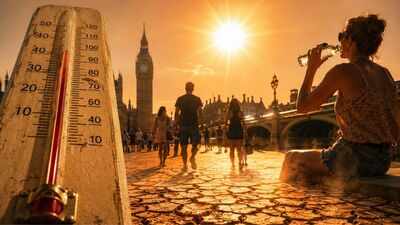
For decades, the summer of 1976 held a special place in British weather history. This has been the season people return to when prolonged heat or dry conditions become part of the conversation.
But this year the comparison has changed. Figures recorded at the University of Reading reportedly suggest that 2026 has already surpassed that long-term reference point in one important measure. While individual heat waves are nothing new, the persistence of high temperatures into late spring and into the summer has caught the attention of climate scientists, especially because it has been accompanied by a prolonged lack of precipitation.
The combination raises new questions about how often such summers are likely to occur in the future, and what that could mean for water supplies, agriculture and public health across parts of England and Wales.
Scientists say 2026 has surpassed one of Britain’s most famous heatwave records
According to observations from the University of Reading’s Atmospheric Observatory, this summer has already recorded 15 days where temperatures reached at least 30 degrees Celsius. The famous summer of 1976 recorded 14 such days at the same location, meaning this year was ahead of the benchmark that has shaped discussions about British heat for nearly 50 years.
The observatory’s weather records go back to 1908, giving researchers a long historical data set to compare. Five of the days recorded this year also rank among the 20 hottest single days measured there since observations began, underscoring how persistent the recent warmth has been.As the BBC reported, Professor Andrew Charlton Perez said the comparison with 1976 is important because that year has long represented the standard by which exceptionally hot British summers are judged.
He said the pattern now points toward climate change rather than a short-term bout of unusual weather.
The arrival of heat coupled with an increasing lack of precipitation
High temperatures did not develop in isolation. Since early March, rainfall has been much lower than normally expected, with less than half the average amount recorded during that period.Rainfall was also rare during the summer itself. Measurable rain only fell in about 10 days, allowing dry ground conditions to become steadily more widespread as the season progressed.Dr Stephen Burt, from the University of Reading, said the lack of rain had led to significant drought over several months rather than only appearing during the recent heatwave. “The wet winter has helped us along so far, but reservoir stocks in the south and east should be depleted quickly, and further water restrictions cannot be far away,” Burt added.
The hidden impact of prolonged dry weather on reservoirs and agriculture
Long periods of drought often create challenges that remain after temperatures begin to drop.
Water companies may eventually need to impose additional restrictions if reservoir levels continue to drop, especially in areas where demand is already high.Reduced rainfall also affects farmland, gardens and local ecosystems. Soil dries more quickly, river levels may fall to lower levels, and irrigation becomes increasingly important for some crops. These effects tend to accumulate over time rather than occurring all at once, making managing prolonged dry weather particularly difficult.
Health concerns during prolonged hot weather
Long periods of high temperatures also carry health risks, especially for older adults, people with existing medical conditions, and those who live in buildings that retain heat.Separate estimates suggest that more than 2,700 deaths in England and Wales during exceptionally warm weather during May and June may have been linked to heat-related causes. While these estimates rely on statistical analysis rather than direct case-by-case attribution, they highlight the broader impact that prolonged hot weather can have beyond discomfort alone.Scientists increasingly point to persistent heat, rather than isolated hot days, as one of the factors that puts the greatest strain on vulnerable groups, healthcare services and public infrastructure.
Variable reference point
The significance of 2026 lies not so much in one record-breaking temperature as in how frequently high temperatures return over the course of the season. Replacing 1976 as the year with the highest number of 30°C days at the Reading Long-Term Observatory represents a notable shift in Britain’s climate record.Meteorologists say summers that were once considered extraordinary are becoming less extraordinary as average temperatures continue to rise. At the same time, prolonged droughts create additional challenges beyond the hottest days themselves, affecting water resources, agriculture and public health long after individual heat waves have passed.