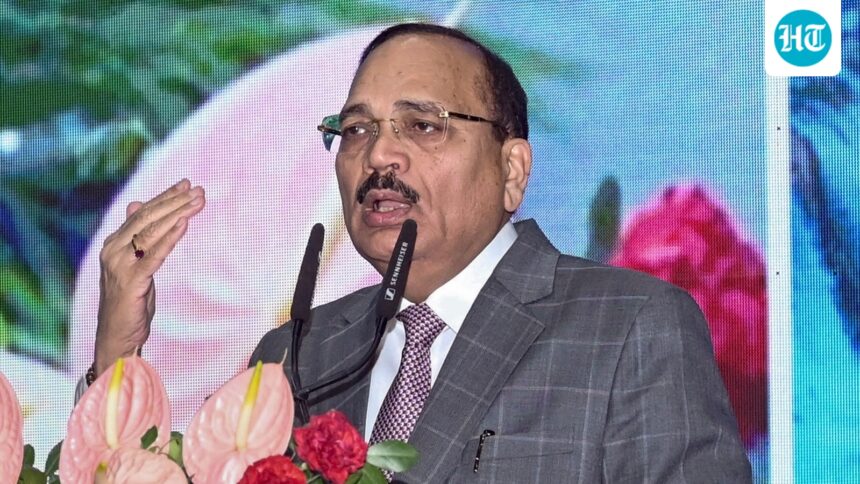
Chief Justice of India (CJI) Surya Kant has unveiled a special list under which four benches will exclusively hear the oldest civil and criminal cases in the Supreme Court, identifying around 800 long-pending matters for speedy disposal in the first systematic case management exercise in the Supreme Court in recent years aimed at institutionalizing disposal of old lawsuits.

The move, which comes as the Supreme Court resumes full capacity after partial working days during the peak summer months, is expected to speed up the disposal of some of the oldest cases pending before the court.
Restoring confidence in achieving justice
Speaking to Hindustan Times, the Chief Justice said the initiative aims to reaffirm public confidence in the justice delivery system by ensuring that old cases receive sustained judicial attention.
“The primary obligation of the judiciary is not merely to decide cases, but to decide them within a time frame that preserves citizens’ confidence in the rule of law. Every pending old case represents a litigant who has waited years, sometimes decades, for closure. The age of a case cannot become a reason for its continued neglect. By creating courts dedicated to hearing exclusively the oldest civil and criminal cases, the Supreme Court seeks to institutionalize a culture in which long-standing lawsuits receive sustained and sustained judicial attention.” The CJI said on Sunday.
Justice Kant added that every old case that reaches its logical conclusion strengthens the credibility of the justice system and reaffirms the constitutional promise that justice will not be defeated by the passage of time.
Four assigned seats
As per the new list notification coming into effect from July 13, the two division benches headed by Justices PK Mishra and SV N Bhatti will exclusively hear the oldest civil matters on non-miscellaneous days – Tuesday, Wednesday and Thursday. Two other benches headed by Justices Manoj Misra and Ujjal Bhuyan will also hear the oldest criminal cases of those days.
The notification reads as follows: “Two Divisional Benches, headed respectively by His Honor Mr. Justice PK Mishra and His Honor Mr. Justice SV N Bhatti, deal exclusively with the oldest civil matters on non-miscellaneous days… Two Division Benches, headed respectively by His Honorable Mr. Justice Manoj Isra and His Honor Mr. Justice Ujjal Bhuyan, deal exclusively with the oldest criminal matters on non-miscellaneous days…”
People familiar with the developments told HT that nearly 200 of the oldest cases have been identified for each of the four courts, meaning a total of about 800 old cases will now receive focused judicial attention.
This initiative represents one of the first major administrative reforms undertaken by CJI Kant and is consistent with his stated aim of tackling dependency through targeted judicial administration rather than ad hoc elimination campaigns.
Outstanding challenge
According to the National Judicial Data Network (NJDG), the Supreme Court currently has 95,911 cases pending, including 74,145 civil cases and 21,766 criminal cases. Of these cases, 37,826 cases, or about 39.4%, are less than one year old, indicating that a significant portion of the list consists of older cases awaiting adjudication.
The four special benches are expected to devote three working days each week exclusively to these inheritance matters, without bearing the usual burden of various hearings.
Changing the list gains importance in light of Judge Kant’s repeated emphasis on adopting structural reforms to address the increasing judicial arrears. Just a day ago, while inaugurating the silver jubilee celebrations of the Indian Institute of Arbitration and Mediation (IIAM), the ICJ observed that India’s accreditation crisis cannot be addressed through arbitration alone.
“Indian courts are currently hearing over five crore (50 million) cases… No judicial model, no matter how well resourced, resolves a backlog of this magnitude on its own. These cases must be partly resolved outside the courtroom, not as a matter of convenience, but as a matter of arithmetic,” he said, stressing that online arbitration, mediation and dispute resolution should serve as complementary pillars of the justice delivery system.
While that letter emphasized promoting alternative dispute resolution to reduce the flow of lawsuits, the list notification makes it clear that the Supreme Court is simultaneously seeking internal institutional reforms to reduce its case backlog.
It is expected that the appointment of dedicated panels for inheritance-related matters will ensure the continuation of hearings in old cases that often remain pending due to changing lists and competing urgent matters. More broadly, the initiative reflects the ICJ’s broader administrative focus on improving judicial efficiency through standardized case management rather than relying solely on judicial power.