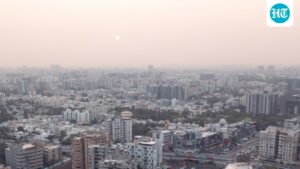
Why does the western coast naturally receive more heavy rains than Delhi or western Uttar Pradesh? Because of the physics of rainfall.

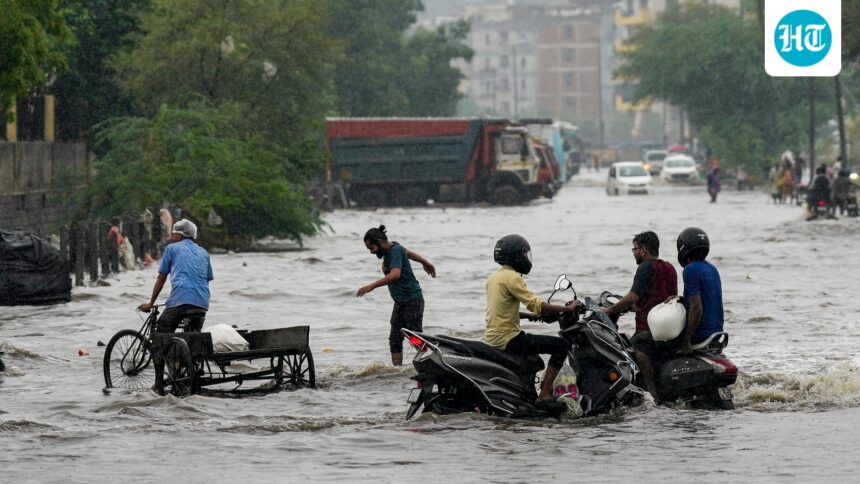
Delhi and neighboring areas have witnessed heavy rains this week, especially since Wednesday. As HT reported on Friday, this was not a record wave in Delhi, but it was still an unusually large amount of rain. Mumbai certainly received more rain than Delhi during the four days ending July 10, and most of Meerut received the same amount of rain as Mumbai. In fact, much of the western coast received the same amount of rain as Delhi and adjoining areas. However, HT’s analysis of gridded data from the India Meteorological Department (IMD) shows that this amount of rainfall is abnormal in the northern regions, and not on the west coast. This highlights some important features of the monsoon.

Here are three maps that illustrate this.
That Meerut’s rainfall is on par with Mumbai’s can be seen from the accompanying map of rainfall for the four days ending July 10 (IMD counts the 24-hour period ending at 8:30 am on the day as rainfall on that date). Delhi averaged around 30 mm rainfall per day in this period, which the IMD classifies as ‘moderate’ rain. However, some areas to the east and northeast of Delhi, such as Meerut and Muzaffarnagar, received more than 64.4 mm of rainfall, which the IMD classifies as different categories of heavy rainfall. Large parts of the West Coast received moderate rains such as Delhi, while Mumbai and adjoining areas received varying levels of heavy rainfall.

While both the western coast and the northern Indian pocket have witnessed moderate to heavy rainfall on average over the past four days, it has been more erratic in the former than in the latter. This can be seen by comparing the rainfall of the past four days with the 1971-2020 average for these four days. The IMD currently considers the 1971-2020 average as the long period average (LPA) to ascertain the extent of unusual rainfall. Comparison with LPA shows that rainfall in Delhi was about five times the LPA in Delhi and about 11-12 times the LPA in Meerut and Muzaffarnagar. On the other hand, rainfall was relatively more than usual on the West Coast: only about 1.5 to 2 times the LPA in places where average rainfall was moderate. In Mumbai, the rate was only about 2.5 times the LPA. Even in Thane and Pune, where the rains were heaviest, it was 6-8 times, not 11-12 times as in Meerut.

Why does the western coast naturally receive more heavy rains than Delhi or western Uttar Pradesh? Because of the physics of rainfall. Precipitation first needs air humidity. This is more readily available on the west coast due to its proximity to the sea than in landlocked places such as Delhi and western Uttar Pradesh, where local moisture supplies are less and external moisture arrives from the distant Bay of Bengal. This is one of the reasons why moderate to heavy rainfall is more common in places on the west coast than in places near Delhi.
Humidity in the air is certainly a necessary, but not a sufficient condition for precipitation. For example, there are several days in the monsoon when the air is humid or saturated with water vapor (commonly called humidity), but it does not rain. This is because rain is water (the liquid state of water) and not water vapor (the gaseous state of water). For rain to occur, water vapor must cool to the liquid state of water. A common example is the appearance of beads of water on a refrigerated bottle of cold drink kept outside on a humid day. Since there are no cooler bottles in the atmosphere, the moisture is cooled differently: by rising into the air. When air pressure drops, humidity rises, as temperatures are cooler, and condenses to form rain. Even this rise has support on the West Coast. The hills of the Western Ghats act as a barrier to the humid winds blowing in from the sea, leaving the winds with no choice but to rise. This is another reason why moderate to heavy rainfall is more common in places on the west coast than in places near Delhi. This also explains why the hilly areas in the north receive less rain compared to places near Delhi.
Obviously, Meerut and Delhi are not as rainy as Mumbai and Pune. So how did this happen? Meerut and Delhi may not have hills like the Western Ghats, but that is no barrier to low pressure. This is exactly what made these places rain this week. As the accompanying map shows, the area around Delhi and Meerut saw some of the lowest pressure levels around July 9, when rains were heavy. That’s why it rained like the west coast here around that time.