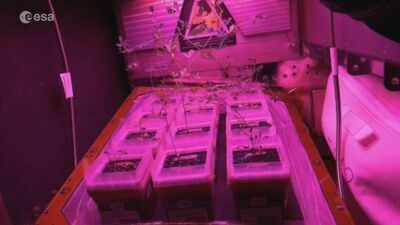
The pink light visible in recent time-lapse shots from the International Space Station is not a camera effect or a reflection from Earth. Instead, it comes from a small plant-growing facility inside the station’s Columbus Laboratory, where astronauts have been tending crops as part of an ongoing experiment into how plants behave outside our planet.ESA astronaut Sophie Adeno recently provided a closer look at the project in a post shared on X, describing the brightly lit room known as Veggie as the station’s “little space garden.” She explained that the unusual purple glow comes from specialized lighting designed to support the growth of plants in orbit. According to the European Space Agency (ESA), the facility was used during Expedition 74 to host a study looking at how plants evolve in microgravity and how they interact with beneficial microbes.
International Space Station scientists study plant growth in space
Space stations are not places most people associate with gardening. However, for years scientists have been experimenting with growing vegetables and other crops in orbit, hoping to learn how future crews could produce food during long-duration missions.The latest investigation focused on clover, a flowering plant widely grown on land for animal feed and soil improvement. According to the European Space Agency, the experiment sought to understand how alfalfa works in conjunction with naturally occurring bacteria that can convert atmospheric nitrogen into compounds that plants can use.
This process is routine in Earth’s ecosystems, but conditions aboard the station are very different. Without gravity’s influence on root growth, water movement and plant development, researchers are interested to know whether these biological partnerships would continue to work in the same way.
Plants grown in space may develop differently under microgravity; Scientists find
The project, known as Veg-06, was not limited to nitrogen-fixing bacteria. The researchers also wanted to examine changes in lignin, a structural material found in plant tissue.Lignin acts as a kind of natural support system, helping stems stay upright and giving plants their toughness. On Earth, gravity plays a constant role in shaping how these structures evolve. In orbit, where this force is largely absent, scientists have the opportunity to study whether plants structure themselves differently.The answers could help researchers better understand plant biology under unusual conditions, while providing insights relevant to agriculture on Earth.
Researchers study structural and chemical changes in plants grown in space
The alfalfa crop has completed its growth cycle on board the station. According to the European Space Agency, astronauts harvested the above-ground parts of the plants and their roots before placing the samples in cold storage.These samples were later returned to Earth aboard SpaceX’s CRS SpX-34 cargo mission, where researchers will perform detailed analysis that cannot be done on orbit.The work is now moving from the station’s growth room to laboratories on Earth, where scientists can compare plants grown in space with their counterparts on Earth and look for subtle differences in structure, chemistry and microbial activity.
Space gardening provides scientific and psychological benefits to astronauts
While the research is aimed at future exploration, astronauts often talk about plants in more personal terms. In her post on
This sentiment reflects a broader theme that has emerged from years of plant studies in space. Green leaves, soil-like scents, and organism care routines can provide a familiar connection to Earth within a highly engineered spacecraft environment.According to the European Space Agency, the ability to grow fresh food may eventually become an important part of missions beyond low Earth orbit. Besides the nutritional benefits, researchers are also interested in how growing plants can support crew well-being during voyages that can last months or even years. For now, the glowing pink room remains a small corner of the International Space Station.