Following up on his “2+6=8” analogy in Indonesia, Prime Minister Narendra Modi once again used mathematics for goodwill, this time in Australia, where he talked about how the two countries can become stronger together.

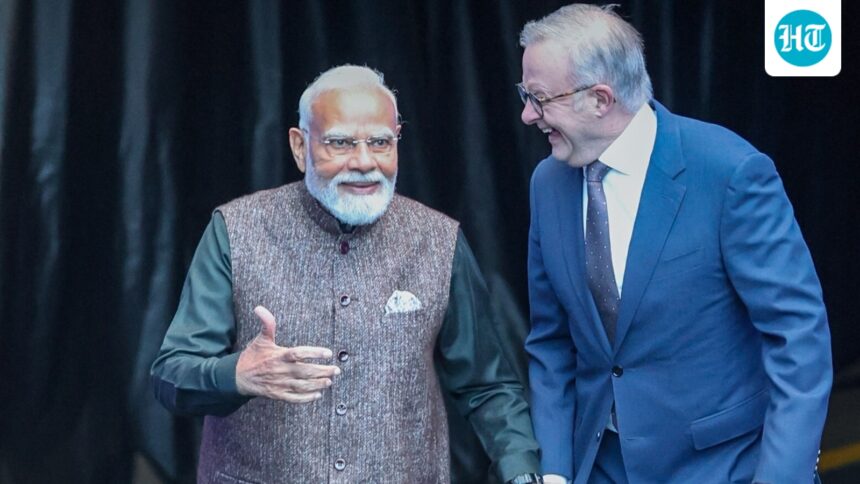
“If one is added to one, it becomes two. But if one stands with one, it becomes 11,” Modi told Australian Prime Minister Anthony Albanese as the two sides participated in the annual Australia-India leaders’ summit in Melbourne on Thursday, Indian news agency PTI reported, in a video.
Speaking in Hindi, the Indian leader said, using the language “ek aur ek gyarah”, “In the true sense, today India and Australia are together. That is why one and one do not become two, but one next to one becomes 11 together.”
Al-Albani smiled when the note was translated.
The comment came just days after Modi used another such metaphor during the ASEAN-India Summit and the East Asia Summit in Jakarta, Indonesia, where he described the relationship through what he called the “2+6+8” formula.
At an Indian diaspora event in Jakarta, after Indonesian President Prabowo Subianto said eight was his lucky number because he is the country’s eighth president, Modi built on the theme by pointing out that India’s Republic Day falls on January 26 — “2 plus 6 equals 8” — and that Prabowo’s birth date is 17 — “1 plus 7 equals 8.”
He also used this framework for relations between India, Indonesia and the Association of Southeast Asian Nations (ASEAN), using numbers to symbolize different aspects of the bilateral relationship. Modi said the number ‘2’ represents the shared commitment of India and ASEAN to peace and prosperity. The number ‘6’ symbolizes six decades of ASEAN’s journey and six years of India’s East Policy Act entering a new phase; While the number “8” refers to the eight basic pillars of cooperation that will shape future engagement.
Earlier, while addressing the Indian community in Trinidad and Tobago during a visit earlier this month, Modi made another numerical comparison, noting that “five plus five equals 10, but in cricket it becomes a century,” referring to the enthusiasm of the crowd and the sporting passion shared between the two countries.
Major visit
The visit to Australia represents the last leg of Modi’s recent three-nation tour, which included events in Indonesia and New Zealand, where he is heading next.
In Australia, Modi and Albanese held wide-ranging talks covering defense and security cooperation, economic relations, education, renewable energy, critical minerals, maritime security and people-to-people ties.
Recognizing critical minerals as the cornerstone of future economic cooperation, the two sides agreed to deepen cooperation in securing reliable supply chains for lithium, cobalt and rare earths, which are seen as essential for clean energy technologies and advanced manufacturing.