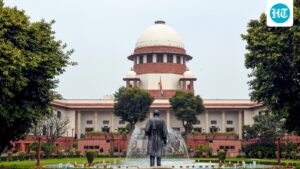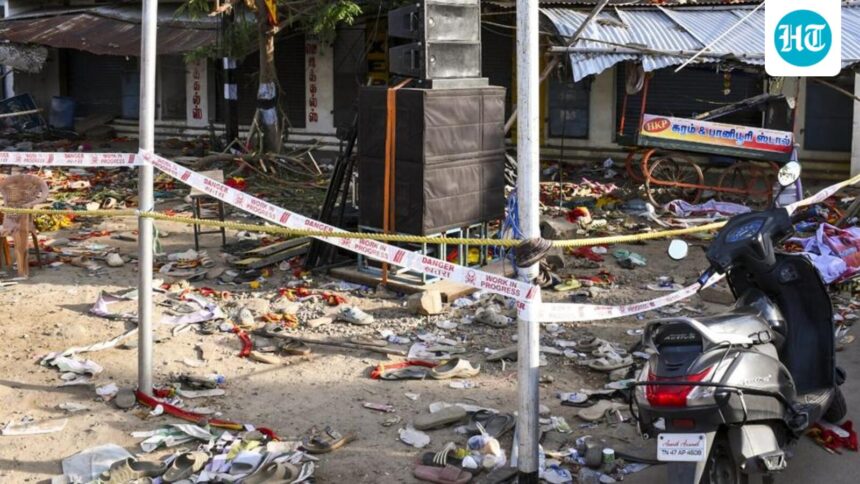
The Supreme Court will on Tuesday hear a petition filed by the Dravida Munnetra Kazhagam (DMK) alleging that ministers in the ruling Tamilaga Vetri Kazhagam (TVK) government, accused in last year’s Karur stampede case, are influencing witnesses in the court-monitored Central Bureau of Investigation (CBI) probe.

A bench of Justices Ehsanuddin Amanullah and Shail Najo approved urgent listing of the application after senior advocate Huzaifa Ahmadi mentioned it on behalf of DMK Rajya Sabha MP RS Bharathi.
Ahmadi told the court that with TVK assuming power in Tamil Nadu in May this year, the integrity of the investigation into the Karur stampede on September 27, 2025 had been compromised.
Ahmadi added, “Some of the defendants in the case are now ministers. They are influencing witnesses. There are serious concerns that this will affect the ongoing investigation. The next date in the case is July 10.” The stampede killed 41 people and injured more than 100 others.
Accepting the request, the court adjourned the matter for hearing on Tuesday.
The stampede occurred during a rally addressed by TVK president C Joseph Vijay, who is now the chief minister of Tamil Nadu.
In his application, Bharati alleged that after coming to power, the TVK government proposed distributing government jobs and other benefits to the families of stampede victims, while the ministers accused in the case made public statements that threatened to jeopardize the ongoing investigation.
The petition noted that, considering the seriousness of the incident, the Supreme Court had ordered a probe into the CBI in October 2025. Being dissatisfied with the state probe, the court also ordered the investigation to be monitored by a three-member supervisory committee headed by former Supreme Court judge Justice Ajay Rastogi.
Describing the current situation as an “exceptional circumstance”, the application said: “Now, after coming to power, the state government proposes to provide more benefits, including compassionate appointments and other welfare measures, to the same families, who are also material witnesses in the CBI investigation.”
“In these exceptional circumstances, where the investigation is still pending, any direct interaction with these key witnesses by persons associated with the subject of the investigation or by the political executive currently in office, especially during the distribution of benefits arising from the incident itself under investigation, could raise concerns, whether real or perceived, regarding the integrity and independence of the investigative process,” the petition added.
The DMK made it clear that it is not opposed to compensation or government jobs to the families of the victims but said such measures should be implemented only with the safeguards directed by the Supreme Court and after consultation with the CBI to ensure the integrity of the investigation.
The application also referred to a recent speech by state Public Works Minister Aadhav Arjuna, an accused in the case, in which he blamed the previous DMK government for the deaths and vowed to settle scores even though the investigation is ongoing. The petition said that such statements are capable of influencing witnesses and undermining the investigation monitored by the court.
The application also sought directions restraining Chief Minister Vijay, Minister Arjuna and other accused or persons connected with the investigation from making public statements attributing criminal liability or commenting on the merits of the pending investigation. It also urged the court to direct the CBI to examine Arjuna’s letter as an attempt to interfere in the investigation.
While ordering the CBI to conduct an investigation, the Supreme Court observed that the tragedy, prima facie, appears to have resulted from the failure of the Tamil Nadu Police to take adequate precautions. The court noted that permission was granted to hold the march at a location connected to a national highway despite similar requests being previously rejected on safety grounds, and found that the police failed to ensure adequate crowd control measures were taken. It also noted that the “political connotations” surrounding the case had eroded trust in the state’s investigation, making an independent investigation necessary.