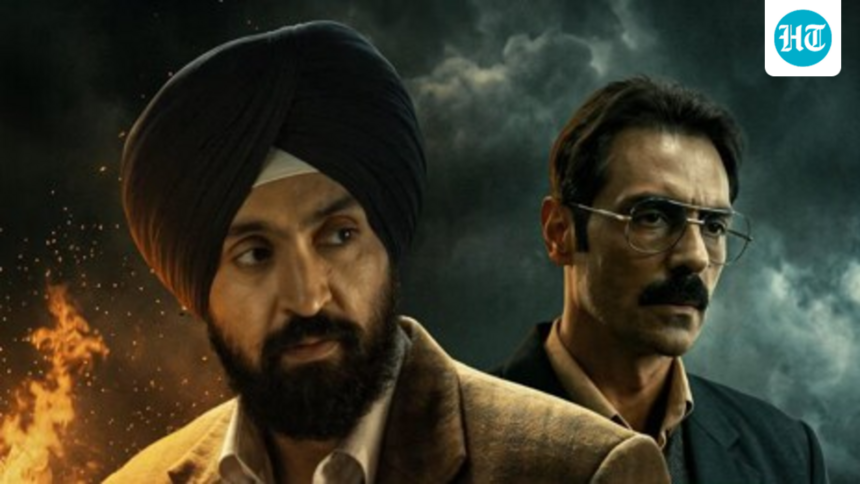
Satluj features Diljit Dosanjh as Jaswant Singh Khalra, who investigated the alleged secret burning of thousands of bodies during the years of militancy in Punjab.

For nearly three years, director Honey Trehan’s biopic on human rights activist Jaswant Singh Khalra has been locked in an uphill battle with India’s Central Board of Film Certification (CBFC).

Originally titled Galogara And then Punjab 95The film came under intense scrutiny when the censor board demanded more than 120 deletions, Gulf News reported.
On July 3, the makers seem to have overcome the theatrical blockade and dropped the complete uncut film directly on ZEE5 under the new title. Satluj. But the victory was incredibly short-lived. Just two days after its OTT premiere, the Diljit Dosanjh film has been pulled from the streaming platform for viewers in India.
“In light of the current developments… Satluj “It will not be available in India until further notice,” ZEE5 said in a statement. “We are committed to exploring all appropriate avenues through due process to return the film to our audiences at the earliest opportunity. Our commitment to creators and stories told with conviction, artistic integrity, and purpose is unwavering.
Read also | Satluj director Honey Trehan remains optimistic even after Diljit Dosanjh hero removed from Zee5: ‘God’s will is sweet’
What is it Satluj on?
The backlash against the film has to do with its crude subject matter. Satluj It features actor-singer Dosanjh as Jaswant Singh Khalra, who investigated the alleged secret burning of thousands of unidentified bodies during the years of militancy in Punjab.
The film is set during the period of insurgency and counterinsurgency in Punjab between the 1980s and mid-1990s, and explores allegations of extrajudicial killings, kidnappings by authorities and human rights violations during this period, according to PunjabDisappeared.Org.
What happened in Punjab at that time
This friction dates back to the partition of India in 1947, which divided the Punjab region and left the Sikh minority feeling politically marginalized.
By the late 1970s, these demands had been formalized in the Anandpur Sahib Resolution, a document demanding greater economic self-sufficiency, political freedom, and control over religious affairs within India’s federal structure.
The central government rejected the decision and said it was a separatist and subversive document.
By the early 1980s, peaceful protests for these demands gave way to mass arrests. This eventually led to a cycle of armed violence in Khalistani, followed by a government crackdown.
Read also | Sukhbir Badal condemns Diljit Dosanjh’s Satluj ban on Zee5 India: ‘An assault on freedom of expression’
Assassination of Indira Gandhi
This accelerated after the assassination of former Prime Minister Indira Gandhi in October 1984 by two of her Sikh bodyguards. The attack was in response to Operation Blue Star, a military operation ordered by Indira Gandhi from 1 to 10 June that year.
This was to remove militants led by Jarnail Singh Bhindranwale who were holed up inside the Golden Temple (Harmandir Sahib) complex in Amritsar. The operation resulted in a large number of casualties, including militants, security personnel and civilians, although the exact numbers remain disputed through various official and independent accounts. Tanks, artillery and infantry participated in the operation, and ended with an attack on the Akal Takht, one of the most sacred Sikh institutions within the temple complex.
In the aftermath, thousands of people were arrested across Punjab, according to a report in Time magazine.
Her death led to anti-Sikh violence in parts of India, especially Delhi, during which thousands of Sikhs were killed by Hindu mobs and their homes burned, the Associated Press reported.

Punjab com. laapataa
During the height of counterinsurgency, security forces, including Punjab Police, Indian Army, and paramilitary units, operated in the state, according to PunjabDisappeared.Org.
Human rights organizations such as Insaf documented thousands of atrocities in more than 12,000 villages at that time.
Security forces routinely carried out arbitrary arrests that quickly escalated into brutal torture. This included mutilation and severe beatings. To cover up these actions, officials often organized “fake encounters” and claimed that suspects had been killed in shootouts when they had actually been executed while in custody.
Sometimes entire families, including children and the elderly, were targeted, and victims’ bodies were often mutilated or secretly burned to remove evidence, according to reports. Thousands of families have been left completely in the dark after their loved ones were abducted by security forces, never to be seen again.
Many of them are still missing to this day. They are known as Punjabis com. laapataa (disappear).
What happened to Jaswant Singh Khalra?
Human rights activist Khalra began investigating when Sikh youth began disappearing from villages, but never returned. His search led him to local cremation sites in Amritsar, where he combed through municipal records, according to Insaf.
It is alleged that thousands of unidentified bodies were found to have been illegally cremated during the years of insurgency in Punjab. He took his findings to the international stage and spoke out against illegal cremations in the Canadian Parliament in 1995.
In September that year, he was kidnapped outside his home in Amritsar, Insaf reported. An Amnesty International report stated that he was threatened by Punjab Police before his disappearance.
Investigators later concluded that Punjab police had kidnapped, tortured and killed him. After a ten-year legal battle, six police officials were convicted in 2005 for their role in the crime.
In 2011, the Supreme Court of India upheld the convictions and life sentences.

Anita Goswami is a Senior Content Producer at Hindustan Times, where she primarily covers Indian and international news. With four years of experience in the field, she has led coverage of Indian general elections, Assembly elections, and national polls in the US, Canada, Bangladesh and Nepal. Its reports cover world wars and major events, including Operation Sindoor, the overthrow of Sheikh Hasina, and the Mahakumbh Mela. It verifies the facts and uses clear sources to ensure the accuracy of the reports. As a former Editor-in-Chief at Storytailors, she has managed teams to produce high-quality content for networks such as NDTV, Profit, CNBC-TV18, Upstox and News18. Her work has appeared on NDTV, Meaww and Global Pulse. Throughout her tenure, Anita has collaborated with and received mentoring from leading industry experts. When she’s not reading, Anita can be found outside or at a bakery. Areas of interest: Indian political history, international elections, and policy analysis History, global conflicts, cultural events, Formula 1, art, media ethics, and reporting on social and political change over time.Read more