Sesame Street It was repurposed for pay TV a decade ago. Reading rainbow It was moved to YouTube last year. until The American experience — winner of 30 Emmy Awards over its 37-year history — was recently relegated to the dustbin of history.
These are certainly dark, dark days for PBS, as the Corporation for Public Broadcasting dissolved itself in January — after Congress cut its funding — leading to devastating budget cuts that rippled across the entire public broadcasting network, forcing some stations, like WNJN in New Jersey, to close entirely.
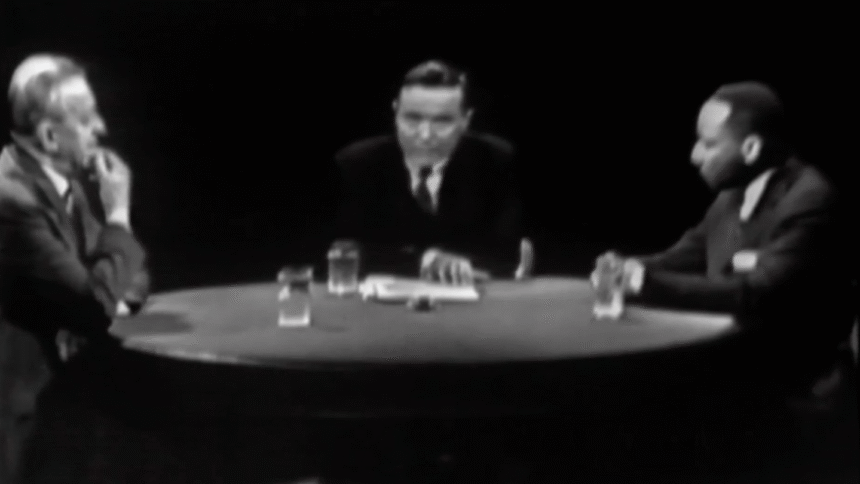
And yet, despite all that, there is a small, humble remnant of the cathode tube that has been broadcasting into homes since the dawn of educational television – Richard Hefner Open mindthe cheery talk show on which Martin Luther King Jr. gave his first televised interview — is still going. In fact, the show just passed its 70th anniversary, making it the longest-running PBS show in history.
“My grandfather wanted to bring intellectual power to public policy discussions,” says Alexander Hefner, who took over as host after Richard Hefner died in 2013. “He wanted there to be a platform in early television that offered something other than bandits and thieves.”
The elder Hefner, a history professor at Rutgers University, began his non-drama radio interview show in 1953 (its first guest was Eleanor Roosevelt). But in 1956, as Richard Hefner saw television asserting its increasing dominance of culture, he began broadcasting from a local NBC affiliate, presenting his 30-minute talk show live. A decade later, in 1966, he moved elsewhere Open mind to Channel 13, a New York public television station he had helped launch five years earlier, which by 1970 had become the forerunner of the newly launched National Educational Television Network, the precursor to PBS.
However, wherever he broadcast the show, the vibe was always the same – strongly intellectual. Each week, guests like Thurgood Marshall, Malcolm

“No answer was too complicated or too long,” says Alexander Hefner. “He always gave his guests time.”
Surprisingly, Richard Hefner’s reputation for honest, civil discourse has put him in the spotlight in Hollywood, of all places. In the mid-1970s, MPAA president Jack Valenti, looking for a way to add some cerebral heft to his organization, convinced the elder Hefner to join and chair its classification board. It didn’t quite fit. Richard Hefner famously complained: “My mother didn’t raise me to count nipples.” But he spent the next 20 years counting something: he was responsible for the events of 1983 Scarface Initial X rating (for violence), and later, in 1990, to launch the MPAA’s NC-17 rating.
However, his television show, as well as his teaching, was always his main focus, and he continued to give high-profile interviews until his death – and even posthumously. “He always had episodes in the box, so there were episodes that aired after he died,” his grandson says.
Alexander Hefner, who had some experience in broadcasting — while an undergraduate at Harvard, he covered the 2008 presidential election as one of CNN’s “youth correspondents” — took over. Open mind In 2014. He has been following in his grandfather’s footsteps ever since. To celebrate the show’s 70th anniversary this year, for example, he’s put together a series of non-viral interviews with city mayors from around the world (currently airing on PBS World).
“Whether it was through biology, or osmosis, or a combination of those, I followed his path,” Alexander Hefner says of his grandfather. He instilled in me a sense of civic responsibility, and that’s what happened Open mind “It was everything from the beginning.”