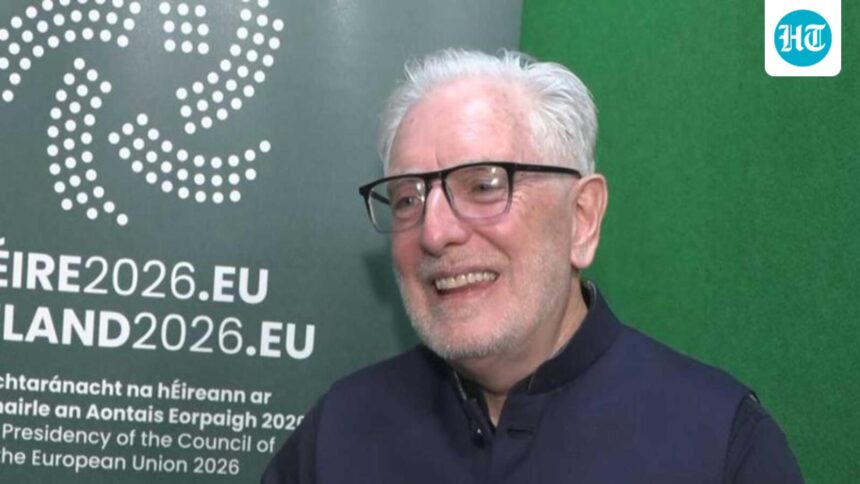
The European Union considers India one of its “most important strategic partners”, with cooperation extending beyond trade to maritime security, technology, connectivity and digital cooperation, Ireland said on Wednesday as it began its presidency of the 27-member bloc.

The ambitious India-EU free trade agreement, negotiations for which ended last January, is expected to be formally signed by the end of the year during Ireland’s six-month presidency of the EU Council. The two sides also participated in deepening cooperation in vital areas such as technology, defense and security against the backdrop of a more transactional approach adopted by the Trump administration in the United States.
“The EU increasingly sees India as one of our most important strategic partners. Our presidency program reflects this, highlighting the importance of the Indo-Pacific region and the priority attached to the EU’s relationship with India,” Irish Ambassador Kevin Kelly told reporters during an event in New Delhi marking the start of Ireland’s presidency of the EU Council.
Besides strengthening the EU Council’s work in supporting progress on the EU-India FTA, the partnership with India “extends beyond trade, to include technology, research, climate action, connectivity, maritime security, resilient supply chains and digital cooperation,” Kelly said. “We are vibrant democracies, major economic powers, and increasingly indispensable partners in confronting global challenges.”
India and the European Union are looking to sign the free trade agreement – which leaders on both sides have described as the “mother of the deal” – by December, so that the agreement could come into force early next year.
At the same time, Kelly made clear that Ireland would remain steadfast in its support for Ukraine, including backing “strong targeted sanctions against Russia,” working to advance Kiev’s path to EU membership, and ensuring Ukraine gets “the funding it needs to defend itself against Russia’s continued unlawful aggression.”
He added that Ireland would also work with its European partners to address the humanitarian crisis in Gaza. He said: “We will push for sanctions on illegal Israeli settlers, call for the suspension of the EU-Israel Association Agreement, and support a just and lasting peace that we hope will lead to a two-state solution.”
Kelly said there was a growing realization on both sides that “what happens in Europe matters to India, and increasingly, what happens in India matters to Europe.” He said this indicates a strengthening of bilateral relations and an understanding that both sides face the same challenges – “how to maintain openness, prosperity and cooperation in a world that is becoming more uncertain.”
He added: “Our future depends on working with reliable partners, and India is undoubtedly one of those partners.”
EU Ambassador Hervé Delphine, who also addressed the media, said Europe has been “China-shocked” and is “confronting an America that is more America-first, more transactional, and certainly challenges the basic assumptions on which we build our transatlantic relations.”
Coming from different perspectives and geographies, the EU and India have “re-adjusted to this new world” and are focusing on strategic independence, Delphine said. “Strategic independence does not mean that you do everything alone… You cooperate whenever you can, and you have to act independently when you have to,” he said.
In the context of the international community’s current focus on free and safe maritime passage after the closure of the Strait of Hormuz, Delphine said that freedom of navigation and unhindered trade are taken for granted as essential elements of the globalization of trade. “This is no longer normal… It started in the South China Sea. You saw it in Hormuz and you will see it elsewhere. I think this should really call the EU and India to act.” [have] “Think more deeply about the implications of that,” he said.