The case of rape and murder of Kashmiri nurse Pandit Sarla Bhatt in 1990 during the early years of the struggle in Jammu and Kashmir remained unsolved for more than three decades.

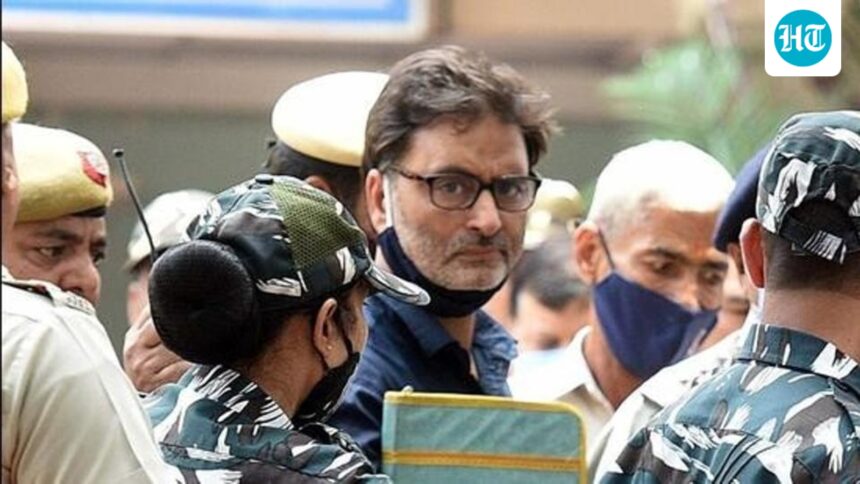
The state investigation agency on Monday filed a 737-page charge sheet against banned JKLF chief Yasin Malik and four others. The document was submitted before a competent NIA court, 36 years after the case went cold during the peak of militancy in Jammu and Kashmir.
Read also | An indictment was filed against Yasin Malik in the 1990 rape and murder case of Sarla Bhatt
Sarla Bhatt rape and murder case
Sarla Bhatt, a young nurse, worked at Sher-e-Kashmir Institute of Medical Sciences (SKIMS) in Srinagar.
On the night of April 12, 1990, she was returning from the hospital to her hostel inside the SKIMS campus when the terrorists kidnapped her in a white Maruti car.
Investigators say she was detained, physically tortured and raped before being shot dead. Two or three days later, her abused and bullet-riddled body was found dumped on a road in Srinagar, HT reported earlier.
A handwritten note recovered from her body claims that the Jammu and Kashmir Liberation Front (JKLF) killed her for allegedly being “informer“(Police informant) for the Criminal Investigation Department.
Investigators have since said they have found no evidence that she worked as an informant.
According to her family, Bhatt was tortured before she was killed. They said her body showed cigarette burn marks on her wrists and neck, according to a report in The Print.
This case became one of the incidents that created fear among Kashmiri Pandits during the rebellion and allegedly led to the exodus of the community from the valley.
Read also | 29 killed in Pakistani ground operations in Afghanistan, a day after the terrorist attack in Karachi
Why did the investigation stop?
The FIR was registered in 1990 under the provisions of the Murder, Criminal Conspiracy, Terrorist and Disruptive Activities (Prevention) Act. As militancy reached its peak, the investigation made little progress.
According to an SIA official, police officers were reluctant to pursue terrorism cases because of the security situation, and many investigators themselves became targets of terrorist attacks.
As Kashmiris left the Valley, many of these cases gradually moved into “cold storage”.
Investigators later found several holes in the original investigation. Weapons recovered from suspected terrorists were not matched through ballistic screening.
The handwriting on the note found with Bhatt’s body has not been analyzed, according to investigators. Important interrogation records were also reported to have disappeared.
Witnesses have died, disappeared or become difficult to find more than 30 years later.
The case is reopened
In 2017, the Supreme Court refused to reopen several Kashmir Pandit murder cases, stating that the mass killings had occurred more than 27 years ago and it was difficult to gather reliable evidence and witnesses, according to a report in The Indian Express.
Later, groups of Kashmiri Pandits approached Jammu and Kashmir Lieutenant Governor Manoj Sinha. In 2023, he instructed the police to prepare a list of murders that occurred in the 1990s. Sarla Bhatt’s case was later transferred to the CIA in March 2024 for fresh investigation.
The agency reopened the investigation, carried out raids, examined new evidence, and eventually filed the indictment.
Read also | Delhi Red Fort blast: NIA charges founder of terror group and two others
SIA fee list
The agency described the indictment as a “historic milestone” in the pursuit of justice for victims of terrorism.
The agency said in a statement that the investigation was based on oral, documentary, forensic, ballistic, medical and electronic evidence collected and analyzed over the years.
“The filing of the chargesheet after nearly 35 years marks a historic milestone in the pursuit of justice for victims of terrorism and represents one of the most important achievements in the investigation into age-old terrorism crimes in Jammu and Kashmir.
“More importantly, the indictment sends a strong and unequivocal message that time can never become a shield for terrorism. No matter how many years have passed, those responsible for terrorist atrocities will remain accountable before the law,” the agency said.
Who was named?
Other than Malik, the charge sheet names Khurshid Ahmad Chalko, Abdul Hamid Sheikh, Ghulam Muhammad Tablo and Muhammad Yusuf Sofi as the accused, HT reported earlier. According to the ISI, Chalko is believed to be living in Pakistan after fleeing Kashmir. Three of the accused have now died, while Malik is in judicial custody in another case.
The accused have been booked under several provisions of Ranbir Penal Code, Terrorist and Disruptive Activities (Prevention) Act (TADA) and Arms Act.
The agency said its investigations found that Malik, who was then the main commander of the Jammu and Kashmir Liberation Front, and the other accused were involved in planning and carrying out the kidnapping and murder. She also said that declaration proceedings had been initiated against fugitive accused Khurshid Ahmad Chalko, whom investigators identified as the shooter.
(With inputs from ANI, PTI and HT correspondents)