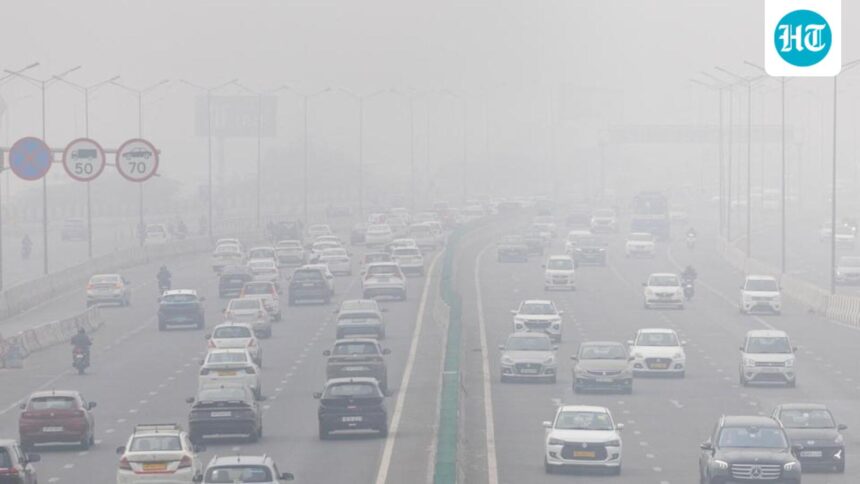
The Ministry of Road Transport and Highways (MoRTH) is preparing to tighten vehicle emissions enforcement, shifting focus from static laboratory test results to monitoring actual on-road emissions throughout a vehicle’s life cycle, Additional Secretary Mahmood Ahmed said on Monday.

“Real-world emissions differ markedly from the emission norms that a vehicle adheres to,” Ahmed said at an event to launch a report on sustainable freight movement by IIT Delhi, TERI and the Air Pollution Action Group (A-PAG).
The official pointed out that factors such as driving conditions, road slopes and driving behavior lead to emissions that are significantly different from those recorded during type approval tests.
The government introduced Real Driving Emissions (RDE) testing after BS-6, under which some vehicles are taken for sample tests and driven under actual road conditions and not just in laboratory settings.
“This has given us a lot of learning and is a big contributor to how we design the BS7 emission norms,” Ahmed said, adding that the government hopes to notify BS-7 this year and give manufacturers time to comply with the new norms.
Ahmed said the ministry is working to strengthen the country’s pollution control system ahead of the 2026 winter season, while acknowledging the shortcomings of the current Pollution Under Control (PUC) certificate system.
“There are a lot of loopholes in the way the GNU system is run across the country,” he said.
According to Ahmed, the proposed changes include geo-tagging vehicles in testing centers, comprehensive encryption of emissions data, and the mandatory insertion of the test probe into the vehicle’s exhaust pipe, in addition to eliminating the manual entry of emissions data to reduce the risk of tampering.
The ministry is also redesigning testing equipment and considering stricter enforcement measures, especially in Delhi and the National Capital Region.
He said: “We hope that in the next two months, and certainly before the start of winter, we will try to come up with this notification, which takes the pollution control system to another stage.”
Ahmed said heavy vehicles remain a priority because although trucks and buses account for only about 2.5-3% of the country’s vehicle fleet, they contribute about 35-36% of transportation-related PM2.5 emissions, making clean freight movement crucial to improving air quality in Delhi-NCR.
Ahmed also referred to the recently approved Parivarthan Scheme as part of the government’s broader strategy to reduce pollution caused by heavy vehicles in Delhi and the National Capital Region. the $The Rs 9,585-crore scheme, approved by the Union Cabinet earlier this month, expands concessions and subsidies to incentivize truck and bus owners registered in the Delhi-NCR region to replace their vehicles with BS-VI or more stringent emission-compliant vehicles, or electric vehicles (EVs).