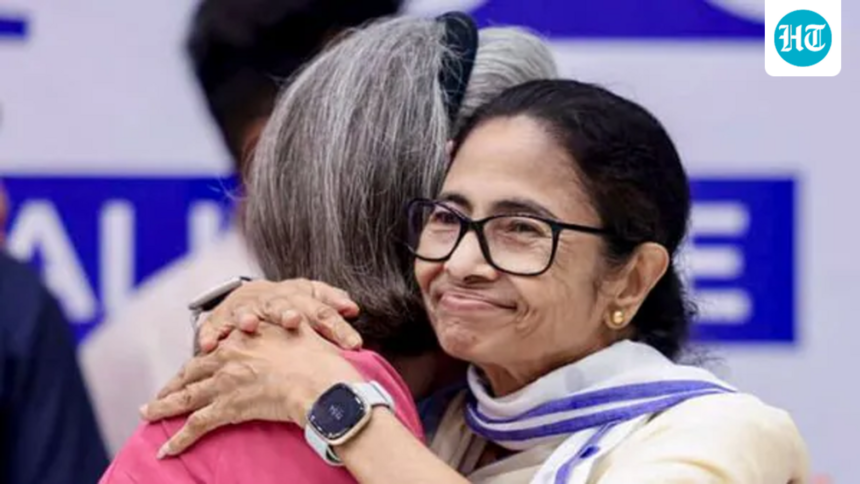
Politicians have a way of sending messages. Behind every handshake and hug lies a reason. One such warm embrace made headlines when Congress leader Sonia Gandhi met former Prime Minister Mamata Banerjee this month. The meeting coincided with a series of walkouts from the crisis-hit Trinamool Congress (TMC) after it lost power in West Bengal in May after 15 years.

This was not the first time that Gandhi and Banerjee had met warmly. Clearly, Gandhi was not content with consoling the beleaguered Banerjee, who left Congress in 1998 to form the TMC. It pushed for unity, sparking speculation about a merger of the breakaway faction with the Congress.
The merger will not only save the TMC but will also breathe new life into the Congress in West Bengal, potentially creating a semblance of opposition against the Bharatiya Janata Party (BJP). The Left parties, which were annihilated by the TMC along with the Congress during its 15-year rule, have shown no signs of recovery.
The two parties must overcome structural obstacles to any successful merger, years after Banerjee, known as a street fighter, became West Bengal’s first chief minister, thanks to her resilience and overcoming a serious head injury she sustained during a public protest against the Left Front government in the 1990s. The merger may or may not happen, but Gandhi’s embrace paved the way for greater synergy between the two parties.
In 2018, Gandhi embraced Bahujan Samaj Party leader Mayawati at Kumaraswamy’s swearing-in ceremony as Karnataka’s chief minister, where non-BJP leaders gathered to display their unity, which was short-lived.
Gandhi showed special affection towards women leaders. In 1999, she drove to Mayawati’s house with a bouquet of pink flowers on her birthday, three years after the BSP leader quit the Congress after contesting the 1996 Uttar Pradesh assembly elections together. Pink is Mayawati’s favorite color. She wears pink on her birthday.
In 2003, Gandhi sent a bouquet when BSP founder Kanshi Ram was hospitalized. Gandhi followed up with a phone call to Mayawati to inquire about her guru’s health.
Political hugs and handshakes have been part of India’s political culture. Friends-turned-rivals Nitish Kumar and Lalu Prasad Yadav embraced in Patna before contesting the 2015 Assembly elections in alliance with the Congress party. The alliance outmaneuvered the BJP even when it returned to power with a full majority on its own at the Center a year ago. Yadav Kumar’s embrace was seen as an end to the 20-year-long cruelty and a return of the social alliance between the Kurmis and Yadavs. The two soon parted ways and are now declared rivals once again.
Before the 2014 national elections, Sonia Gandhi shared the stage with Sharad Pawar at a rally in Bhandara in Maharashtra, marking the reconciliation between the two leaders. Pawar defected from the Congress Party in 1999 and formed the Nationalist Congress Party in the same year over Sonia Gandhi’s foreign origin issue. There was talk of the NCP faction led by Sharad Pawar merging with the Congress.
The NCP founder lost his party after his nephew Ajit Pawar split it and allied with the BJP. Sharad Pawar is 85 years old and suffering from an illness, while Ajit Pawar died in a helicopter clash this year, leaving his faction literally rudderless. The NCP and TMC, two major splinter factions of the Congress, are now in disarray.
In Uttar Pradesh, which is scheduled to go to the polls early next year, the chaos necessitates a strengthening of the alliance between the Samajwadi Party and the Congress. The Socialist Party has abandoned the old policy of balancing the distance pursued by its founder, the late Mulayam Singh, between the BJP and the Congress.
Yadav avoided sharing the stage with Congress leaders until he attended the ceremony of the former United Progressive Alliance government unveiling his report, flanked by Sonia Gandhi and then Prime Minister Manmohan Singh. Yadav later joined the dinner with senior UPA leaders. When asked about his presence there, he replied: “They showed a lot of respect.” Years later, the response offers one way for Congress to rebuild alliances when many of its once-difficult allies need them more than it does.