Return He returned to television this spring to offer one final critique of the Hollywood machine. After focusing on the comedic anger towards reality television; The ebb and flow of drama pouring out of the writers’ rooms; and the broader landscape of network television. Co-creators Michael Patrick King and Lisa Kudrow, who also star, turned their attention to the AI threat in season three. “One of the main reasons we came back was because of Valerie’s character [Kudrow] “I always had issues with the writer the other two seasons. So the idea of coming back for season three with an Inhuman writer was really interesting,” King says.
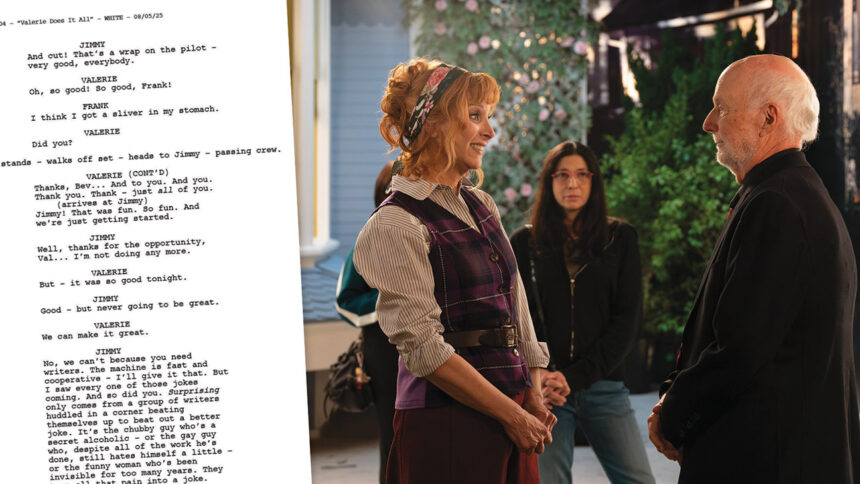
In this scene from the fourth episode of what will be the final season of the HBO comedy, Valerie has just finished filming the pilot for her new show, How is that?! Ever the optimist, she is surprised when director Jimmy, played by famous reality TV director James Burroughs, tells her that the show won’t really be great as long as it’s written by artificial intelligence, illustrating the major tension emanating throughout the season and Hollywood in general.

She says this scene suits Kudrow, because it shows how determined her character is. “It also shows two types of characters,” King explains. “One person who doesn’t need anything from the industry anymore, Jimmy — he’s got it all, he doesn’t need it, and it’s no fun for him — and Valerie, who, no matter how no fun it may be, still needs to put on a great show. She has to work, but she also has to strive.”

Here, Jamie delivers the season’s mission statement, summarizing the roots of all the panic around artificial intelligence in Hollywood. “The part of the speech that I find most resonant is: ‘A bunch of writers in the corner are beating themselves up for making the best joke,’” King says. “There’s a lot in my history of writing sitcoms over the years about the group dynamic of beating themselves up to get the best joke. It’s not a goad. It’s a battle.” “Life is tough, and it gets over people. The great thing about that is that comedy writers can sometimes find a way to turn it into gold,” he adds.

While Jimmy says in the script that the husband-and-wife writing duo, played by Abbi Jacobson and John Early, are no fun, the episode aired without that line. King says they filmed it but ended up taking it out in the editing room. “I thought, ‘Jimmy has worked with a lot of writers who weren’t involved, but they were.’” [especially disengaged]” he explains. “It’s not like Jimmy needs everyone to be in a kumbaya situation, but he needs them to be involved. And all we’ve really seen by the time you see this is that Valerie is fun. And the actors are fun. We were always trying to point out that it wasn’t them. It was a situation that wasn’t right for him.

What Valerie wants, Kudrow says, is for the AI to be able to write better, write more surprising jokes, and return her to being a supreme comedic force. “He says to her right before he leaves, which is the killer line of the scene, ‘It’s too bad, this could have been the thing,'” King says. “Valerie has been looking for ‘the one’ for a long time now. She was No. 1 on her first show, in the ’90s, and so, she’s on a tractor beam to be recognized as great. … And what she wants is to be seen as ‘Cool, you’re the one.'”

“Like the first season of reality TV — and Michael has written some hilarious reality TV shows that we then couldn’t believe happened with our own eyes — we’re not trying to predict, we’re trying to reflect what fear is, what it’s about,” Kudrow says of how Hollywood portrays AI in action. “We had one thing we wanted to do,” King adds. “The big threat we faced was that we wanted to be on the air before any studio would admit they were using it.”

Up to this point in the season, bringing AI into the production process of a TV show had not been directly accessible to Valerie. “But it will continue to do so,” Kudrow says. “It became clear to her that she needed a writer, and that you needed a series director who was a writer. Because this was too much for her to do.” How Valerie deals with various conflicts — and how that changes from AI impacting her writing to directly impacting her role — was one of the things King and Kudrow were keen to explore. “We talked about it a lot,” King says. “One of the most important aspects of Valerie for us is showing that she is adapting and evolving. Even in a scene that we’re talking about, she hears the truth and then decides, ‘He’s old-fashioned, I’m contemporary.’” When faced with the truth of continuing or stopping or feeling depressed or excited, she will choose the positive.
This story first appeared in the June standalone issue of The Hollywood Reporter magazine. To obtain the magazine, click here to subscribe.