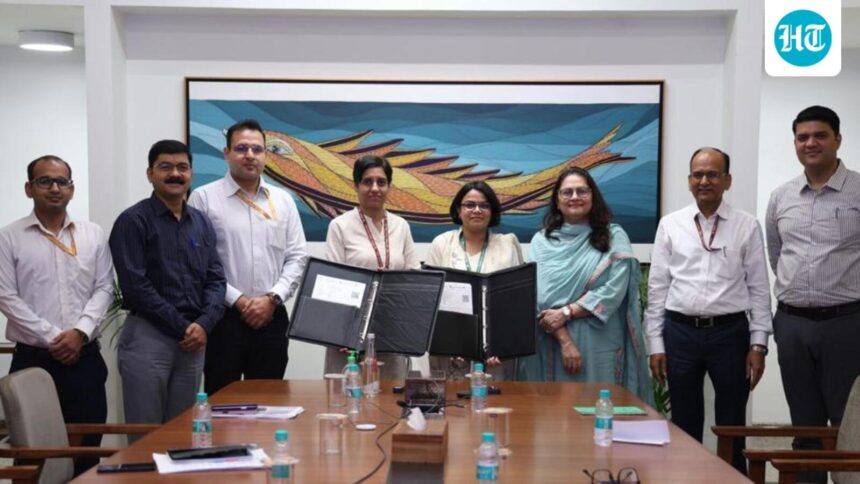
The National Education Society for Tribal Students (NESTS), under the Union Ministry of Tribal Affairs, on Friday signed two agreements aimed at strengthening the Eklavya Model Residential Schools (EMRS) network, in partnership with the Bihar government to improve implementation of tribal boarding schools and with education technology company CoGrad to provide AI-powered academic support to tribal students across the country.

The first MoU, signed with the Bihar Mahadalit Vikas Mission of the state social welfare department, aims to strengthen coordination for planning, establishing and monitoring emergency medical response systems in Bihar.
“Under the agreement, Bihar will receive financial assistance of $100 million $1.47 lakh per student under the EMRS scheme, bringing it in line with other states that have entered into similar agreements with NESTS. Ranjana Chopra, secretary, Ministry of Tribal Affairs, said the appointment of teaching and non-teaching staff will be done through a centralized process to ensure uniform standards and transparency.
“The MoU also provides for the adoption of a common academic framework based on the NCERT (National Council of Educational Research and Training) curriculum and aligned with CBSE (Central Board of Secondary Education) standards, with the aim of improving educational outcomes and expanding opportunities for tribal students in the state,” she added.
Separately, NESTS has signed an agreement with CoGrad (Supervision Educare Private Limited) to deploy AI-driven tools across the EMRS ecosystem. The initiative will support over 9,000 teachers working in 499 functional EMRS systems and is expected to benefit over 1.5 lakh tribal students nationwide, officials said.
As part of the collaboration, CoGrad will provide free access for two years to a customized version of its teacher-focused platform, Medha AI, and train teachers, school principals and academic administrators on its use, a senior ministry official said.
“The platform provides tools for automated testing and creating assessments, planning lessons, creating 3D educational models, and developing teaching and learning materials,” he said, who requested anonymity.
The initiative is in line with the National Education Policy (NEP) 2020 and the government’s broader push for technology-based education, the ministry said. Officials said the twin agreements reflect a broader effort to improve the quality of residential education for tribal students through stronger governance, better infrastructure and greater use of digital learning tools.