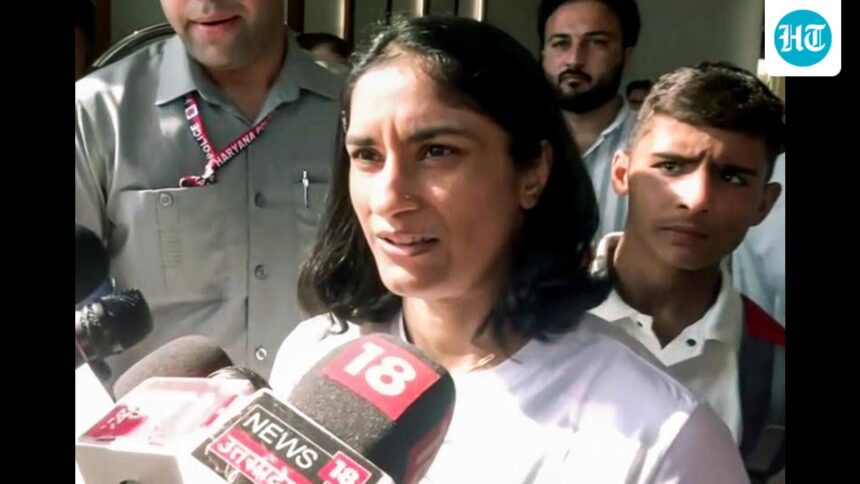
The Supreme Court on Thursday closed the appeal proceedings filed by the Wrestling Federation of India (WFI) against wrestler Vinesh Phogat’s participation in the Asian Games selection trials after she failed to qualify, stating that it should not be considered a “repetition” of the negative observations made by the Delhi High Court against the federation on May 22.

“In view of subsequent developments, the present special leave petition has become frivolous,” a bench of Justices BS Narasimha and Aravind Kumar said.
On 29 May, the Supreme Court allowed Phogat to participate in the trials even as it exempted her from the Supreme Court order declaring FIVB’s refusal to consider the past achievements of prominent players as exclusionary.
On Thursday, senior advocate D N Gobordhan, representing WFI, informed the court that Phogat has been allowed to participate in the trials as per its order. “It didn’t work, and it created chaos there,” Gobourdhan said.
“The order is now over. You can either withdraw this order, or we can reject it as futile,” the judge told Jobourdin. Gobourdhan told the court that the matter still required adjudication as the High Court concluded that WFI’s move to issue a show cause notice to Phogat was “erroneous”, “retrospective” and “unfortunate”.
He urged the Supreme Court to strike out these notices because Phogat’s petition challenging the notice is pending before a single-judge bench of the Supreme Court. “These observations will now bind the single judge,” he said.
The bench then clarified that “hereby, this court should not be deemed to have reiterated the observations of the Supreme Court.” With these observations, the court rejected the appeal.
On May 29, the Supreme Court said it was reluctant to intervene because of Phogat’s background and what she had gained for the country. She said she would examine the Supreme Court order to iron out some wrinkles while hearing WFI’s appeal against the Supreme Court’s May 22 order.
The Supreme Court said the IWF’s selection criteria for the Asian Games, which restricted eligibility to wrestlers who won medals in 2025 while ignoring previous performances, left no discretion for the federation to consider talented athletes like Phogat, who took a sabbatical due to maternity leave. This represents a significant departure from previous practice, she said.
The Supreme Court noted that Phogat’s exclusion from selection trials was directly related to her leave and provisional eligibility requirements. She noted that her maternity and recovery period coincided with the timing of the tournaments necessary to meet the eligibility criteria, which affected her ability to qualify for the trials.
The Supreme Court said on May 29 that it was concerned about the way and manner in which the Supreme Court had interfered with the policy. “The Constitutional Court must know that these are national and international sports. This matter about femininity has no relevance. This kind of approach taken by the courts to intervene has created problems for other similar federations, as we have seen in football, leading to exclusion.”