The Supreme Court has constituted a five-member committee to come up with a uniform definition of the ecologically fragile Aravalli range to regulate future mining activities, and submit a report on conservation of the range by August 31.

The committee will be headed by Indian Council of Forest Research and Education (ICFRE) Director General Kanchan Devi, according to a May 25 order passed by a bench headed by Chief Justice of India (CJI) Surya Kant.
The court said that any course of action adopted must be informed, scientifically sound and consistent with the principles of environmental protection and sustainable development.
The court also asked the committee to keep in mind “diverse and competing considerations” while making its assessment and involve all stakeholders, including the NCT states of Delhi, Rajasthan and Haryana, ecologists, non-profit organisations, mining lease holders, project proponents, villagers, farmers and local communities whose livelihoods are intrinsically linked to the Aravalli ecosystem, among others.
“The proposed commission is expected to objectively evaluate the effects of the intended measures and assist this Court in determining whether their implementation may result in environmental, environmental, or other consequences that may be difficult, if not impossible, to reverse,” the order announced Tuesday said.
Read also: The unusual rise in pollution in summer highlights the Aravallis’ diminishing role as a dust buffer
To be sure, the Supreme Court has already stopped mining across the entire Aravalli region pending the final report and consideration of the HPC.
This case is scheduled to be heard on September 7.
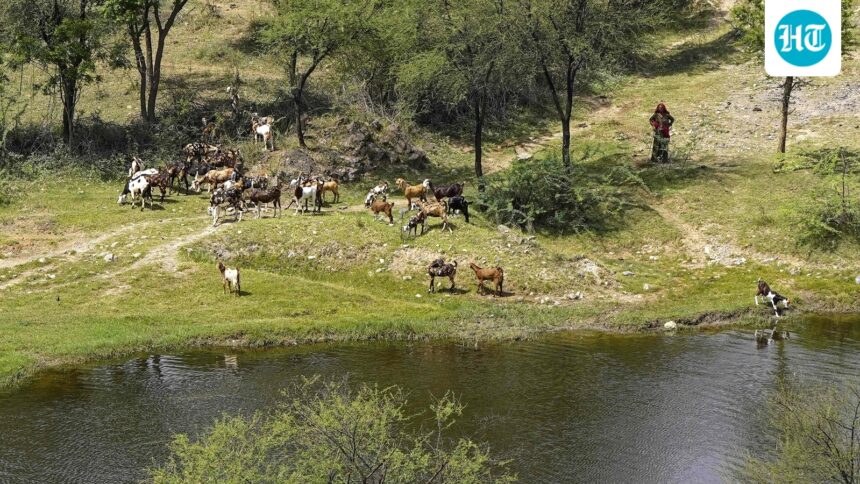
The Aravalli Range is the ‘green lung’ of northwest India and is an indispensable geographical barrier separating the arid northwestern desert from the fertile northern plains. Since 2002, the Supreme Court has regulated mining in the Aravalli region. In 2018, an FSI report exposed illegal mining operations in the region, reporting the disappearance of 31 hills across 3,000 locations in Rajasthan and Haryana.
In November 2025, the Supreme Court laid down a common definition of the Aravalli Hills and Range as proposed by an eight-member committee headed by the Secretary, Ministry of Economy, Finance and Climate Change. The committee stated that any landform located in the Aravalli areas that is 100 meters or more higher than the local topography is called Aravalli Hills. Likewise, it stipulated that two or more Aravalli hills located at a distance of 500 meters from each other would form the Aravalli mountain range.
The order led to widespread criticism and concerns that such a definition would encourage illegal mining and harm the ecological integrity of the Aravalli ecosphere. On December 29, the Supreme Court took suo motu cognizance of the matter and stayed its earlier order. In the same way, the court ruled not to grant any mining license, whether for issuing new lease contracts or renewing old ones.