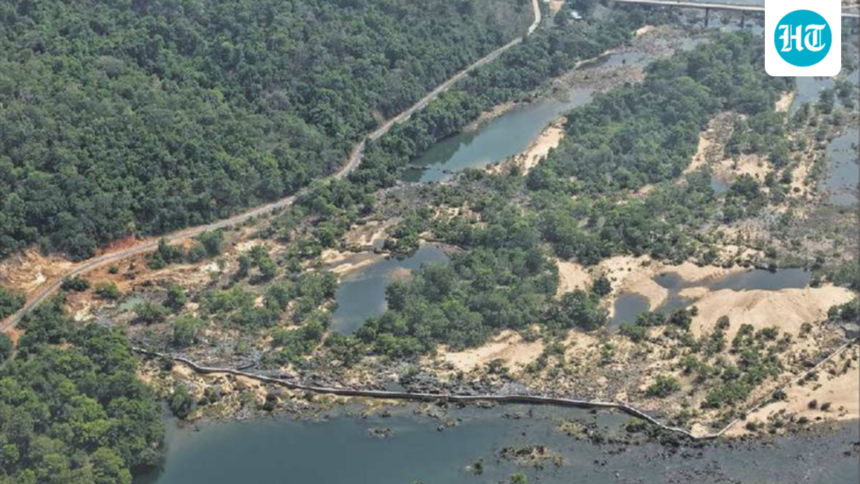
The Chhattisgarh government has resumed a survey for the long-stalled Budghat multi-purpose project on the Indravati river in Dantewada, reviving a dam proposal that could submerge, fully or partially, as many as 56 villages in Maoist-hit Bastar district — and sparking uncertainty among tribal communities who are yet to be told where they will be resettled.

Devesh Dhruv, Dantewada District Collector, confirmed that the survey instructions had been issued. He added: “The goal is to complete the comprehensive survey within seven to eight months. Teams from relevant agencies are constantly visiting the area.”
The multi-purpose Budghat project, managed by the Water Resources Department, is one of the oldest pending river valley projects in Bastar, having been first envisioned in 1979. It received World Bank loan approval in 1984 but was halted in 1987 after protests over displacement, loss of forests and concerns raised by tribal communities.
Efforts to revive the project were resumed in 2020, with a revised detailed project report (DPR) prepared by the Central Public Sector Corporation WAPCOS Limited at a cost of $Rs 34.91 crore — the cost of preparing the report, not the cost of the project itself. The consultant has been given time until 31 December 2027 to complete the DPR. The total cost of the project is estimated at approximately $30,000 Crores.
According to a senior WRD official, speaking on condition of anonymity, the revised DPR project envisages the construction of a dam with a full reservoir level of 452 meters and a height of 67 meters from the river bed, with an estimated total storage of 2,727 million cubic meters and an installed hydropower capacity of 125 MW, expandable to 300 MW.
The official said revised estimates put total inundation at 10,441 hectares covering 36 villages, while broader administrative estimates suggest 56 villages could fall entirely within the inundation zone and nearly 200 villages face indirect or broader impacts. More than 5,700 hectares of forest land are also likely to be submerged or affected.
Officials have certainly not revealed how many people will be affected, although it is likely in the thousands.
The project aims for irrigation, hydropower, drinking water supply and industrial water supply in the Indravati basin. The Indravati River, one of the major tributaries of the Godavari River, originates in the Kalahandi district of Odisha. The revised DPR plan proposes to cover irrigation across a command area of 3.78 lakh hectares benefiting 236 villages in four districts, with a lift irrigation system proposed to ensure availability of drinking water.
The DRC project also includes a proposal to divert water towards the Mahanadi River Basin, providing additional irrigation benefits to farmers in Dantewada, Bijapur and Sukuma districts.
Local tribal groups oppose this. Suresh Karma, president of Sarv Adivasi Samaj, Dantewada, said displacement remains the biggest unresolved challenge and demanded that the government clarify where the affected families will be rehabilitated and what criteria have been set for resettlement.
“More than 50 villages are likely to be affected by the project. If any site is identified for resettlement of such a large number of people, prior consultation and approval of local people is also necessary,” he said, adding that local deities would fall within the inundation zone.
Karma said the affected communities could not see any direct benefit from the project, and no rehabilitation and resettlement plan was offered to the villagers.
Shiv Kumar Mandavi, a resident of Hetalpadom village under Bengaluru panchayat, said villagers are strongly opposed to this as the government has not clarified its stand on displacement and rehabilitation. “Our agricultural lands and livelihoods are tied to this village,” he said. “The government has not yet told us whether we will get land equal to the area affected by the project. It has also not informed us where we will be rehabilitated.”
Mandavi also claimed that in March this year, a group from Telangana had visited villages in the district under the guise of floods and road-related works, but in reality they were conducting a survey for the Budghat project. “They moved around different panchayats for four days to conduct surveys. Their car had ‘Government of India’ written on it. After the villagers protested, they had to return,” he added.
Alok Shukla, organizer of Chhattisgarh Bachao Andolan, said, “The proposed project will not only affect dozens of villages in the submerged area, but will also destroy the dense forests rich in biodiversity, including a major part of the national park area. This project will bring massive destruction instead of development. Since the entire area falls under the Fifth Schedule area, the government should not go ahead with any work without the approval of Gram Sabhas.”
Mandavi said the government should not conduct surveys without informing the villagers and should submit a rehabilitation plan before going ahead.
The district collector said he was not aware of any protests. “I have not heard of any protests so far. There may be concerns among some groups or individuals and they will be addressed in due course. The people of Bastar will benefit from this project and the goal is the well-being of the area,” Dhruv said.