Bengaluru Chief Minister Siddaramaiah on Wednesday received the ‘Social and Educational Survey Report’ prepared by the state Backward Classes Commission in Vidhana Soudha, bringing back focus to the decade-long caste census exercise that continues to shape political tensions in Karnataka.

The report was handed over to Principal Secretary Shalini Rajneesh in the presence of Siddaramaiah by committee chairman Madhusudan R Naik at a time when political uncertainty has gripped the ruling Congress, with speculation growing about a possible change in leadership in the state.
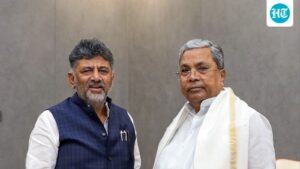
Naik dismissed suggestions that the timing of the filing was linked to developments within the Congress or reports that Siddaramaiah might step down to make way for Deputy Chief Minister DK Shivakumar.
“Some members said they would not be able to come on that date and asked for the matter to be completed early. So we held the meeting on Wednesday. It may be a coincidence that there were some political developments that may have happened, but that has nothing to do with our work,” Naik told reporters.
The submission revives the unresolved political legacy of the 2015 Socio-Economic and Educational Survey commissioned during Siddaramaiah’s previous tenure as Prime Minister. Conducted at reported cost $162 crore, the exercise attempted to map the caste composition of Karnataka through one of the largest state-level census efforts undertaken in the country.
Although the survey was completed years ago, its results became politically explosive after sections of dominant communities, especially the Vokkaligas and Lingayats, objected to the reported demographic estimates and questioned the methodology used during the census.
Figures leaked from the survey indicated that Scheduled Castes account for 19.5% of Karnataka’s population, Muslims 16%, Lingayats 14%, Vokkaligas 11%, while Kurubas make up 7%. The proportion of Other Backward Classes collectively has been estimated at about 20%, with the Scheduled Castes, Scheduled Castes, Muslims and Kurubas together accounting for approximately 47.5% of the state’s population.
These numbers have unsettled long-held political assumptions in Karnataka, where the Lingayats and Vokkalegas have historically remained among the state’s most influential communities in electoral politics and power structures. Opposition to the report grew steadily as leaders from both communities said the findings understated their numerical strength and could affect reservation policy, political representation and allocation of benefits.
Shivakumar, a prominent Vokkaliga leader within the Congress, has publicly supported the demands for a new caste survey rather than accepting the earlier results. The report submitted by the Vokkaligara Sangha on November 15 last year and endorsed by Shivakumar along with ministers and MLAs, directly challenges the credibility of the report.
“The survey is incomplete as the report says they visited 5.4 crore people across Karnataka. As per the Aadhaar figures available, there are 6.9 crore people in the state, so the report is clearly incomplete. If the government accepts this report, it will be unfair to the Vokkaliga community,” the letter said.
The representation further claimed that the survey teams failed to visit every household and instead “fabricated details and figures.”
The stalemate over the report eventually led Congressional leadership to support a second caste survey. Within political circles, some leaders privately interpreted the decision as a way to delay a politically costly conclusion on the original report without formally disposing of it. Others argued that a new practice was necessary to respond to objections raised by influential communities and to create broader acceptance of any future political decisions based on class data.
Naik said the committee completed the survey about six months ago and spent months analyzing the material with the help of experts before finalizing the report. “We were analyzing the survey and preparing the report with the help of experts. The report was ready for about a month. But I prepared it in English. Since the official language of the government is Kannada, it had to be translated, which took a long time,” he said.
According to Naik, the committee initially intended to meet on May 29 to finalize the application, but previously postponed the meeting after some members indicated they would not be available on that date. “All members have already agreed to the report we prepared earlier. Today’s meeting was just to fine-tune it and read it again. At the meeting, everyone confirmed their agreement and said we can move forward,” he said.
He also sought to mitigate expectations that submitting the report would automatically lead to implementation. “When the government receives the report, it may have to put it before the Cabinet. The Cabinet will take a call. Once the Cabinet accepts the report, if it accepts it, it should be made into law through a government order. Or it may come before the House for approval,” he said.
Siddaramaiah has consistently advocated caste census and sided with Congress leader Rahul Gandhi, who at the national level has called for data collection based on caste as a basis for redistribution and social justice.
A congressional leader familiar with the developments said that returning the report to the government may put the next administration in a difficult political position. “Receiving the report will mean that the cabinet will have to discuss it, and that will anger the dominant communities, especially the Vokkalegas, who are represented by Shivakumar. It will be a difficult decision,” the leader said.
(with PTI inputs)