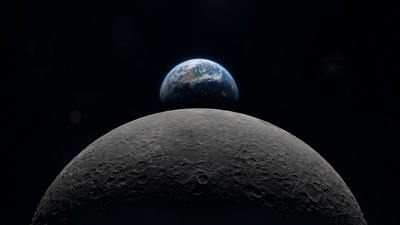
Getting to the moon is expensive. Every kilogram of fuel carried by the spacecraft must be lifted out of Earth, which itself burns more fuel. That’s why aerospace engineers and orbital mechanics researchers spend an enormous amount of time looking for even the smallest efficiencies in how spacecraft travel.
Cutting out a few meters per second here and there can save millions of dollars per job. Now, an international team of researchers say they have discovered just that: a more efficient route between Earth and the Moon, calculated using advanced computer models, and hiding in plain sight all along.
How gravity powers spacecraft free via the interplanetary transport network
To understand why this discovery is important, it helps to understand how spacecraft actually move.
Engines only occasionally catch fire. For most of the journey, spacecraft rely on the gravitational forces of planets, moons and the sun to carry them along natural paths through the solar system. These gravitationally determined paths are often referred to as the interplanetary transportation network, and they pass through the solar system like invisible highways.
Their use is, in fact, free payment.So finding a cheap way to the Moon has a lot to do with gravity, specifically the gravitational forces of both the Earth and the Moon.
Researchers studying these trajectories look for so-called “variables,” which are natural trajectories that guide the spacecraft toward the desired orbit without requiring constant engine thrust. The question is always which part of the variable to enter and from which direction.
The counterintuitive discovery that turns conventional lunar navigation on its head
And this is where this new research took an unexpected turn. Conventional thinking assumed that the most logical approach was to enter the Moon’s orbit at the point closest to Earth, which was the obvious intuitive choice.
But the researchers found that it is better to introduce this variable from the other side. “Instead of assuming that it is easier to choose the part of the variable that is closest to Earth, we can use systematic analysis in faster ways to try to find non-trivial solutions,” said study co-author Vitor Martins de Oliveira, a postdoctoral researcher at the University of São Paulo in Brazil. In other words, walking around turns out to be more efficient than walking straight.
How 30 million simulations led researchers to a more fuel-efficient lunar route
The method behind this discovery has its roots in so-called functional connections theory, a mathematical framework that reduces the computational burden needed to run complex orbital simulations. Using this approach, the team simulated 30 million different routes to the Moon, with 280,000 simulations referenced in their published study. This scope of analysis would have been much more difficult to carry out using older methods, which is partly why this particular path had not been identified before. The newly reported route uses 58.80 meters per second less fuel than the previously cheapest known route. This may not sound exciting, but in orbital mechanics, delta-v, the measure of the velocity change required from the spacecraft’s engines, is the currency of mission planning. Lower delta-v means less fuel, less mass at launch, and lower costs at each phase of the mission.
Why would this new lunar path also eliminate communications blackouts in space?
Efficiency gains aren’t the only advantage. The orbit proposed by the researchers also maintains uninterrupted communication with Earth, something current methods do not always guarantee.
“The Artemis 2 mission, for example, lost contact with Earth for a period of time because it was directly behind the moon,” Oliveira noted. The new path completely avoids this problem, keeping the spacecraft in constant contact with ground stations throughout the flight.
What does the discovery of the Moon’s path mean for the future of lunar space missions?
Researchers are careful to frame this as a beginning rather than a final answer. Their models took into account gravity from the Earth and the Moon only.
Future research could include additional variables such as the influence of the Sun’s gravity, which could lead to more cost-effective paths.“The systematic analysis we applied in our work is something that could be more widely adopted in the future,” said the study’s lead author, Alain Kardec de Almeida Junior, a researcher at the University of Coimbra in Portugal.The study was published in April in the journal Astrodynamics. As private agencies and companies plan an increasingly ambitious list of lunar missions over the next decade, the tools that make those missions cheaper and more reliable will grow in value. It turned out that this person had always been there waiting to be found on the other side.