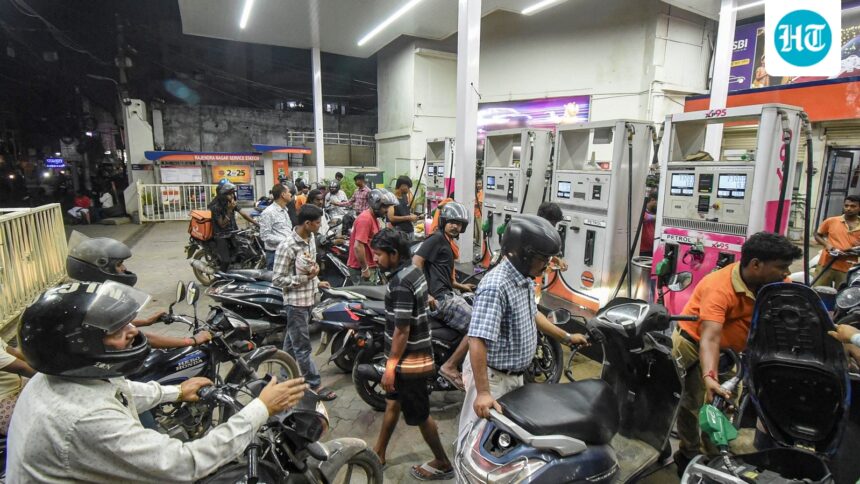
Fuel prices in India have quadrupled in less than two weeks, and experts say another hike cannot be ruled out as the US-Iran war continues to disrupt global energy supplies and keep crude oil markets volatile.

State-run oil marketing companies (OMCs) on Monday ₹2.61 per liter”>Gasoline prices increased by $2.61 per liter and diesel $2.71 per litre, with cumulative increases since May 15 to approx $7.35 f $7.53 per liter respectively.
In Delhi, petrol is now being retailed at $102.12 per liter and diesel at a price $95.20 – The first time in four years that petrol prices in the national capital exceeded the level $100 marks.
path Live updates on petrol and diesel price hike across India
These increases come amid continuing tensions in West Asia following the US-Iranian conflict that erupted in late February. The main reason behind the rise in oil prices was the disruption of traffic through the Strait of Hormuz.
Why does the Strait of Hormuz affect fuel prices in India?
The sharp rise in petrol and diesel prices in India is closely linked to the disruption of the movement of oil through the Strait of Hormuz – one of the world’s most important energy shipping routes. Nearly a fifth of the world’s crude oil and liquefied natural gas supplies pass through the narrow waterway between Iran and Oman, making it vital for countries that rely heavily on imported energy, including India.
In the wake of the escalation of the US-Iranian conflict in West Asia, trade movement through the Strait has been severely disrupted, raising fears of supply shortages in global markets.
The uncertainty has pushed Brent crude prices up sharply, raising costs for India’s state-run oil companies, which import most of the country’s crude oil needs. Since India imports more than 85% of its crude oil needs, any interruption in global supplies or a rise in international prices directly affects domestic fuel prices.
Why experts believe more hikes may follow
Industry executives and energy analysts say the current round of reviews may not be over yet.
According to sector experts, state-run retailers are still trying to recover current revenue losses as well as “recovery shortfalls” accumulated in the past while maintaining price stability despite rising crude oil costs during the early phase of the war and the House of Representatives election season.
Brent crude jumped from about $72.87 a barrel on February 27 to nearly $120 in March after the conflict escalated sharply. Although prices have retreated recently and briefly dipped below $100 amid hopes for diplomacy, analysts say the current crude oil environment is still expensive enough to continue to pressure fuel retailers in India.
Experts who track OMC’s finances estimate that the daily losses were roughly tied $The Rs 1,000-crore tally has come down significantly after repeated spikes, but it has not completely disappeared. Several analysts told Reuters they believe a fifth increase is possible unless Brent crude stays below $100 a barrel for an extended period.
The government had previously hinted at taking difficult decisions
The Center had already indicated earlier this month that fuel price corrections may become inevitable.
Petroleum Minister Hardeep Singh Puri had said that “at some point the government has to take a view” on oil prices amid severe disruptions in global supplies.
Prime Minister Narendra Modi also urged citizens to conserve fuel and foreign exchange by adopting measures such as car sharing, increasing use of public transport and avoiding unnecessary expenses. These messages were widely seen as preparation for prolonged economic and energy uncertainty.
Banker Uday Kotak also warned that India should prepare for a “more complex problem” linked to geopolitical instability and energy security.
Peace talks between the United States and Iran raise hopes, but the siege of Hormuz remains
Recent diplomatic developments have led to a slight decline in global oil prices, with reports indicating continued backdoor talks between Washington and Tehran on a possible ceasefire and reopening of the Strait of Hormuz.
US officials indicated that progress is being made toward a broader agreement that includes reducing regional escalation and restoring energy flows. Former US President Donald Trump has claimed that the framework was “largely negotiated,” although Iranian officials have publicly downplayed some of these claims.
However, the US has also reportedly confirmed that the effective blockade and restrictions around the Strait of Hormuz will continue until a formal agreement is reached. This has fueled expectations that although the road could be reopened after a successful agreement, energy supplies are likely to remain restricted until negotiations are fully concluded.
Currently, trade traffic through the Strait remains severely disrupted, with security risks, insurance concerns and maritime tensions continuing to impact oil shipments. Experts warn that even after a diplomatic breakthrough, it may take some time for normal operations to fully resume.
OMC’s profits raise controversy
The repeated increases have also drawn criticism because the three state-run fuel retailers – Indian Oil Corporation, Bharat Petroleum and Hindustan Petroleum – recently reported strong profits.
Together, the two companies posted combined net profits of more than $77,000 crore in 2025-26, driven by stable crude oil prices and strong refining margins during most of the year before the conflict intensified.
However, company executives stress that current retail prices do not fully take into account the sharp rise in global crude oil and transportation costs caused by the West Asia crisis.
For consumers, the immediate concern remains whether fragile negotiations between the United States and Iran will succeed quickly enough to reopen the Strait of Hormuz and cool crude oil prices – or whether protracted uncertainty pushes India toward another round of fuel price hikes.