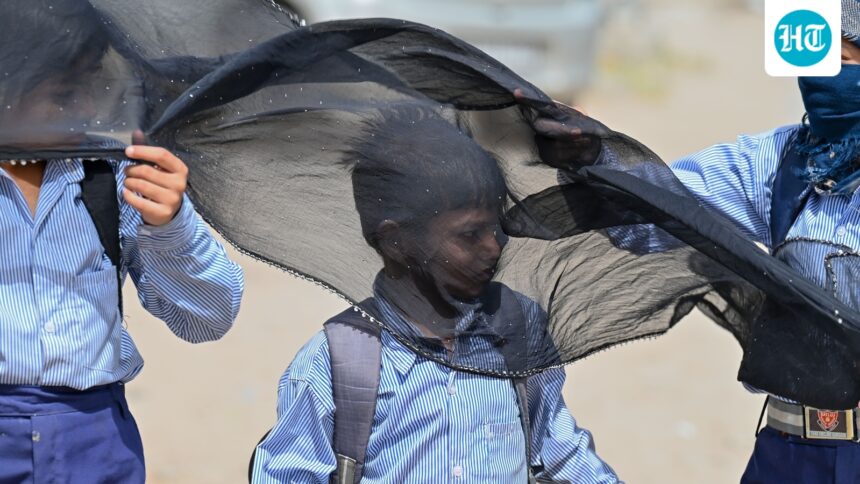
Delhi’s harsh summer is no longer limited to daytime. Even the nights offer little respite, with the capital recording its warmest May night in 14 years on Thursday. From rising hospitalizations and rising electricity demand to increasing fire incidents, a prolonged extreme heat wave has begun to strain daily life across the capital.

According to the India Meteorological Department (IMD), Safdarjung, the primary weather station in Delhi, recorded a minimum temperature of 31.9 degrees Celsius on Thursday, five degrees above normal. This reading marks the first “warm night” of the season and the warmest May night recorded in Delhi since May 27, 2012, when the minimum temperature reached 34.2 degrees Celsius.
The maximum temperature in Safdarjung was 43.6 degrees Celsius, which was 3.4 degrees higher than normal. Several parts of the city recorded higher temperatures, with The Ridge emerging as the hottest station at 45.3°C as isolated heatwave conditions continued for the fourth day in a row.
On Wednesday, Mungeshpur area in northwest Delhi was the hottest location in the city with the temperature reaching 46.3 degrees Celsius.
Cooling shelters become shelter
As temperatures continued to rise dangerously, residents and tourists sought comfort in cooling shelters set up across the capital. Equipped with air coolers, fans, drinking water and oral rehydration solutions, the shelters allowed people to rest throughout the day to escape the harsh sun.
Inside one of these shelters on Wednesday, officials distributed water mixed with rehydration salts while people sat near coolers to recover from the heat.
“We came here for a walk. But it is very hot here. The cooling system here is good for us,” 25-year-old tourist Basharat Ahmad Mulla told the Associated Press.
Increase in cases of sunstroke
High temperatures are also beginning to be reflected in hospitals across the city. Ram Manohar Lohia Hospital on Thursday reported its first two cases of heatstroke this season, with both patients said to be in critical condition.
Hospital officials said a 24-year-old student was taken to the hospital around 1.45am after he fell seriously ill while traveling on a train. Doctors said his body temperature exceeded 105 degrees Fahrenheit and he was experiencing vomiting, fecal incontinence and altered consciousness.
The second patient, a 55-year-old man, was taken unconscious by police to the hospital at about 10:45 a.m. and had a body temperature of 104 degrees Fahrenheit, officials said.
At Sir Ganga Ram Hospital, doctors said there was a significant rise in the number of patients reporting heat-related symptoms.
“The temperature is rising. In Delhi, the temperature is between 45 and 47 degrees, so a lot of patients are coming to us,” Dr Atul Kakkar, head of the department of internal medicine, told ANI.
Doctors have warned that prolonged exposure to extreme heat can lead to heatstroke, which is one of the most dangerous heat-related diseases, capable of damaging the brain, kidneys, heart and muscles if treatment is delayed.
Energy demand is rising
The extreme heat also pushed electricity demand in Delhi to record levels for the second day in a row.
According to State Load Despatch Center (SLDC) data, Delhi recorded peak power demand of 8,231 MW at 3.31 pm on Thursday, narrowly lower than May’s all-time high of 8,302 MW recorded on May 29 in 2024.
However, power distribution companies said supply remained stable despite the sharp rise in consumption.
As HT reported earlier, Delhi’s power demand is expected to reach 9,000 MW this summer, with telecom companies already preparing for the expected increase.
Also nationally, India recorded its fourth consecutive day of record peak power demand this week as heatwave conditions intensified in several states.
Fire report every 7 minutes
The high temperature also led to multiple fire incidents across Delhi. According to Delhi Fire Services (DFS) data, the department received nearly one fire-related call every seven minutes this week.
DFS received 173 calls on May 17, 186 calls on May 18, 251 calls on May 19, and 212 calls on May 20.
At least four major fires were reported on Thursday alone, including incidents at a guest accommodation in Tagore Garden, two warehouses in Siraspur, a residential building in Gulabi Bagh and a forest area near the Yamuna floodplain. Fortunately, no injuries were reported.
Orange alert in place
The IMD has now extended its ‘orange’ alert for heatwave conditions until May 27.
“A heatwave was observed at a few places over Delhi on Thursday, making it the fourth consecutive day of heatwave in the city. Delhi also witnessed warm night conditions,” an IMD official said.
The official added that the prevailing weather pattern is likely to keep temperatures high over the next few days. “In this likely scenario where dry northwesterly to westerly tropospheric winds prevail and strong westerly disturbances are absent, the heatwave will continue to affect Delhi till May 27,” the official said.
A little rest in the coming days
Weather experts said Delhi is unlikely to benefit from the weak western disturbance that has begun affecting the western Himalayan region.
The system may bring scattered rain to nearby areas but is not expected to cool Delhi, said Mahesh Palawat, Vice President, Skymet.
“The impact may extend up to Punjab and Chandigarh, with some scattered rain, but Delhi is unlikely to feel any impact from it,” he said.
(With inputs from Jajeev Gandhiuk, Jignasa Sinha and Riddhima Gupta)