The Center on Thursday told a parliamentary committee that it will implement recommendations to limit the number of attempts by NEET-UG aspirants and introduce an upper age limit as part of the next phase of reforms in line with the recommendations of the Radhakrishnan Committee, HT has learnt.

In its presentation to the Parliamentary Standing Committee headed by Congress MP Digvijaya Singh, the National Testing Agency (NTA) said three “long-term measures” – moving from pen-and-paper tests to computer-based tests; Introduction of multi-session and multi-stage testing; The imposition of the number of attempts and age restrictions – will be implemented in consultation with the Ministry of Health following the recommendations of the expert committee headed by former Indian Space Research Organization Chairman K Radhakrishnan.
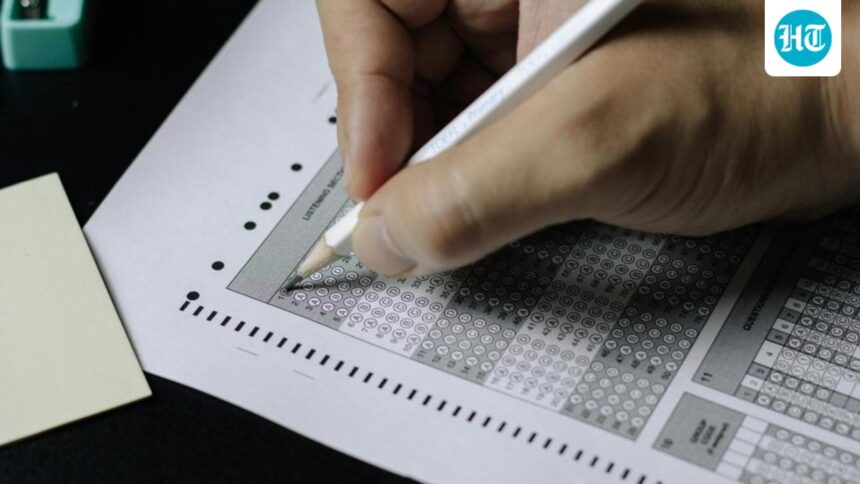
Currently, NTA conducts NEET-UG in one shift in pen and paper mode with the minimum age being 17 years. There is no upper age limit and no upper limit on the number of attempts.
The confirmation comes against the backdrop of NTA NEET-UG 2026 being canceled on May 12 after at least 120 questions in the ‘guess paper’ overlapped with the May 3 exam, affecting over 2.2 million students. The retest will now take place on June 21.
During Thursday’s meeting, people familiar with the matter said the NTA argued that this was not a case of a “leak” of the paper and that irregularities and malpractices had come to light.
MPs from the ruling Bharatiya Janata Party also opposed the use of the word “paper leak” to refer to the recent irregularities during the meeting, even arguing that the meeting agenda document circulated earlier should not have used the phrase.
Explaining the sequence of events, NTA told the committee that it conducted the medical entrance examination on May 3 in which more than 2.2 million candidates appeared. On May 7, the NTA received inputs “regarding alleged malpractice activity around the exam”, which was sent to central agencies on May 8 for “independent verification”.
Based on the findings later shared with the agency, the government canceled the examination on May 12 and referred the matter to the Central Bureau of Investigation (CBI) for a thorough investigation.
Ten people including Shivraj Raghunath Motigaonkar, founder of a training center in Latur; PV Kulkarni, retired chemistry lecturer from Pune; Manisha Gurunath Mandhari, a botany teacher in Pune, was arrested in the paper leakage case. Both Kulkarni and Mandhare were part of NTA’s NEET-UG 2026 expert panel.
It is confirmed that the parliamentary committee headed by Congress MP Digvijaya Singh currently has 28 MPs in view of the presence of three vacancies.
There are 17 members from the BJP, four from the Congress, three from the Samajwadi Party, two from the Trinamool Congress and one each from the Dravida Munnetra Kazhagam.
And the Nationalist Congress Party-SP.
In its application seeking custody of the accused on May 14, the CBI said the union education ministry had alleged in its complaint that “NEET-UG examination conducted on May 3 was hacked due to distribution of confidential tests in PDF format through WhatsApp prior to the examination and that some FAQs allegedly matched the actual examination paper…”
Ajay Singh, vice-chancellor of UP University of Medical Sciences, Saifai, Etawah, Uttar Pradesh, welcomed the maximum number of attempts and age limit proposals. “After a certain point, the ability to learn new skills and cope with the rigors of medical training declines,” he said. “We already have such limitations in many competitive exams, and it is important to ensure that students do not repeatedly spend years attempting a single exam to the detriment of their academic and professional growth.”
Any upper limit on attempts or age should not be implemented immediately and should be announced in advance, and it is preferable to give students two to three years to prepare, said Preetesh Maurya, a NEET coaching teacher from Lucknow.
“Strict restrictions could disadvantage rural and economically weaker students, especially those from government school boards with weaker educational backgrounds, compared to better-educated urban candidates. While some restrictions are needed to prevent students from spending years repeatedly attempting the exam, candidates should be allowed to attempt until at least the age of 25,” he said.
On May 15, Union Education Minister Dharmendra Pradhan announced that NEET-UG will be conducted in computer-based examination mode from next year. NTA currently has the capacity to administer CBT to 150,000 candidates per shift and aims to increase the capacity to one million next year.
NTA is implementing the recommendations of the K Radhakrishnan Committee in two phases, with the first phase already activated for NEET-UG 2026 and scheduled to continue with the re-examination on June 21.
These include Aadhaar-linked biometric verification at centres, face verification on registration, multi-layer frisking by state police and NTA teams, portable jammers deployed by Bharat Electronics Limited and Electronics Corporation of India Limited, and CCTV surveillance in all exam rooms with AI-powered surveillance for any suspicious activity.
The agency has also established 34 state-level control rooms in tertiary institutions, apart from central monitoring centers in the NTA and the Ministry of Education. The district-level committees headed by collectors are audit centres, while all the 500-plus city coordinators are principals of Kendriya Vidyalaya Sangathan or government schools. More than 99.5% of the centers were managed by the government, while 16 senior positions were created and experts from bodies such as the University Grants Commission were deployed to strengthen the operations of the National Tourism Agency.
The implementation of NTA’s second phase in planning includes cloud screening infrastructure, blockchain-enabled security architecture, stronger encryption protocols, the establishment of an NTA-owned public testing platform and the eventual alignment of engineering and medical entrance exams – aligning engineering and medical entrance exams through common standards, technology and processes to create a more integrated and flexible national testing system, without necessarily consolidating them into a single test.
Since its inception in 2018, the NTA has conducted more than 270 tests, covering more than 66 million candidates.