Of all the film genres, the coming-of-age film is probably what the French do best. It is not difficult to find a lot of great examples: Truffaut’s example 400 strokesEustache Miss Petites AmoreosePialat New childhood and A nos amours (For our loved ones)Cheney Wild reeds And Kashish Games of love and chancebut not limited to. Film historians may have a good academic explanation for this phenomenon, but if I were to guess, it would be that French authors, especially those from the New Wave onwards, tended to reject the cut-and-dry narratives and exaggeration of Hollywood screenplays in favor of something more honest, messy and personal – which is pretty much the definition of adolescence.
For her stunning debut, La Gradivacinematographer-turned-director Marine Atlan approaches the genre in the most French way possible, presenting a sprawling chronicle of teenage angst that begins as a relaxing class trip to Italy and gradually morphs into a tale of devastating loss. Featuring a fascinating cast of unknowns and a style that captures them with both beauty and realism, this deserving winner of the Cannes Critics’ Week Grand Prix announces the arrival of a formidable new talent.
La Gradiva
Bottom line Announces the arrival of a tremendous new talent.
place: Cannes Film Festival (Critics Week)
ejaculate: Colas Coignard, Suzanne Gerin, Mitia Capellier Odat, Antonia Borisi
exit: Atlan Marine
Screenwriters: Marine Atlan, Anne Brouillette
2 hours and 25 minutes
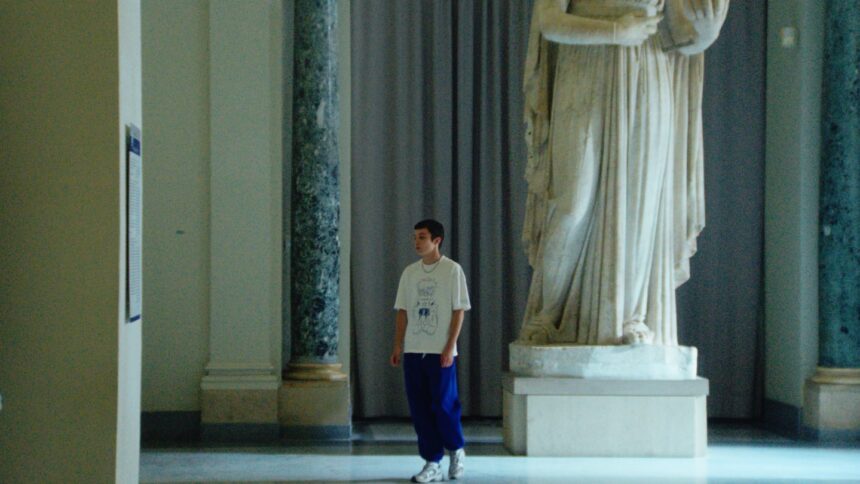
What makes Atlan feel fresh and part of a long tradition of great French teen films is how you fill it with new faces, costumes, situations and sexual preferences, while depicting the kind of dramas that have been happening since the invention of drama. In fact, the iconic setting of La Gradivawhich follows a class of high school seniors to Naples and Pompeii, is used to frame this story of unrequited love and teenage turmoil against precious artifacts from antiquity—frescoes, statues, bodies calcified in agony—that depict the same objects from thousands of years ago. Times may have changed, and everyone is glued to their phones now, but feelings are still feelings.
This is immediately apparent in the film’s opening scene, which shows the charismatic Tony (Colas Coignard) spying on his handsome friend James (Mitya Capellier Odat) while the latter sleeps with a colleague on the train from Paris. Tony, who is gay, looks on with curiosity and a fair amount of jealousy as James — the class’s ladies’ man and an indifferently good student — makes out with a girl, setting the stage for the conflict that dominates much of the film’s second half.
Another conflict Tony faces is with his origins: his maternal grandmother was a maid in Naples and claims to have had an illicit love affair with a local aristocrat, until the latter was killed in the 1980 earthquake that devastated Naples and the surrounding area. Tony has now reconnected with his roots, even if he doesn’t speak much Italian and no longer has a connection to that side of the family.
Tony’s double duty fuels a story that seems to have been created casually but becomes darker and more dramatic as time goes on. The first hour or so La Gradiva It actually feels, at times, like a loose French break movie, with the kind of authentic situations and performances that directors like Kechiche have done so well previously. Atlan deftly guides the ebb and flow of changing moods – the way a joke can suddenly turn into a bitter fight, or the way a quick glance at another colleague during a museum visit can speak of loneliness and longing. But she gradually settles into the three-way or four-way love affair that lies at the heart of her plot.
If Tony is the film’s hero, and James is the object of his desire, then the narrator appears in Susan (Susan Gerin), the top student in her Latin class but also the student with the fewest social connections. In an interesting scene between Susan and other girls while they are relaxing in the dorm one night, they ask her why she hasn’t had sex yet, and she says to them: “Have you seen my face?” It’s this kind of crushing honesty that characterizes the film itself, as if Atlan were a fly on the wall with a camera (the director, who filmed last year’s Cannes entry Girl in the snowserved as DP with Pierre Mazoyer).
There is a lot going on above and below the surface La GradivaWhether it’s the class differences between Tony and James, or the latter’s sexual fluidity, it’s impossible to cram it all into one review. Atlan’s film seems to drag on at times, particularly during some long lecture scenes by the group’s dedicated, if disillusioned, teacher, Madame Mercier (Antonia Borisi), who emerges as the other major character: a woman whose cultural sensibilities betray as much a deep longing as well.
But everything we see happens for a reason, leading to Tony’s increasing isolation and erratic behavior, until a series of events lead to a very heartbreaking ending. Before that happens, Atlan films the students celebrating a recent night out together, dancing and rapping to singer Theodora’s club anthem “Kongolese sous BBL” as they each figure out which college they’ll be going to next year.
As in many of the scenes of her remarkable debut, the director turns her camera warmly toward the joyful faces and bodies of the cast, capturing them between ecstasy and anxiety, between fear and exhilaration – young people looking toward the future but forever stuck in the drama of our past.