

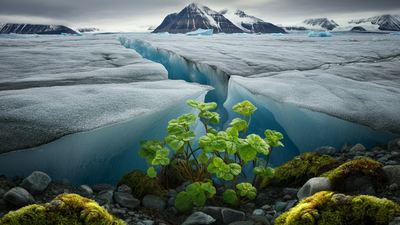
Photo of melting glacial ice revealing resilient tundra vegetation, a quiet and sad testimony to Baffin Island’s changing landscape | Image credit: TIL Designs
As Arctic ice melts on the eastern side of Baffin Island in Canada’s Arctic, scientists have discovered ancient tundra plants that have remained buried under the ice for more than 40,000 years.According to a study published in the journal Nature Communications, researchers collected 48 samples of tundra plants from the edges of 30 ice caps on eastern Baffin Island. Radiocarbon dating showed that the ages of the plants ranged from about 40,000 to more than 50,000 years ago. Most importantly, plants were found siteThat is, it has been completely preserved in its original position.Keep plants where they once grewNot only the age of the plants, but also their placement is important in this case.
It is said that the plants were not transported there through wind or water erosion, but rather remained in their original environment until the ice receded to reveal them.The samples were obtained from approximately one meter from the current ice boundary, a place where small changes in melting can reveal objects hidden underground for tens of thousands of years. This strengthens the hypothesis that the plants were buried when ice advanced in the late Pleistocene and remained under a stable ice cover for a very long time.
Moreover, the presence of such findings in different ice caps makes their discovery even more plausible. The researchers conducted repeated sampling at nine sites, including testing several branches of the same plant and several plants from the same location.Evidence supported by rock surface testingDespite all this, the team did not resort only to plant-based radiocarbon dating in their study. To confirm the date of the ice sheet, they also turned to carbon-14 dating of rock surfaces near the sites at nine different sites.Using this data, scientists modeled the history of the ice sheet and found that all but one site had likely been continuously covered in ice since the Holocene epoch, which began after the last major ice age about 11,700 years ago. According to the researchers, combining botanical dating with dating on rock surfaces gave much better confirmation that the sites were covered by continuous ice and did not undergo a cycle of thawing and refreezing.
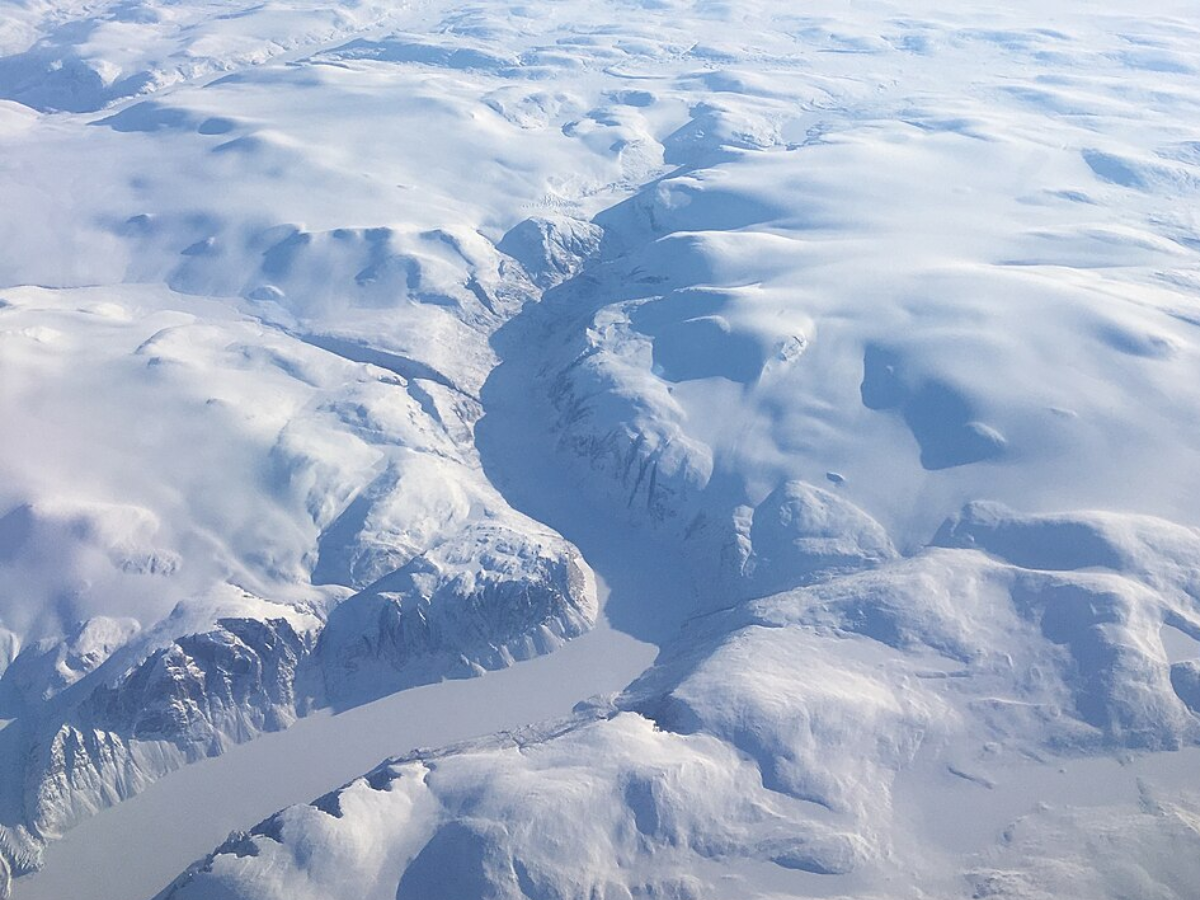
An aerial view of Baffin Island Image credit: Wikimedia Commons
What this discovery reveals about the history of the ArcticAt least some of the ice caps on eastern Baffin Island appear to have served as archives where plant specimens were kept frozen within a constant blanket of ice for several thousand years. It is worth noting that the conclusion was not reached that the entire Baffin Island was covered by a single ice sheet for 50 thousand years. In other words, it is specifically the local ice caps and their margins that scientists have studied.However, experts consider the discovery valuable because it proves that some Arctic ecosystems remained preserved within ice sheets throughout warm periods, including the Holocene, without adapting to new climatic conditions.As it turns out, the age of some plants predates the last glacial maximum, dating back to 26,000 years ago.A broader picture of climate change on Baffin IslandThe discovery is also linked to broader climate research on Baffin Island. According to a study published in the Proceedings of the National Academy of Sciences, ancient plant DNA preserved in lake sediments on Baffin Island revealed major shifts in vegetation during previous warm periods such as the last Ice Age and the Holocene, highlighting how sensitive Arctic ecosystems are to climate change.The implication is that Baffin Island has always been vulnerable to climate changes, with its vegetation constantly growing and shrinking depending on climate changes.Recent studies conducted in east-central Baffin Island have also highlighted how difficult it is to access the area, even in light of environmental changes.Receding ice reveals a hidden archiveWhile melting Arctic ice is usually viewed in terms of its impact on sea levels and ecosystems, this kind of discovery points to another impact: geological and biological information from past eras is beginning to be revealed by the melting, after being covered by ice for eons.These fossils from Baffin Island are not only impressive in terms of age; They are supported by multiple lines of evidence. Radiocarbon dating of plants, repeated sampling and surface analysis of rocks lead to the same conclusion: that this part of the Arctic was covered in ice for an unusually long period of time.As the temperature rises in the Arctic accelerate, there is hope that more such relics from Earth’s distant past will be discovered in the coming years.