

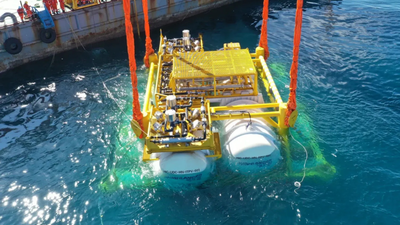
China has officially launched the world’s first wind-powered underwater commercial data center off the coast of Shanghai’s Lingang Special Zone. The futuristic facility contains approximately 2,000 servers housed inside pressure-resistant underwater modules positioned alongside offshore wind turbines.
Designed to support AI workloads, big data processing, and large local language model development, the project combines renewable energy with natural seawater cooling to reduce electricity use, land requirements, and fresh water consumption. Chinese developers say the underwater system achieves a highly efficient power usage efficiency (PUE) rating of about 1.15, which is much lower than many traditional land-based data centers.
A massive underwater computing project near Shanghai
The project was launched through a partnership involving the Administrative Committee of Lingang Special Area, Shanghai Lingang Special Area Investment Holding Group and HiCloud Technology. Additional operating agreements were later signed with companies including China Telecom, Shenergy Group and CCCC Third Harbor Engineering.Construction of the facility began after the agreements were finalized in June 2025.
The project reached construction completion in October 2025 before trial operations began earlier this year. Full commercial operations officially began in May 2026.The data center is located between the first and second phases of the Lingang offshore wind farm, and is directly connected to nearby renewable energy infrastructure. The entire project reportedly cost about 1.6 billion yen, or about $226 million.
Nearly 2,000 servers have been deployed underwater
The underwater data center was developed in phases, starting with a smaller 2.3 MW pilot facility before expanding to a full 24 MW commercial operation.Within the offshore units are approximately 2,000 servers designed to support AI computing, big data annotation, 5G infrastructure services, local training of large language models and cloud computing operations. China Telecom and local computing provider LinkWise have already deployed GPU clusters inside underwater units to support AI processing and data-intensive workloads.Unlike traditional server farms built inside massive industrial buildings, the Lingang facility uses sealed underwater pods placed beneath the ocean surface near offshore wind turbines. Developers say this design helps reduce land use while improving cooling efficiency.
How does seawater cooling work?
One of the project’s most important innovations is its cooling system. Traditional data centers rely heavily on industrial air conditioning systems and cooling towers to prevent servers from overheating.
These systems consume huge amounts of electricity and often require large supplies of fresh water.Instead, the underwater data center in Shanghai uses seawater as a passive cooling mechanism. According to HiCloud technology, the heat of the server changes the refrigerant inside the copper pipes from liquid to gas. The gas naturally rises to the upper cooling layer, where the surrounding seawater removes the heat through a heat exchanger.
Once cooled, the refrigerant condenses back into liquid form and returns to the server units through gravity.Developers say this creates a low-energy heat exchange cycle that significantly reduces the need for traditional powered cooling systems.
Why does PUE rating matter?
The facility is said to maintain an energy efficiency rating of approximately 1.15.PUE measures how efficiently a data center uses electricity. A lower score means that more energy goes directly toward computing rather than cooling or general infrastructure.Many traditional enterprise data centers operate near 1.5 or even 2.0 due to significant cooling requirements. In comparison, a PUE of 1.15 places Lingang’s underwater facility among the most energy-efficient large-scale data centers currently in operation.The project developers claim that the system reduces electricity consumption by 22.8%, completely eliminates the use of fresh water and reduces land use requirements by more than 90%.
These numbers are particularly important at a time when artificial intelligence infrastructure is rapidly increasing global consumption of electricity and water.
Powered by offshore wind energy
Another key feature of the project is the integration of renewable energy. The underwater modules are positioned adjacent to Lingang’s offshore wind farms, allowing the facility to draw most of its electricity directly from wind power generated at sea.Reports indicate that more than 95% of the project’s electricity comes from renewable energy sources.
This is especially important as AI systems and GPU clusters continue to increase global energy demand at a rapid pace.The Chinese underwater project combines renewable energy, undersea engineering, artificial intelligence computing and natural cooling systems into one integrated platform. The project is widely seen as part of China’s broader drive to boost its position in artificial intelligence infrastructure and green computing technologies.
Underwater engineering challenges
Despite its efficiency advantages, underwater infrastructure presents many engineering difficulties. Saltwater corrosion remains a major concern in the long term because seawater can gradually damage electronics and metal structures. Engineers must also ensure that the underwater capsules remain completely sealed against pressure and water leakage for years at a time.Maintenance is another big challenge. Replacing damaged hardware underwater is much more complex than servicing traditional server racks inside regular buildings.
Operators therefore rely heavily on closed modular systems, remote monitoring and infrastructure redundancy to reduce the need for physical repairs.Fiber optics and subsea power cables also present reliability concerns since underwater cable repairs are expensive and technically difficult.
Comparisons with Microsoft’s Natick project
The Shanghai project has drawn comparisons with Microsoft’s Project Natick pilot, which tested underwater data center pods off the coast of California in 2015 and then near Scotland’s Orkney Islands in 2018.Microsoft experiments have shown that underwater environments can reduce hardware failure rates because stable temperatures and enclosed conditions limit exposure to oxygen and human intervention. However, Microsoft finished the project commercially by 2024 without moving to full-scale deployment, in part because maintenance and operational complexity remained difficult.China’s Lingang facility is different because it has already entered full commercial operation on a much larger scale and is directly integrated with offshore renewable energy infrastructure.Although the Lingang project is widely touted as the world’s first offshore wind-powered underwater data center, it is not the first underwater data center overall.That distinction belongs to a previous underwater commercial data center project launched near Hainan, China. What makes the Shanghai facility unique is its integration of offshore wind energy and large-scale underwater AI computing infrastructure.
Why underwater data centers could become more popular
The rapid growth of artificial intelligence is dramatically increasing global demand for electricity, cooling systems, and land for data centers. Technology companies and governments are now exploring alternatives to traditional server infrastructure, including underwater data centers, floating computing platforms, liquid immersion cooling systems, and even nuclear-powered artificial intelligence facilities.China’s underwater project represents one of the most ambitious attempts to date to combine renewable energy generation with infrastructure Sustainable AI computing infrastructure. If the Lingang system performs successfully over the coming years, similar underwater marine facilities could become an important part of the future global AI infrastructure.