A new, star-studded immersive experience at London’s Barbican Center invites us to explore “imagined futures for our planet, rooted in real technology and climate-based possibilities”, and imagine a better future. Diego Luna’s voice (Rogue one, Andor, And your mother as well) takes us out of everyday life with an introduction to In other worldscreated by designer, director and producer Liam Young (Planet City), in collaboration with leading voices from film, television, literature and science. Luna’s voice also brings us back to it with an epilogue at the end of the interactive exhibition.
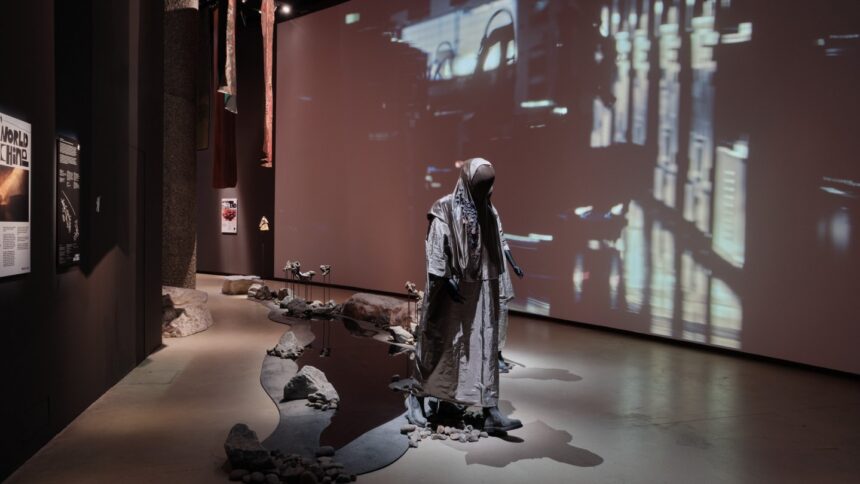
On the journey through six worlds, you can experience audio stories, projection of films on LED walls, furnishings, costumes, installations, soundscapes and massive projections, as well as set design, film miniatures and meditative artefacts. Other famous voices you can hear include those of Jeffrey Wright (American fantasy, Casino Royale), Maxine Peake (I swear, shameless), Adam Young (The Lord of the Rings: Rings of Power), Dennis Goff (Andor), Finnish actress Alma Puesti (Fallen leaves), Australian actress Natasha Wanganeen (Rabbit proof fencing), space scientist and broadcaster Maggie Adrain (host of the BBC programme Sky at night(And actor and director Richard Ayoade)Phoenician plan, IT crowd).
Among the writers behind this experiment is Lisa Joy (Western world, He falls), Kim Stanley Robinson (Ministry of the Future), Chen Qiufan (Amnesty International 2041), Jin Woo (Blue-eyed samurai) and artificial intelligence scientist and artist Kate Crawford (Atlas of Artificial Intelligence), with costumes by Anne Crabtree (The Handmaid’s Tale, The soprano, Western world).

“These works operate in the spaces between design, imagination and the future, immersing us in the consequences and opportunities of the decisions we make today,” Barbican’s description of In other worlds. “It’s about stepping away from the harsh reality and asking: What if the future was full of hope?”
Described by the BBC as “the man designing our future,” Young highlights: “The future does not rush at us like water. It is not something that happens to us. It is an act of creation. It is something we make together, moment by moment.”
Luke Kemp, Head of Creative Programming at Barbican Immersive, adds: “The immersive program at the Barbican is a place to explore some of the most important themes of our time that puts the visitor at the heart of the experience. It’s hugely exciting to work with Liam Young and his collaborators on this major exhibition, as now is the time to look again for new stories, imagine different futures and create the worlds we want to exist, rather than the ones they were created for.” These amazing environments created with leading talent will bring us closer to the possibilities that are possible.
In fact, during a press preview for In other worlds On Thursday, Young highlighted that he and his creative collaborators wanted to showcase “speculative worlds that serve as rehearsals for the future, for the world to come.” This may be his first solo exhibition in the UK, but he stressed that, as in the film, the director may be a public face but not the sole creative force, the experience at the Barbican would not have been complete without all his partners.

Among the ideas you encounter during your immersive journey are the World Machine, the technoglomerates, or stones “made from the raw materials of artificial intelligence,” the new space industry for indigenous people, and the Planet City, “one city for all the inhabitants of the Earth,” that is, a city for 10 billion people with 7,000 languages stacked in layers, while the rest of the planet returns to the wilderness. Despite its dense population, Planet City is “full of hope, life, diversity, holidays, festivals and carnivals,” Young says. “Planet City becomes a giant party.”
Some of the worlds you’ll experience may seem dark, but the creator wants to send visitors home with hope. “In other worlds “It’s an attempt to create a set of visions for a hopeful future,” Young highlights. “What we tried to do with the show is create an entry point for conversation about what the future could be and create a shared conversation. [It’s] It’s a rallying cry or a call to arms to say that the future at this point in time has to be legitimate again in this very urgent and critical moment, where it sometimes seems so difficult to be optimistic about our future in so many ways. I believe this is the project of our generation – finding ways to be optimistic in the midst of darkness.
Similar to how the exhibition is designed to break new ground in terms of immersive experiences and new ideas, it also takes visitors beyond the normal spaces of the Barbican to end up in its own car park, or parking garage. There are no limits to our imagination and ideas!

Indeed, the Barbican experience that In other worlds Young emphasizes that the proposals “are not a set of solutions, but rather an attempt to reorient us around new visions of a future that operates on planetary scales.” “A lot of the images you see are quite provocative or confrontational. They’re challenging, in the sense that they don’t necessarily look like what we’ve been trained to think of as hopeful images of the future. There are no rooftop trees or small-scale community gardens in Brooklyn. Instead, there are massive infrastructural works, large-scale geological engineering, and atmospheric shifts. They are images that try to meet the scale of the moment.”
Young concludes, “The crises we face are no longer crises of technology, but crises of imagination.” “It is the result of our biases, our blind spots, our politics and our prejudices. If we wanted to, we could wake up tomorrow and change everything about the way we engage with the world, and this is a potentially powerful place indeed – at the forefront of the potential for change.”