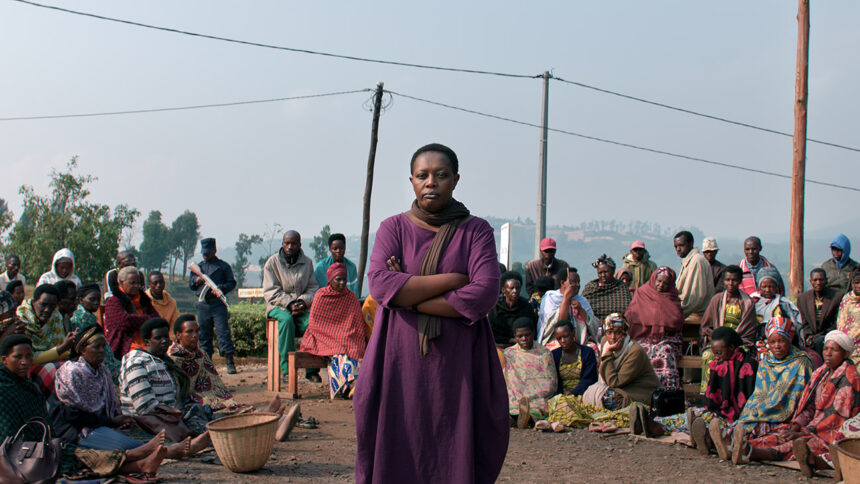
“I forgive” are the first words uttered by Veneranda Ben ImanaBut her fierce gaze and the clenching of her arms across her chest told a different story. In the midst of a cast of mostly non-professional actors, Clementine Yu. Nirinkendi brings Veneranda and all its painful contradictions to life. Ben ImanaA burning and intimate picture for the nation.
Writer-director Marie-Clémentine Dosabejambo’s drama is set in the Rwandan village of Kibeho in 2012. It’s the final year of the gacaca courts, community-based courts focused on addressing genocides committed, neighbor against neighbor, in the past decade. Through the character’s complex and often tense relationships with her teenage daughter, sister, and mother, as well as with the other women in her village, Dosabigambo crafts a story that is emblematic and painfully specific.
Ben Imana
Bottom line Mother Courage.
place: Cannes Film Festival (What Look)
ejaculate: Clementine Yu Nyirinkinde, Kesia Kelly Nishimwe, Isabel Capano
exit: Marie Clementine Dosabegambo
Screenwriters: Marie Clementine Dosabegambo, Delphine Agout
1 hour and 41 minutes
The person Vénéranda formally forgives in the opening scene is Karangwa (Aime Valens Tuyisenge), the man accused of killing her brothers and other relatives. Of the eight children raised by their mother (Arivier Caguiere), only Veneranda and her sister Suzanne (Isabelle Capano, who starred in Eric Barbier’s film) are left behind. Small country) survives. Susan’s anger is as explosive as her sister’s. She claims to judge Adelette Mugabo that Veneranda “has no right to pardon on behalf of our family” and is determined to bring Karangwa to justice.
She has no use for the community meetings that Veneranda, as district social affairs officer, has begun leading. Local women are invited to share fresh memories, and to deal with the kinds of things that may be immaterial to the courts. Their sessions form part of the country’s “Rwandatitude” programme, which aims to reunite Rwandans after years of ethnic conflict and bloodshed.
Just as mentioning ethnicity is prohibited in courts, there is no such identification at these gatherings, and no way of knowing whether any of these women are Tutsi or Hutu, whether her husband has been murdered or is in prison for murder, until she stands up to tell her horrific story. (The film’s title is a Kinyarwanda word that emphasizes collective identity, not the ethnic divisions between Tutsis and Hutus that Rwanda’s European colonizers encouraged and imposed.)
The younger generation, embodied by Veneranda’s free-spirited daughter, Tina (Kesia Kelly Nishimwe), and her boyfriend, the low-key photographer Richard (Elvis Ngabo), have grown up without any racial classifications. But while Veneranda sees herself as a model of tolerance for the women in the group, she is unable to see past Richard’s Hutu heritage, and is cold-hearted toward Tina when she becomes pregnant and is expelled from school. “Neither Richard nor his family have done me any harm,” Tina points out sensibly, while her mother fumes with shame and judgment, her inner turmoil finding expression in baffling hypocrisy.
Cruel as she can be, Vénéranda is the devoted caretaker of her mother, who has lost her voice as well as her memory, and the silent, regal observer of the unfolding family drama. Veneranda also takes care of her sister, whose health was taken away from her, her husband and her child during the attacks. Susan is burning with rage even as her physical strength diminishes. “Can’t you stop with your nonsense about forgiveness?” She hisses at Vénéranda, urging her to reveal some long-hidden truths to Tina.
What connects these two is the depth of what they endured, the unspeakable brutality; What sets them apart is how they respond to it. Ben Imana It offers no simple definitions of courage, but rather a frenetic human collective portrait of its possible expressions, with the extraordinary trio of Nirinkinde, Kabano, and the radiant Nishimoe forming the broken but still hopeful heart of the story.
Dusabejambo, working from a screenplay she wrote in collaboration with Delphine Agut, is interested in her characters’ pain and resolve, which is reflected in the liveliness of the setting. Thanks to strong contributions from cinematographer Mustafa Al-Kashif, production designer Ricardo Sankara, and editor Nadia Benrachid, the film is cinematic in a way that’s not at all jarring, from the first images of gently rolling hills and birdsong to the bright interiors of Veneranda’s house and Igor Mabano’s gentle score. Just as a short clip of voiceover indicates that one word, ejoThat means yesterday and tomorrow Ben Imana It contains entire worlds in one very specific here and now.