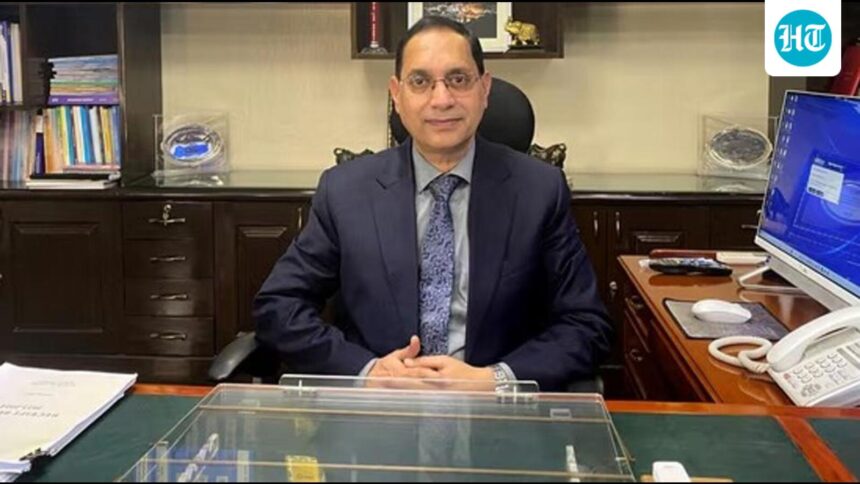
Tuhin Kanta Pandey, Chairman of the Securities and Exchange Board of India, said here on Monday that Indian markets have remained resilient despite the increased volatility caused by the ongoing West Asian crisis, although volatility remains within manageable limits.

Responding to concerns about the impact of geopolitical turmoil in West Asia on the Indian stock market, Pandey said market volatility had risen but was not beyond the ability of investors and institutions to handle it.
“Indian markets have remained very resilient, despite increased volatility. But it is nothing that the markets cannot handle,” Pandey said, adding that resilient markets are able to absorb shocks before returning to a “normal path” once uncertainty subsides.
However, he warned that the current global crisis poses major challenges due to its wide-ranging impacts, particularly through disruptions in oil prices and supplies.
“The current crisis is very difficult in terms of the extent of its impact on the rest of the world. Especially through oil. It is a shock in prices and supplies of oil to the rest of the world,” he said.
Read also:In the West Asian crisis, an opportunity for China
He added that economies around the world are being affected and facing inflationary pressures, in addition to “spillovers” and second-order economic effects.
Pandey said the government was taking measures to address the situation and stressed that an early solution to the crisis would benefit the global economy.
“The sooner this crisis is resolved, the better for the rest of the world,” he said, adding that market ups and downs were a natural feature of globally interconnected financial systems.
Highlighting the expansion of Indian capital markets over the past decade, the SEBI Chairman said that the market capitalization has risen sharply from… $95 lakh crore in 2016 to approx $463 thousand crore in April 2026. During the same period, the corporate bond market grew from $20 lakh crore to approx $60 thousand crores.
Participation from individuals has also risen significantly, with the number of unique investors rising to about 145 million from 38 million in 2019, Pandey said.
“Today we have about 145 million unique investors,” he said, noting the strong participation in the primary market as well.
Despite a “very difficult year” for markets, Pandey said capital formation remained strong, with approx. $Rs 13 lakh crore was raised through debt and equity markets last year.
Compared with advanced economies, he said, India witnessed 366 initial public offerings in the previous year, while “there are countries in the European Union, for example, that did not conduct a single initial public offering in an entire year.”
He added that mutual funds have emerged as a major channel for household participation in financial markets. Assets under management increased from $12 lakh crore in 2016 to approx $82 lakh crore by April 2026, while monthly Systematic Investment Plan (SIP) inflows have increased more than ten-fold – from approx. $3,000 crore in April 2016 to more $31,000 crore in April 2026.
Regarding foreign investment trends and market cycles, Pandey said that every market goes through ups and downs compared to its global counterparts. He pointed to factors such as earnings growth, foreign investment inflows and currency movements as affecting investor returns, especially after-tax dollar returns to foreign investors.
Reiterating concerns about the geopolitical situation, he said that oil-related disruptions caused by the conflict in West Asia remained a significant risk to economies around the world, with the potential for continued inflationary and broader economic consequences if the crisis persists.