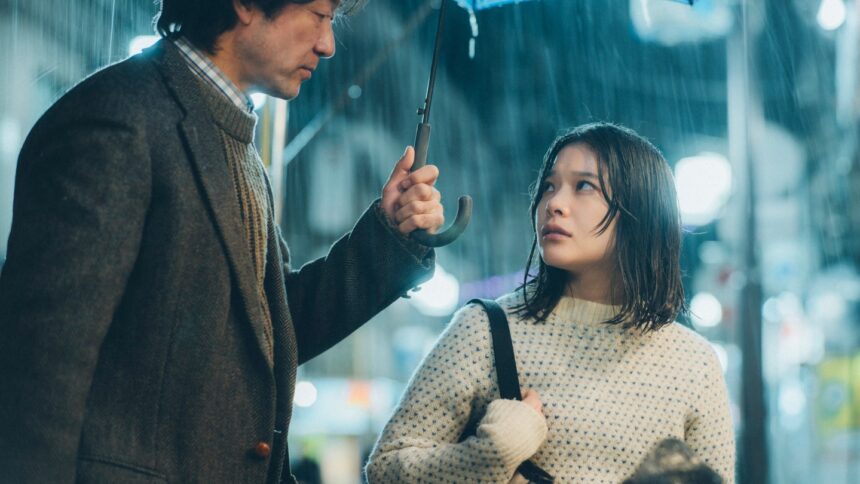
For a film preoccupied with the mechanics of light, Yukiko Sude’s All the Lovers at Night mostly unfolds in the shadows—in the dim glow of a Tokyo apartment window at sunrise or on the empty city streets at midnight on a birthday no one celebrates. Adapted from Mieko Kawakami’s acclaimed novel, the Japanese director’s stunning fourth film uses the halting rhythms of an awkward first romance to ask expansive philosophical questions: How does the self become visible, and how much of what we feel is truly our own?
Un Certain Regard sidebar premiere at Cannes, All lovers at night She came to SOD through its producer, who handed her Kawakami’s book—her first encounter with this particular novel, despite being a long-time fan of the author’s work.
“My interpretation of the book is that it was about light,” Sood says. Hollywood Reporter. “Naturally, as a filmmaker, light being a subject was an irresistible challenge. How could I not do that?”
The story follows Fuyuko (Yukino Kishi), a freelance proofreader who lives an almost monastic life of urban anonymity: long days of solitary work in her quiet apartment, occasional outings with her outgoing colleague, Hijiri (Misato Morita), and an annual self-indulgence—a midnight walk across the city on her birthday. But Fuyuko’s inner life isn’t nearly as peaceful as her outer appearance suggests, and cracks begin to appear when she mysteriously takes up a habit of secret, heavy daytime drinking. The subtle sea change in her life begins when she meets Mitsutsuka (Shogun The star is Tadanobu Asano), a high school physics teacher, at a local cultural center, where she is considering taking a class. He speaks in a gentle, almost mysterious way, answering her questions about the subject he is studying with epistemological musings about the counterintuitive mechanics of light. A series of tentative meetings in cafés ensue – but even as a real connection begins to take shape, each holds secrets they don’t know how to account for or reveal.
Kawakami – from All lovers at night It was the first Japanese novel to be shortlisted for the US National Book Critics Circle Award – giving Sood and her team complete creative freedom, declining feedback or requests at any stage. “She basically said, ‘It’s in your hands,'” Sood recalls. The novelist made only one remark when the two first met to discuss the script: that the book was a decade old and could use at least a little updating to ensure its authenticity—and thus, Sood inserted a passing reference to artificial intelligence and its potential impact on the plight of the professional proofreader.
What I preserved most was the philosophical undercurrent of the novel. Light, as Mitsutsuka gently explains, only becomes visible when it strikes an object. The film also suggests that we do the deepest work within ourselves. “You have yourself, and you have the object of your affection,” Sood says. “But getting really close to them – what does that mean?” Meanwhile, Fuyuko is haunted by a question akin to any artist’s: Are her thoughts and feelings really hers or are they merely adaptations of things she has already read, and already absorbed? Amid her quiet despair, she justifies her withdrawal from social life by believing that this is at least a form of authenticity—call it affect anxiety as an everyday life practice.
Sood says this topic also delighted her when she was drafting the screenplay for the film adaptation, which came out relatively effortlessly.
“This idea seemed very familiar to me as a filmmaker,” she says. “When you make a film, you’re never quite sure whether you’re drawing on some accumulation of cinema that came before you, or whether you’ve actually come up with something original.”
It was these dual concerns – light and authenticity – that guided Sode’s formal choices for the film. She was adamant about shooting in 16mm, and despite budgetary concerns, her producers eventually relented after the entire cast and crew of the film joined her pleas for permission to use the analogue format.
“When you shoot on film, you can capture the light on the physical film as it is,” Sood explains, “whereas if you use digital, it can become very dull, or lose the quality of feeling that you are really seeing it.”
The choice of 16mm also reinforces what she calls the film’s “analog” spirit—a quality embodied by its script-reviewing characters, whose intense, meticulous work contrasts with the empty comfort of the age of artificial intelligence. Cinematographer Yasuyuki Sasaki, who also shot Kiyoshi Kurosawa’s latest film which premiered at Cannes. Kokorojo: Samurai and Prisonershows Tokyo in pictorial half-light: glowing neon, late-afternoon expanses, and smudged city stoplights.
Sode’s visual strategy also extended to the way her camera translates Fuyuko’s anxious inner feelings from Kawakami’s first-person narration.
“Aside from Mitsutsuka, you see her with other male characters who are always sitting sideways, or not really sitting facing forward — which of course means she is holding herself back and not interacting with them 100 percent,” she explains. With Mitsutsuka, the framing via quotes from their conversations gradually hardens and moves down to eye level—formalizing Fuyuko’s slow openness, as she moves toward vulnerability.
The film’s meticulous architecture is anchored by two standout performances from its stars. Kishi – who made his way internationally as a deaf boxer in Berlinale favorite Sho Miyake Small, slow but steady He plays the role of Fuyuko with a wonderful and cautious inner feeling. Asano, Japan’s favorite artist who recently won a Golden Globe Shogun He introduced him to wider Western audiences, bringing his usual engaging specificity to Mitsutsuka, working from a character background he had constructed himself. “Boy, was it unexpected,” Sode says of the original story Asano created for Mitsutsuka as part of his process. “I’m afraid I don’t really think I should share what it was like,” she adds with a laugh.
Threaded through All lovers at night “It’s a portrait of a certain kind of contemporary Tokyo,” says Sood — a reclusive urbanite in his 30s or 40s who has built a life of emotional self-protection so well-fortified that it precludes the usual natural desires for romance or family formation.
“The city allows people to blend in and disappear,” she says. “If you choose not to associate with anyone and just live your life, that means you’re less likely to get hurt. But at the same time, we as human beings, as human beings, can’t live without others — and so there’s that longing, that longing as well.”
For all of the film’s quiet sadness, Sood insists that Fuyuko’s arc turns into something resembling a blessing. Her isolation has always been a myth of privacy, and what she ultimately trades off is self-defense for a more authentic identity.
“Whether her love was fruitful or not, Fuyuko, having experienced romance, is able to say that she is one of many people around the world who have experienced great love,” Sood says. “So, in a way, she found Nakama – Companionship – In a society where everyone feels a little lonely.