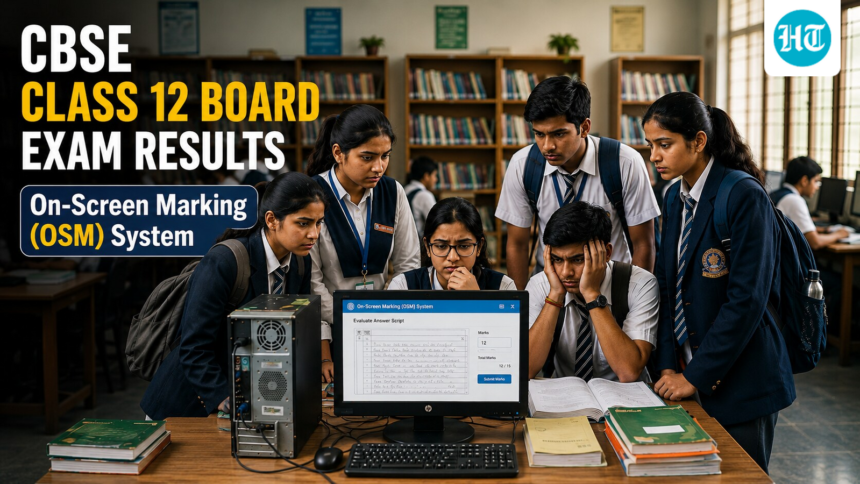
A fresh controversy has erupted over the On-Screen Marking (OSM) system newly introduced by the Central Board of Secondary Education (CBSE) to evaluate the results of the Class 12 board examinations for the year 2026. The examination results were announced on Wednesday, recording a significant decline in the overall pass percentage this year to 85.2%, a decline of 3.19 percentage points from last year and the lowest level seen in the last seven years.

CBSE has defended the new method, saying it has been used to improve “transparency, fairness and consistency” in the assessment process. The Ministry of Education also rejected concerns surrounding the marking process and said that the system is safe and follows global practices used in transparent assessment.
Read also | ‘The system cannot be changed’: Opposition attacks CBSE mandate in three languages for Classes 9 and 10
During a press conference, Sanjay Kumar, Secretary, School Education, Ministry of Education, announced that the fees for answer sheet verification and re-evaluation have been reduced to $100 each.
Now, the main question is: What exactly is the OSM system that has created so much buzz among students?
What is On-Screen Marking System (OSM)?
CBSE has moved away from the traditional method of examining papers and introduced digital assessment for Class 12 through an on-screen marking system. Under this process, 98.6 million answer sheets were assessed without printing them or transporting the physical papers to examination centres.
As part of this system, answer sheets were scanned and uploaded to an electronic platform where teachers scanned them on computer screens. Marks were entered digitally, comments were provided online, while the system automatically calculated totals to reduce the chances of errors. Through OSM, CBSE has evaluated 98,66,622 answer books.
This process eliminates errors in grossing, posting and uploading by ensuring that each answer is checked against the specified marking scheme, as previously reported by HT.
The board said this was the largest digital assessment exercise to date and represented a significant change from the traditional system used for years.
He also stated that reduced human involvement reduces manual handling, which often leads to calculation errors. “Assessors award marks only according to the marking system, which ensures objective assessments,” she said.
What teachers said about the system
School principals and teachers who spoke to HT after the results gave various reasons for the low pass percentage.
The principal of a Delhi school, who requested anonymity, claimed that the system was introduced too quickly and teachers did not receive adequate training.
“Many teachers, especially in government schools, were not familiar enough with technology. Ideally, OSM should have been implemented next year after wider preparation,” the school principal said.
However, a teacher at a government school in Delhi who participated in the Class 12 assessment process said the new system has reduced the chances of mistakes.
“The low pass rate has more to do with how students attempt papers than with OSM itself. Students do not take board exams seriously and therefore perform poorly,” the teacher said.
What the Department of Education CBSE said on the system
Responding to concerns raised on social media, CBSE on X said it had “observed” the issues being discussed.
The council said the OSM system was introduced to improve “transparency, fairness and consistency” in assessment. The process ensures step-by-step marking and totals are calculated automatically, reducing human errors, she added.
The council also confirmed that the revaluation facility will continue this year.
Speaking at a press conference, Sanjay Kumar of the Education Ministry said that 98,000 answer sheets for Class 12 were scanned and the process followed three levels of security. “It was found that despite repeated scanning, there were still some problems with legibility because the ink used on some of the answer sheets was of a very light colour. Even after scanning, it was not possible to make these texts completely legible.”
“In such cases, the examinees were directed to evaluate the texts manually and award marks accordingly. More than 13,000 answer sheets were separately identified and manually checked. After the manual evaluation, the marks obtained were entered into the system.”
“Special attention has been paid to security levels and related issues so that the marking process carried out through the on-screen assessment remains completely accurate, transparent and fair,” he added.
CBSE Controller of Examinations Sanyam Bhardwaj told news agency ANI that “there is a possibility of an error occurring” during the evaluation process.
“CBSE is an institution that works in the interest of students, and we work with complete transparency. We are evaluating nearly 1.25 lakh answer scripts. There is a possibility that an error may occur somewhere. To correct such errors, we are providing certain facilities to our students,” he said.
CBSE class 12 results
The overall pass rate this year was 85.20%, down 3.19 percentage points from last year’s 88.39%.
Once again, girls performed better than boys, with the success rate reaching 88.86%, compared to 82.13% among boys. The difference was 6.73 percentage points. In 2025, the percentage of girls reached 91.64%, while the percentage of boys reached 85.70%.
94,028 students (5.32%) scored 90% or above, while 17,113 students (0.97%) scored 95% or above. The number of students enrolled in the cabin category also increased to 163,800 students, or 9.26%, compared to 129,095 students, or 7.63%, last year.
With inputs from Rajeev Mullick, Sanjay Maurya and agencies