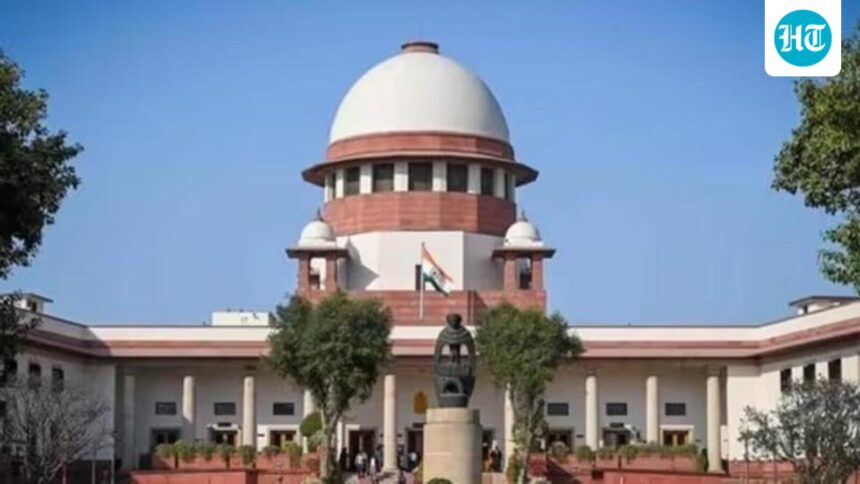
The Union government on Saturday notified an ordinance increasing the bench strength of the Supreme Court from 33 to 37, excluding the Chief Justice of India (CJI), paving the way for appointment of four additional judges amid growing attachment and growing calls for more constitutional benches.

The Supreme Court (Number of Judges) Amendment Bill, 2026 received the assent of President Draupadi Murmu and was published in the Gazette of India on Saturday. The Decree amends Section 2 of the Supreme Court (Number of Judges) Act 1956 by replacing the word “thirty-three” with the word “thirty-seven”.
The decree was issued under Article 123 of the Constitution since Parliament is not currently in session. This comes days after the Union Cabinet, headed by Prime Minister Narendra Modi, approved the proposal following a formal request made earlier this year by Chief Justice of India (CJI) Surya Kant.
In its statement issued on May 5, the government said that the increase aims to ensure “faster justice,” noting the growing backlog of cases. The latest expansion comes more than six years after the previous review in 2019, when Parliament increased the number of judges from 30 to 33.
The move represents the first expansion in the power of the Supreme Court since 2019, when Parliament increased the number of judges from 30 to 33, excluding the International Court of Justice. The latest amendment comes at a time when the Supreme Court is grappling with more than 92,000 pending cases, with frequent concerns raised about the inability to regularly constitute larger constitutional benches due to a shortage of judges.
People aware of the development had earlier pointed out that CJI Kant, in a letter to the Center in February, had sought an immediate increase by four judges while suggesting a calibration approach under which the impact of the expansion could be assessed later before any further increase is considered. The proposal was also followed up by the Office of the International Criminal Court, underscoring the urgent need to increase judicial power.
The Constitution does not specify a specific number of judges in the Supreme Court. Under Article 124(1), it provides for the appointment of the Chief Justice of India and leaves it to Parliament to determine the strength of the court through legislation, allowing for periodic reviews in response to increasing caseloads.
While the expansion aims to ease the burden on existing courts, where most matters are heard by a bench of two or three judges, with larger constitutional benches sitting to hear important legal questions, it also paves the way for a major round of judicial appointments over the coming months.
With the scheduled number rising to 37, the Supreme Court will have as many as 10 vacancies that need to be filled during the tenure of CJI Surya Kant, who heads the body responsible for recommending appointments. His predecessor, former ICC judge Bhushan R Gavai, retired in November, while Justice Rajesh Bindal resigned from his post in April.
The court is also set to see a series of retirements throughout the year: Justice Pankaj Mithal is scheduled to retire on June 6, followed by Justice JK Maheshwari on June 28, Justice Sanjay Karol on August 28, and Justice Satish Chandra Sharma on November 29.
With CJI Kant himself set to retire in February 2027, the expanded force means that a significant portion of the composition of the court will be shaped during his tenure as head of the bench.
The Supreme Court officially began on January 28, 1950, with an approved strength of eight justices – one from the ICJ and seven associate justices. This structure was set by the Constitution, and in its early years, all eight justices sat together to hear cases.
Later, it operated a modest force of 10 judges (excluding the ICJ) under the 1956 Act. This number was first increased to 13 in 1960 and then to 17 in 1977. However, the effective workforce remained limited to 15 judges for a period until 1979, when ministerial restrictions were lifted at the request of the then ICJ.
Subsequent decades saw further expansions. The approved strength was increased to 25 in 1986 and then to 30 in 2008. The latest revision came before the current proposal in 2019, reflecting ongoing efforts to align judicial capacity with the growing list.