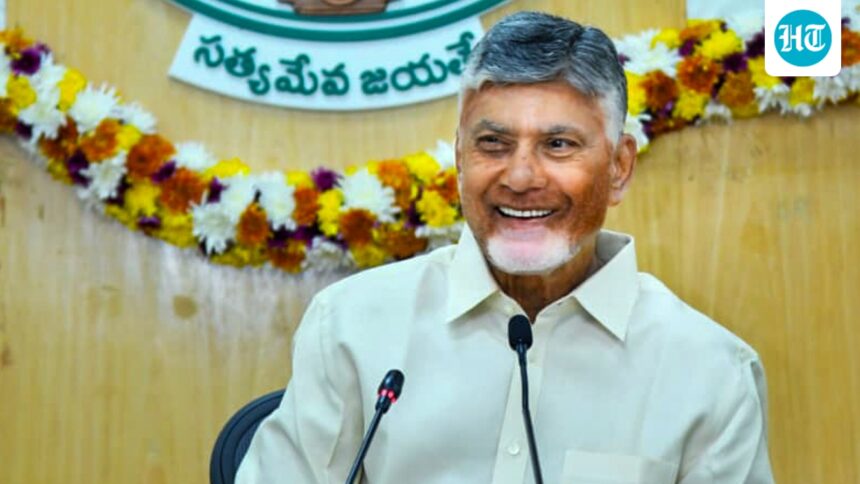
Andhra Pradesh Chief Minister N Chandrababu Naidu on Saturday announced enhanced incentive for families with more than two children as part of the state government’s new population management policy.

Addressing a public event at Tamrapalli village in Srikakulam district, Naidu expressed concern over the low population growth in the state. “Children are our wealth. This is the message I want to drive home throughout the state,” he said.
In this context, the Prime Minister announced that the state government plans to provide incentives to families who have a third and fourth child. He said that the government would provide incentives $30,000 for the birth of a third child $40,000 for the fourth child.
On March 5, Naidu presented a draft of a comprehensive “Population Management Policy” document in the state assembly, noting that the government was shifting its focus from traditional family planning to “population care” in view of declining fertility rates and future demographic challenges.
As part of this policy, the Prime Minister said the government is proposing financial incentives for childbirth. “Under the plan, parents with a second or more child will receive… $25,000 on delivery. He said this move would be a major political intervention to encourage population growth.
The policy also suggests $1,000 monthly food support for five years for the third child, in addition to free education until the age of 18 years. In addition, the government is considering 12 months of paternity leave for the birth of a third child, including two months of paternity leave for fathers.
According to the Prime Minister, there are currently about 300,000 families, or 58% of the total number, that have only one child, while about 217,000 families have two or more children.
He said the state’s total fertility rate currently stands at 1.5, a sharp decline from 3.0 recorded in 1993, while the ideal level should be 2.1 to maintain demographic balance. “If the total fertility rate continues to decline rapidly, the number of people of working age could decline significantly, which could lead to a slowdown in economic growth,” he told the assembly.
He said this policy has become crucial for the country as fertility rates steadily decline, a trend already seen in countries such as Japan, South Korea and Italy. Similar patterns are now emerging in India and Andhra Pradesh.
Citing 2023 data, Naidu said about 670,000 births were registered in the state during the year. If the current trend continues, 23% of the population could become elderly by 2047, posing challenges to the economy and social welfare systems.
He also pointed out that the rate of women’s participation in the labor force in the state currently stands at 31%, and if it rises to 59%, the state’s gross domestic product may increase by about 15%.
Naidu said the policy will adopt a five-stage life cycle approach to population management, built on five key pillars – Matrutvam (motherhood), Shakti (empowerment), Kashima (well-being), Nipuniyam (skills) and Sanjivani (healthcare).
At the Narasanapet meeting on Saturday, the Prime Minister said the government was working to strengthen the anganwadi system and provide financial assistance $15,000 for mothers under the ‘Thalliki Vandanam’ scheme.
Highlighting the land administration reforms, Naidu said the government was cleansing and updating land records through a comprehensive resurvey exercise. He stated that modern technology is being used to print and issue patadar (land ownership) books of accounts in a tamper-proof manner to prevent tampering with land records.
The Chief Minister further emphasized that the government has taken the responsibility of ensuring that there are no land disputes anywhere in the state by March 2027.