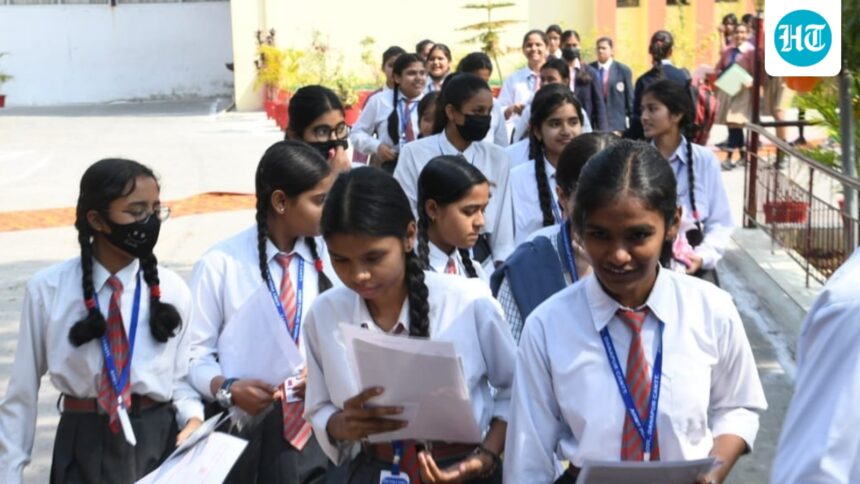
The Central Board of Secondary Education (CBSE) has officially introduced the tri-language policy, making the study of three languages compulsory for students from Class IX onwards, from July 1.

However, the board clarified that there will be no board examination for the third language (R3) chosen by students in Class X, news agency ANI reported. Assessments for this language will be school-wide and internal. The council said this was to maintain focus on learning and reduce any undue pressure on students.
CBSE also said that schools may offer any language from the CBSE list of subjects, provided that at least two of these three selected languages are “indigenous Indian languages”.
What the CBSE circular says
At least two of the three languages must be indigenous Indian languages, as per the National Education Policy (NEP) 2020 and the National Curriculum Framework for School Education (NCF-SE) 2023, the CBSE circular issued on May 5 said.
Regarding third language assessments, the circular stated that “All R3 assessments shall be entirely school-based and in-house. The performance of students in R3 will be duly reflected in the CBSE certificate.” She said that no student will be prevented from appearing for the Class 10 board exams due to R3.
English – a foreign language or a native language?
CBSE said that foreign languages can only be studied as a third language if the other two languages are Indian languages, or as an optional fourth language.
Explaining the implementation of the three-language formula, Sudha Acharya, principal of a school in Delhi, said there are 44 languages in the CBSE list of language subjects including English and Hindi.
“If a school offers, for example, Urdu at R1 level and Hindi, Tamil or any other indigenous language at R2 level, students can choose foreign languages like French or German as a third language, as there are already two indigenous languages in India,” Acharya said.
What about English?
“If English is studied at R1 or R2 level, a foreign language cannot be chosen at R3 level. English is not a foreign language but also it is not an indigenous language in India. Schools can introduce foreign languages as a fourth language through reading clubs,” she added.
Regarding the transition, CBSE said that students of Class IX will temporarily use Class 6 R3 textbooks for the chosen language, until textbooks for secondary level are made available.
The Council has also asked schools to update their R3 language offerings for grades 6 to 9 on the OASIS portal by 30 June.