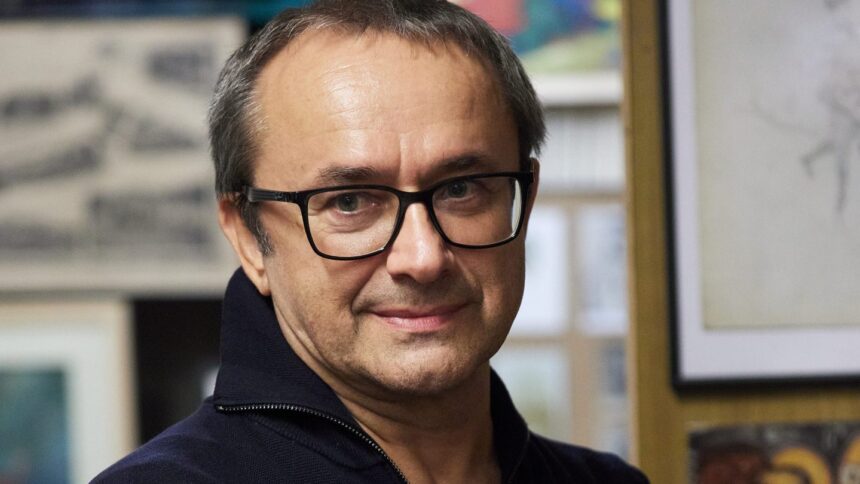
In the 2000s, Andrey Zvyagintsev asserted himself as one of the greatest filmmakers of his generation. The Russian national had already received widespread acclaim for his 2003 debut Returnbut with the 2011 trilogy Elena2014 Juggernaut And 2017 Without love – all of which won awards at the Cannes Film Festival, and the latter two were nominated for an Academy Award for Best International Feature – and his unique ability to tell intimate stories on an epic scale was on full display. Specifically: uncompromising, brutally realistic depictions of contemporary Russian society.
Then Zvyagintsev’s momentum stalled. Some potential future projects couldn’t get off the ground, but more importantly the pandemic did. The director contracted Covid-19 and almost died from severe lung damage, an ordeal that took 18 months of his life and left him unable to move for an entire year. He made what he described as a miraculous recovery, “resurrecting” in Paris, where he recovered, into a very different world: his country was at war with Ukraine, in a bleakly escalating situation.
Zvyagintsev was always determined to speak openly about Russian life and culture in his films, and in turn was inspired to take on his next project – Minotauradapted from Claude Chabrol’s 1969 thriller The unfaithful wifeCo-written by Simon Lyashenko. The director had been trying to acquire the rights to the Franco-Italian classic long before the outbreak of war, but the timing turned out to be just right, as he was able to combine his long-standing fascination with the material with a dark new chapter in his country’s history.
In his first interview outside of Cannes via a Russian language interpreter, Zvyagintsev spoke about his unexpected return.

Nine years have passed between this film and your previous feature, Without love. I know you had some films in production and you got sick too. What can you say what those years were like?
For two years, we’ve been trying to make a movie called Opposite JupiterWhich we started in 2018 or 2019, and we tried to revive it in 2020-2021. [The struggles] It was all about the expensive budget for this project.
But most of this time was spent, as you rightly say, due to my illness. It was a terrible disease that took 18 months of my life. For 12 months, I couldn’t get up, and it was all about Covid. So the pandemic hit me hard. I was bedridden. I couldn’t move my hand. I couldn’t move my legs. I couldn’t use it at all. With what actually happened, you can consider this a complete and utter miracle. It took a lot out of me. As indicated, you are dead. Forty days of induced coma is roughly equivalent to death. And then I was sent. It was absolutely incredible. I can honestly tell you that 40 days of coma is not the best fun one can have. You don’t exist. But gradually, very gradually, I began to adapt. I underwent a course of rehabilitation. In August 2022, I came from Germany to Paris in a wheelchair. I started moving, I started walking, I started being myself again.
When it comes to a long illness like this, can you talk about what it feels like as an artist and director on the other side? The way she describes it, it was a profound and terrifying experience. It will have to change the person somewhat.
It is very difficult for me to talk about it because I have never consciously tried to dissect and analyze it, whether I have been enriched by the experience or impoverished. I’m so glad I rose from the dead. Then I looked again at the projects, all the scripts that had accumulated on my desk, and tried to analyze them, “What are these scripts and what are these projects?” And whether they are still waiting for the hour when they will be turned into films. I don’t really know if it’s still relevant in our day and time. I would compare it to a millipede, where one of the little legs suddenly twitches and you don’t know what the outcome will be because of that little twitch.
But I wouldn’t be honest with you if I said I didn’t think about it at all, and I didn’t have anything [new] My feelings are a result of my illness. The main idea, or rather motivation and feeling, that I gained from this experience is that one should live in a fast lane. The borderland in which I found myself and the observations I had after I arrived in reality [had me] I realize I’m grateful to fate for this lesson – and the lesson is that you can’t really leave something for tomorrow. All important decisions, and all projects, must be implemented as quickly as possible. I will not wait for the producers to procrastinate. I will do it quickly.
Minotaur It is a loose adaptation of Claude Chabrol’s 1969 film The unfaithful wife. The setting has been moved to 2022. How did this happen?
In 2018 we failed to reach an agreement on obtaining rights to amend the text. I’m so glad we didn’t make it back then in 2018. Otherwise it would have been a different story. We decided to make the new version in Russia and in the Russian language. I’m grateful that it all happened in 2022, after the war in Ukraine started. This is exactly why the entire project is moving forward.
As for why I decided to choose this particular film to adapt, I’ll tell you this story behind it: In this scenario, there is a scene in which not a single word is said. When you watch the movie you’ll know what I mean. I was completely mesmerized by this setup. This is exactly what cinema is about. If you have a 20-minute scene that has all the detail, all the substance, all the understanding, but not a single word is spoken — that’s really great filmmaking. This is every director’s dream.[[It briefly switches to English]I think – this is my opinion.[[He laughs]
Actual disposition of the characters – Here I would like to point out that the title of the film is likely in both the French and English versions The unfaithful wife Because that’s exactly where it all starts from the first scene: the collision. We know that the husband, who is the main character, just stands by and watches what is happening.
So, how did the Russo-Ukrainian War affect this adaptation, specifically? What prompted you to respond to him directly?
The film begins in September 2022 and this is perhaps the most tragic and difficult page in the country’s history. That’s when general mobilization was announced in the country. What is happening between Russia and Ukraine, who live in a world without censorship – of course one can resort to making fairy tales about superheroes, one can refer to the language [war]But don’t tell me what’s happening behind your window. [For me] It would have been simply, utterly impossible.
You shot this film in Latvia, unlike your previous films which were shot in Russia. How did you find that experience?
There wasn’t much different. The creative team is from all over the world. Some are in Los Angeles, some are in Spain, some are in Vancouver, some are in Cypress, and one is in London. In Latvia, we found our partners, and then these partners became our friends. Many people speak Russian in Latvia – 40% of the population speaks Russian – and we had a team where the working language was Russian. We were very happy to shoot this way.
Of course the relationship was new, the people were new, even though the camera crew was exactly the same. Latvia is a country that was part of the Soviet Union, and pockets of which are still very recognizable. Some of them, you can’t really distinguish between some of the abandoned areas of Moscow – the really run-down area of Moscow – or the suburbs. That’s why we chose to shoot in Latvia, because we all realized that we couldn’t do it in Russia. Filming in Russia now would be impossible.
***
Minotaur Premiering May 19 at the Cannes Film Festival.