If you’ve spent any time on the film festival circuit, you’re probably familiar with the “hidden gem” reputation of the San Sebastian International Film Festival. The ‘gem’ part is easy to explain: world cinema, shining stars, enthusiastic locals, size that allows for real connections, world-famous cuisine and the incomparable charm of this Basque city on the bay. It’s the “hidden” part of the equation that raises some eyebrows.
After 73 editions, San Sebastian remains somewhat under the radar for some in the industry, overshadowed by its larger European counterparts. Despite its mix of international authors and celebrities, SSIFF is sometimes labeled as focusing mostly on Spain and Latin America. The timing is also not in its favour: the September festival follows Venice and sometimes overlaps with the Toronto festival, meaning it competes with the giants for world premieres.
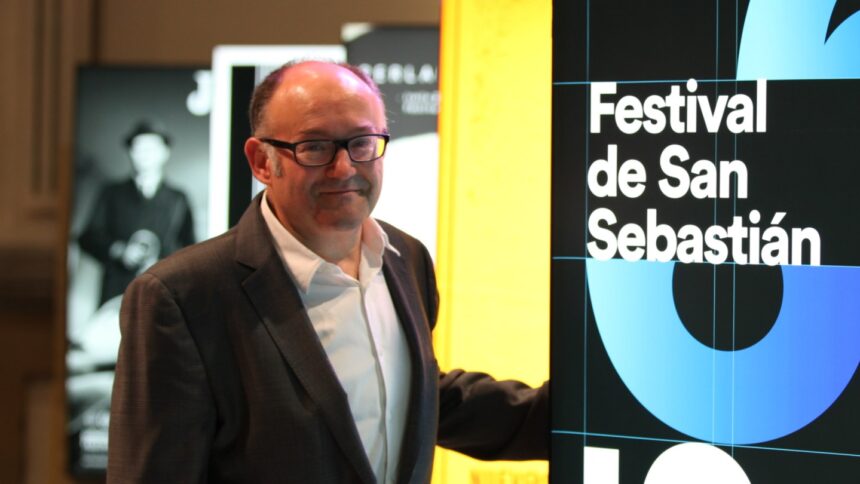
“I think one of the strengths of the San Sebastian Film Festival is its awareness of its basic characteristics and its refusal to try to be anything else,” says San Sebastian Film Festival director José Luis Ribordinos, who will retire after 15 years after the 74th edition this fall (September 18-26), to be replaced by current deputy director Mayalyn Beloki.
“We cannot be a major market, but we can have interesting industrial activities such as a Europe-Latin America co-production forum or an investor conference,” Ribordinos continues. “We can’t make the biggest US releases of the year premieres, but we can show some of them with their band members in parallel sections.”
In other words, the event has found its place. “We are a festival with an audience large enough to interest industry and critics, but small enough to feel human and welcoming,” says Repordinos. “We work with humility, and our motto is ‘We are the smallest of the greats.’”
San Sebastian regulars agree: “Everyone thinks of Cannes, Venice and Berlin, but it’s the smaller festivals like San Sebastian that people gravitate to,” says Christine Vachon, co-founder of New York-based Killer Films. “Those are festivals where you can spend time with local filmmakers, artists, and funders.”
The festival achieved A status in 1957, just four years after its launch. Early visitors included such luminaries as Federico Fellini, Alfred Hitchcock, Jean-Luc Godard, Kirk Douglas, Audrey Hepburn, and Elizabeth Taylor. The Donostia Lifetime Achievement Award, created in 1986, has attracted big names such as Gregory Peck, Bette Davis, Lauren Bacall, Al Pacino and Anthony Hopkins.
Last year saw two accomplishments: the youngest recipient ever – Jennifer Lawrence – and the first female producer honoree (Esther García, Pedro Almodóvar’s in-house executive). After accepting Donostia, Lawrence said it was “really special” to be “at a festival where people really love cinema – the art of storytelling and the spirit of films”.
The festival industry has expanded over the years. They include the Creative Investors Conference (which is in its fifth year, in collaboration with CAA Media Finance), the Europe-Latin America Co-Production Forum and a range of other initiatives focused on new directors, works in progress, startups and more. Last year’s edition welcomed just over 2,400 certified professionals from more than 1,500 companies in 65 countries.
“The Europe-Latin America Co-Production Forum has been a great success for years now,” highlights Rebordinos. “Selecting only about 16 projects is difficult given the high quality of the presentations. More and more industry members are participating in this event. The Investors Conference has also become a premier event that brings together some of the most important names in global film production and investment.”
SSIFF is also the crown jewel of the rapidly growing regional Basque industry. “Its sights are firmly set on filmmaking as an evolving global force,” says Rob Stone, a long-time observer, emeritus professor of film studies at the University of Birmingham and co-author of the book. Basque Cinema: A Cultural and Political History. However, he is still “a Basque at heart,” he says.
Since José Mari Guenaga and John Juraño Flowers (Loric) became the first Basque-language film to premiere in the main competition in 2014, and there has been at least one local film in the festival’s official selection every year. Last year, 37 Basque productions were screened at the festival, evidence of the industry’s growth as a production hub thanks to major new incentives. The festival, in turn, had an estimated economic impact of €47.9 million ($56.2 million) on the region in 2024.
“There was a lot of very good material to choose from, and last year, there was a lot of it [Basque films] But, she adds, “Jose Luis has always said he doesn’t want Basque products to be here for free — he doesn’t want it to seem like if you’re from here, you automatically come in.”
However, “SSIFF is excellent at identifying, attracting and nurturing indigenous talent in Spain and Latin America,” says Belén Vidal, a reader in film studies at King’s College London and a specialist in Spanish cinema, emphasizing how that talent often ends up becoming the year’s biggest films from these regions. “Attend SSIFF for next year’s ‘big’ Spanish titles.”
After Basque director Alauda Ruiz de Azua received the Grand Golden Shell Award at the festival for her film Sundays (Los Domingos) Last year, it went on to sweep the country’s Oscar-equivalent Goya Awards. “Participating in San Sebastian helps a lot in establishing the film’s profile and giving it exposure, especially in Europe and Latin America, and especially in Spain,” says Manu Calvo, co-producer of the film. Sundays Through Encanta Films.
“Winning the Golden Shell was a turning point for the film,” adds Buenapinta Media’s Marisa Fernández Armenteros, who is also a co-producer of the film. “An award like this opens a lot of doors, because you go from being just another film on the festival circuit to gaining big exposure in Spain and beyond. It helps with international sales, expands its reach to other festivals, and allows the film to find audiences it might not have otherwise reached, who, if Los DomingosIt was associated with him and filled the theaters.
As anyone who has attended SSIFF knows, the stages at the festival itself are always full. Last year’s edition saw 181,183 spectators attend 666 shows of 254 titles from 56 different countries, an audience increase of 5.15 percent compared to the previous year. “Ticket prices remain low and stable to ensure local audiences are able to attend shows,” Stone points out.
Repordinos did not have to look far for his replacement. “I am very happy that the person appointed…is a member of my team, and is also an essential part of the work that has been carried out over the 15 years,” says Repordinos.
The transition process is already underway. “Now that the appointment has been made, my responsibility in the coming months is to work closely with Mayalyn so that she arrives in January 2027 with as much understanding of the festival as possible,” says Repordinos.